Friday, 11 October 2013

Brewing a Prairie Artisan Ales 'Merica clone

In September, my wife and I were lucky enough to make another trip to San Diego, one of the beer meccas of the U.S. Despite being accompanied by our 16-month-old daughter, we did pretty well in the beer department, I thought; I personally had 36 new beers during the week we were there. Along with trips to the San Diego Zoo and several beaches, we also visited Modern Times, Stone Brewing World Bistro & Gardens (Liberty Station location), Pizza Port Ocean Beach, and a few choice beer bars, such as Toronado.

As expected, many of the beers I had were fantastic... lots of very hoppy IPAs and DIPAs were consumed! However, one of my favorite beers of the trip was a hoppy Saison brewed by a fairly new brewery called Prairie Artisan Ales... out of Tulsa, Oklahoma. Yep. Oklahoma. They brew many different types of Saisons; the one I had was called 'Merica. It was fabulously grassy and fruity, with a good amount of funk in both the aroma and flavor. When I arrived home, the Wyeast 3711 French Saison yeast I had ordered from my LHBS arrived; I had originally planned on brewing a Modern Times Lomaland clone, or some other Saison, but I decided to attempt to put together a 'Merica clone recipe.

Searching the internet for other attempts at 'Merica clones turned up nothing. There IS some helpful info on Prairie's website, however:

"‘Merica is a single malt, single hop saison. It’s brewed with floot malted pilsner and 3lbs per bbl Nelson Sauvin hops. The beer is conditioned with 2 brett strains and wine yeast."
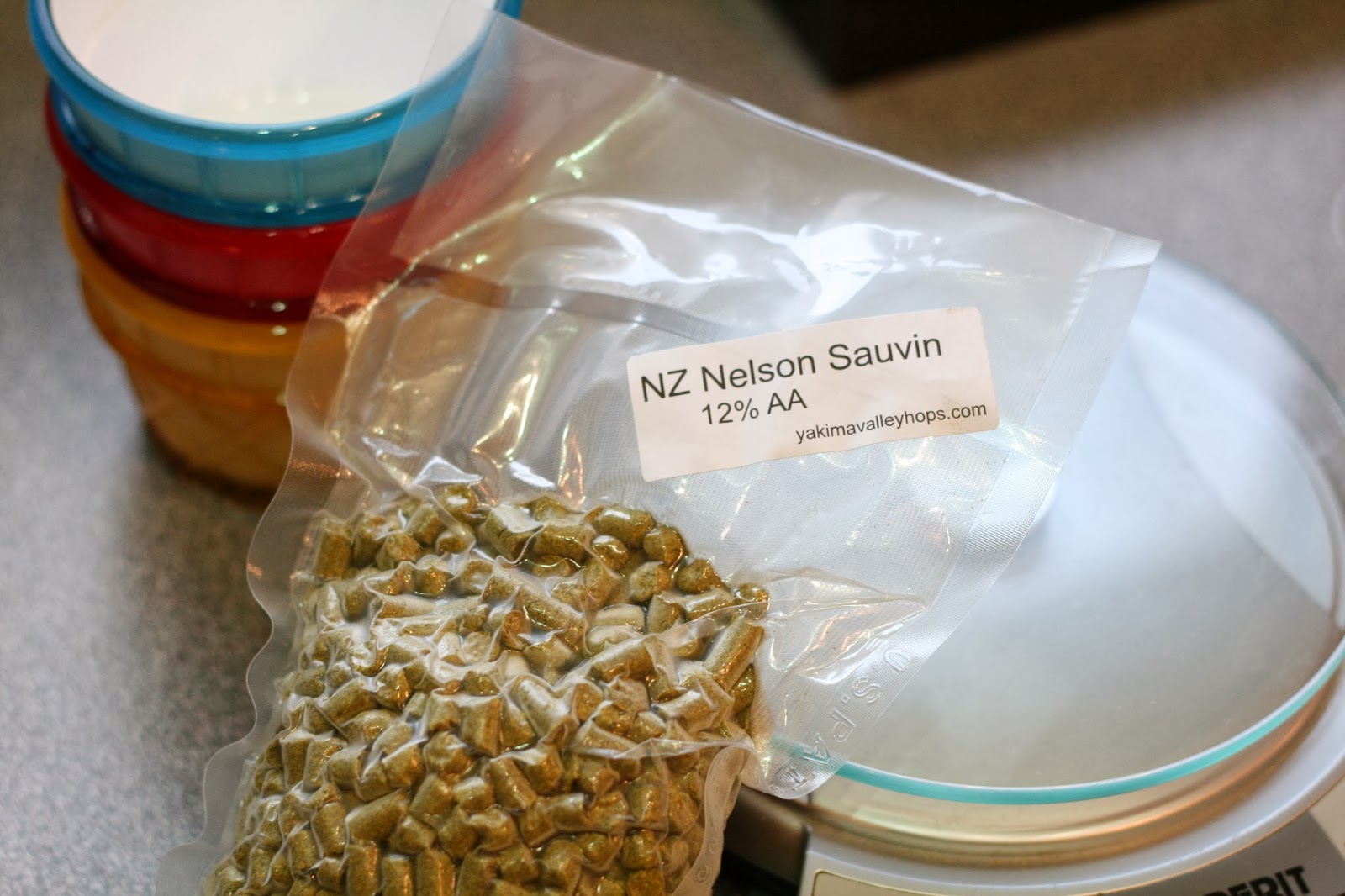
While I've never brewed with Nelson Sauvin hops before, I just happened to have 8 oz of it from an order I made with Yakima Valley Hops a few months ago... 3 lbs/bbl equates to about 8 oz for a 5 gallon batch. Perfect! It was meant to be (Disclaimer: If you put your mind to it, you can convince yourself of anything in homebrewing). Nelson Sauvin is a New Zealand variety hop that has been quickly growing in popularity over the past few years. It is well-known for a strong fruity flavor and aroma: gooseberries, passionfruit and grapefruit, or a Sauvignon Blanc (white wine) character.

I thought I'd try sending a direct message to Prairie's Facebook account, asking for a bit more help with the recipe, but unfortunately they didn't respond. I mainly wanted to get a rough idea of the hop schedule, and find out whether the beer was dry-hopped or not (I assumed it was, from the strong aroma). I dug around a little more, and found the IBUs (35) listed on the Shelton Bros. (beer importers) site; they also note that the beer is "heavily dry-hopped". After a little more searching on Prairie's website, I found that their Standard Saison (their "everyday" beer) is dry-hopped with 1 lb/bbl of Motueka, another New Zealand hop variety. I figured this was a good number to shoot for in the dry-hopping of my 'Merica clone, which amounts to about 2.5 oz for 5 gallons.

The grist of the recipe was easy, obviously - 100% pilsner malt - with 3 grams of Gypsum thrown in the mash, just to increase the calcium levels of my water a little. As for the hop-schedule, however, I was on my own. When you're hopping a beer to about 35 IBUs with 8 oz in a 5 gallon batch, and the hop variety has an alpha acid % of 11... well, it seems to me that you pretty much have to avoid any early hop additions, or the IBUs on the beer are going to end up being too high. I fooled around with the additions on Beersmith, and decided to go with three at increasing amounts: 1 oz at 10 minutes, 2 oz at 5 minutes, and 2.5 oz at flameout, with a 15-minute hop steep. That should get me roughly around 35 IBUs... and hopefully one hell of a lot of hop flavor and aroma. And a lot of hop sludge leftover.

Now, while I've brewed with Brettanomyces in the past, I've never strictly bottle-conditioned with it. Because Brett is capable of fermenting carbohydrates with as many as nine molecules of glucose (compared to brewer's yeast max of three molecules long), it can slowly chew away at leftover sugars in the beer for months, and even years, producing more CO2, increasing the risk of gushing and bottle bombs.

Don't get me wrong, lots of breweries bottle condition with Brett, and it certainly doesn't always result in exploding bottles. Orval is probably the most well-known Brett-bottle-conditioned beer out there; I've opened bottles that were over three years old, and there hasn't been any gushing at all... just fantastic, mouth-watering funkiness! For the homebrewer, the two main issues when adding Brett at bottling are how MUCH Brett do you add, and how much bottling sugar, if any?

There's some good articles out there about approaches to take (check out this one from The Mad Fermentationist), but I'm going to keep it simple for myself, and take the safe route. I decided on splitting the batch in two from the very beginning: 
  • Half will have the bottle dregs from several Brett beers pitched in over time. I'll try to start pitching the dregs before the 3711 is completely done fermenting, because in my experience with it, it can ferment LOW, which wouldn't leave much in the way of sugars behind for the Brett to work on. Not a very accurate approach, but hopefully it'll be ok. When the gravity seems to have plateaued, I'll dry-hop for a week or so and then bottle it as-is.
  • The other half will be fermented with JUST the 3711, dry-hopped for a week, and bottled without Brett. I figure this is a good way to a) have a Saison to drink a little earlier, and b) compare the qualities that the Brett hopefully adds to the other half.
I'm not really sure what the added wine yeast at bottling provides to the beer, but I'll probably add a little dry wine yeast that I have on hand, at least to the Brett-half, just for the heck of it. Some of Prairie's beers are starting to show up in Maine, I believe, so hopefully I'll find a bottle of 'Merica when I'm there later in the month to compare to my results.

UPDATE: After I tweeted the link to this post, Prairie responded back about the hop schedule. They say they use a 60-minute bittering addition (so, it would have to be very small), and 1 lb/bbl whirlpool, 2 lb/bbl dry-hop. This translates to 2.5 oz Nelson at flameout for a 5-gallon batch, and 5 oz for dry-hopping. So, I was right for the whirlpool, but added hops at 5 & 10 minutes that should have gone into the dry-hop, for the most part. 

Recipe targets: (5.5 gallons, 75% efficiency) OG 1.056, FG ~1.007, IBU ~35, SRM 4, ABV ~6.5%

Grains:
5 kg (100%) Bohemian Pilsner

Hops:
Nelson Sauvin - 28 g (11% AA) @ 10 min
Nelson Sauvin - 56 g @ 5 min
Nelson Sauvin - 70 g @ flameout (steeped for 15 minutes)
Nelson Sauvin - 78 g dry-hop for 7 days (divided in two, 39 g for each half-batch)

Misc.: 1/2 tab Irish moss @ 5 min

Yeast: Wyeast 3711 French Saison (with a 1.5 L starter)

Water: Fredericton city water, carbon-filtered; 3 g Gypsum in the mash

- Brewed on October 7th, 2013, by myself. 60-minute mash with 16.5 L of strike water, mashed in a little under target temp of 151 F. Sparged with 5.5 gallons of 168 F water for final volume of ~7.5 gallons in the kettle.

- SG at 1.044, slightly over target of 1.042. 90-minute boil. Final volume a bit over 5.5 gallons. Flameout hops steeped for 15 minutes, then turned on immersion chiller. Chilled down to 64 F, then poured ~10 L into 3-gallon Better Bottle, and the rest into a 6-gallon BB (lots of trub got into this half). OG on target of 1.056. Aerated with 60 seconds of pure O2 for each half, and placed in laundry room, ambient temp about 72 F.

- 8/10/13 - 14/10/13 - Over this week, visible fermentation was never fast and furious, bubbling about 3-4 times per 10 seconds in the airlock, temp 70 F.  Gravity got down to 1.009, so I attached a heat belt to the non-Brett portion and turned it on, bringing the temp up to the high 70s. Pitched the bottle dregs of two bottles of Orval into Brett portion.

- 25/10/13 - Added dry hops to non-Brett portion directly into primary.

- 29/10/13 - Bottled non-Brett portion with 85 g table sugar, aiming for 3 vol CO2 for 10 L and a max temp of 78 reached.

- 4/11/13 - Over the next few weeks, pitched bottle dregs of three more bottles of Orval and one bottle of Allagash Confluence. Racked Brett portion into secondary on Nov. 12th.

- 28/11/13 - Added dry-hops to Brett portion into secondary fermentor.

- 4/12/13 - Bottled Brett portion with 67 g table sugar (and ~1/8 pack Lalvin EC-1118 rehydrated yeast... a white wine yeast, unfortunately realized I didn't have any red wine yeast), aiming for 3 vol CO2 for 2.13 gallons with a max temp of 78 F reached.

- 24/12/13 - Tasting notes... damn, what a delicious beer! Huge Nelson presence, lots of fruit (berries, specifically)... amazing! Close to the real thing, but more hoppy and lacking a bit of hard-to-place funkish character.

Monday, 30 September 2013

Brewing an American Pale Ale (with Belma and Cascade)

Crap, I let it happen again! An almost-two-month hiatus from brewing! I won't lay on the excuses, but am I the only homebrewer that finds it more difficult to brew regularly in the summer? Temperature issues aside, there always seems to be so much going on, it can be tough to squeeze in a brew day. Luckily I got a couple batches brewed in both June and July, so I didn't run out of beer for August and September... but I sure did miss brewing!

Anyhow, back to business. I had ordered a smackpack of Wyeast 3711 French Saison from my LHBS a few weeks ago, but it arrived later than expected. Before I could get a starter made, an impromptu brew day came up. All I had on hand was good ol' US-05, so I decided to whip together an American Pale Ale. I took a quick look at my inventory list, hop-wise, and picked out a couple of varieties that I still had 1/2 lb of, but hadn't used much of lately... Belma and Cascade.

Anyone who's homebrewed is familiar with Cascade, but Belma is definitely a newer variety. I used a small amount of it in a Witbier I brewed a few months ago, but this time I really wanted to use it in higher quantities. As mentioned in the Witbier post, Belma is a variety created by the farmers at Hops Direct, and is supposed to be quite fruity, described as having notes of orange, melon, pineapple... and especially strawberry. I had thrown around the idea of brewing an APA solely with Belma hops, but thought I'd try mixing it in with equal amounts of Cascade. With the typical characteristics of Cascade, I'm aiming to have an APA that is REALLY fruity.

Once I had the hop varieties picked out, I threw together a recipe. As I said, at first I had intended on brewing the beer with JUST Belma, so I planned on using a recipe in For the Love of Hops, by Stan Hieronymus. In one section of the book, Stan talks to Russian River's Vinnie Cilurzo concerning a standard recipe Vinnie uses when he wants to get a feel for what characteristics a single hop brings to a beer. The recipe is really more intended to be for an IPA, but I just scaled it back to an OG of about 1.050. It's made up of 74% 2-row, 13% Maris Otter, 10% Crystal 15 L, and 3% Acid malt. The hopping amounts he used in this recipe are a little lower than what I wanted to go with, so I created my own hop schedule from here.

I really hopped this beer... I wasn't trying to overdo it, by any means, but I tried to take advantage of the "hop bursting" method that I've been using more lately, where you add the high majority of your hops at the end of the boil. In this case, I only made one hop addition during the boil... a very small amount of Belma at 60 minutes to about 10 IBUs. I then added a large amount - 3 oz each of Cascade and Belma - at flameout, and let the hops steep for 15 minutes before turning on the chiller. You still get some IBUs when the wort is this hot, but you're mainly trying to extract a lot of flavor and aroma from the hops. This is the method used in the Modern Times Fortunate Islands clone I brewed in July, and that beer came out pretty fantastic. I then, of course, had to dry-hop the beer, so I decided to go with equal amounts Belma and Cascade again, 1&1/4 oz of each for 7 days.

This brew day was also the first for two new pieces of equipment for me. First, I finally replaced my crappy turkey fryer with a Blichmann burner. I was given the opportunity to buy this product brand new for an extremely reasonable price, and I couldn't resist. With an evenly-distributed flame, the burner is supposed to be much more efficient with propane, and provide a better boil in a faster time. I CAN say, after using it once, that it's a damned-sturdy product, and is obviously built to last. And standing next to it in my garage when the wort is boiling no longer sounds like I'm in the engine of a 747. This thing is QUIET. I also had zero soot on the bottom of my kettle after the 60-minute boil was complete, a first for me in homebrewing.

My other new product is a Thermapen. I wouldn't say that I've had major problems with my fairly-cheap digital thermometer that I've been using for a couple of years now, but it takes a long time to get an accurate (?) reading. I've been hearing a lot of highly-exuberant testimonials about the Thermapen over the years (both for brewing and cooking), and an opportunity came up (again!) to buy one at a reduced price. It really is very fast... only takes about 2-3 seconds to get a temperature reading, and the accuracy seems pretty fantastic.

I plan on fermenting the beer at around 68 F for a couple of weeks, tops, and then adding the dry-hops directly into primary for a week. Bottled from there, I hope to be drinking this beer by mid-October. I'm also behind on some tasting notes for more-recent brews, but I'll try to get the results for this APA posted soon after starting to drink it.

Recipe targets: (5.5 gallons, 78% efficiency) OG 1.052, FG ~1.012, IBU ~35, SRM 5.3, ABV ~5.2%

Grains:
3.41 kg (74%) Canadian 2-row
591 g (13%) Maris Otter
454 g (10%) Crystal 15 L
136 g (3%) Acid malt

Hops:
Belma - 7 g (11.3% AA) @ 60 min
Belma - 84 g @ 0 min (steeped for 15 minutes)
Cascade - 84 g (5.5% AA) @ 0 min (steeped for 15 minutes)
Belma - 35 g dry-hop for 7 days
Cascade - 35 g dry-hop for 7 days

Misc.: 1/2 tab Irish moss @ 5 min

Yeast: 1 package Fermentis US-05 dry yeast, rehydrated

Water: Fredericton city water, carbon-filtered; 5 g Gypsum, 3 g CaCl in the mash

- Brewed on Sept 18th, 2013, with Jill. 60-minute mash with 15 L of strike water, mashed in at target temp of 153 F. Sparged with 5 gallons of 168 F water for final volume of ~6.75 gallons in the kettle.

- SG at 1.043, slightly over target of 1.042. 60-minute boil. Flameout hops steeped for 15 minutes, then turned on immersion chiller. Chilled down to 64 F, then poured/filtered ~5 gallons into Better Bottle. OG a bit low at 1.050. Aerated with 75 seconds of pure O2 and placed in laundry room, ambient temp about 68 F (a bit high).

19/9/13 - Some light activity in the airlock in the AM, temp 68 F. By the evening, bubbling vigorously, temp still at 68 F.

20/9/13 - In the AM, still lots of airlock activity, temp up to 70 F.

22/9/13 - Returned from being away for a few days, airlock activity has stopped completely. Temp 70 F. Took a gravity reading of 1.013.

28/9/13 - Added dry-hops directly to primary.

5/10/13 - Bottled with 101 g table sugar, aiming for 2.4 vol CO2 for 4.5 gallons, with a max temp of 70 F reached.

13/11/13 - Tasting notes... turned out pretty enjoyable. Easy-drinking, nice hop presence, but could definitely use a kick in the bitterness department.

Wednesday, 25 September 2013

Tasting : A Witter Shade of Pale 2.0 (Witbier with Belma hops)

Getting to this beer a LOT later than I would like... I originally planned on having it ready to drink at the beginning of summer, or maybe even a bit earlier. It's been bottled for over two months now, but the reason I took a while to get to it is due to one of the most frustrating problems in homebrewing: a stuck fermentation.

When I brewed this beer, fermentation was fast and furious - it took off within 12 hours, was quite vigorous while it was going, and within a couple of days the krausen had diminished and there was barely any activity in the airlock. Because the OG wasn't high (actually even came in a bit below target), I just assumed that it didn't take long for the yeast to do their work. I then let the beer sit in the fermentor for 3 weeks, until I planned on bottling it.


Well, that turned out to be a big mistake. I took a gravity reading after 3 weeks, and it had stalled at 1.019. Not exactly the end of the world, but at about 7 points above target for a beer that isn't high alcohol, and is supposed to be refreshing... well, I was little peeved. I left it in the fermentor for another week, rousing the yeast by gently rocking the Better Bottle every day, but it did no goo - 1.019 is where it sat. I briefly considered pitching some bottle dregs of some Brett beers into it; I kind of liked that idea, actually, of making a funky Witbier. However, I knew that it would take some time to let the Brett do their thing, and I really wanted this beer for summer, so I ended up bottling it as it was. The problem with this is where do you aim in terms of carbonation? I don't keg, so I had to consider what I wanted to risk more... aim for low carbonation in case the yeast "woke up" and consumed the remaining sugars in the beer (as in what I assumed happened to my recent ESB)? Probably the smart move, but if that didn't happen, then you get a fairly-flat Witbier. However, flat beer can't physically injure you... bottle bombs technically can!

So, I split the difference and aimed for 2.5 vol CO2, about what you'd do for "moderate" carbonation. A Witbier should really be 3 vol or even more, so I was hoping to get some decent carbonation, and no explosions. In the end, I'm not sure why fermentation got stuck. The temps never got low in our house. I'd say that maybe it was because of the high percentage of flaked wheat and oats, but the grist of the recipe isn't much different that last year's Witbier, and that finished with no problem. And I made a good-sized starter for a pretty-fresh smackpack. Ah well... the joys of working with yeast!

All said and done, luckily the beer came out pretty good. It doesn't taste overly sweet, even with the high FG, and at less than 4% ABV, it's certainly very sessionable! I'm not too sure if the two additions of Belma hops bring much to the table, but the aroma and flavor of the beer definitely isn't 100% in the norm for the style. Now that I've been drinking it over the summer, and most of the bottles are gone, I CAN say that it is over-carbonated... when you open a bottle that sat at room temperature for awhile, there's quite a lot of foaming over when you pour into the glass. Luckily, high carbonation in a beer like this isn't much of a flaw, unlike the previously mentioned ESB, which was like Champagne by the time I finally finished it all.

I'd certainly brew the beer again... the recipe, other than the Belma hops, is pretty much your standard Witbier recipe. I like what the higher amount of orange peel added to the beer this time. If you're looking to get some Belma character in your Witbier, though, I'd definitely go with more than I added. Doubling it would probably not be overdoing it at all.

Keep in mind the tasting notes below were actually written back in late July... I wouldn't dream of trying to give a fair review to a 2+ month-old Witbier!

Appearance: Poured with an extremely large, white creamy head. Fades a bit and then stays there, great retention. Body is cloudy and dark yellow.

Aroma: Strong aroma of both coriander and orange citrus... the extra orange peel really came through this time. There's a bit of sweet pilsner character as well, and maybe just a touch of strawberry character from the Belma.

Taste: Bang-on with the aroma, lots of coriander and citrus, without being overpowering. Again, a little bit of sweetness/tartness from the pilsner and wheat malt. Refreshing. No real hop flavor to speak of.

Mouthfeel: Light-medium bodied, slightly creamy from the wheat malt. Very high (effervescent) carbonation.

Overall: I like it, minus the issues with the overcarbing. As mentioned above, I'd increase the Belma hop additions to try to make it shine through more.

Saturday, 24 August 2013

Brewing a Russian River Pliny the Younger clone

When I brewed the Russian River Blind Pig clone last month, I already had the next couple of beers planned out. While I've actually had Blind Pig several times, I decided to brew another Russian River clone - this time, one of the biggest white-whale beers out there, Pliny the Younger. Now, Pliny the Elder is the brewery's regular-release Double IPA (DIPA); it's not exactly wide-release, by any means, at least in terms of distribution, but if you're somewhere in the West Coast U.S., chances are you'll find Elder on tap or in bottles, somewhere. And it's a fantastic beer, pretty much deserving all the accolades it has received over the years (and there's been a lot of them). I actually brewed the widely-available clone recipe (straight from Vinnie Cilurzo, owner/brewer at Russian River) a couple of years ago, and it came out pretty fantastic.

Pliny the Younger, however, is a DIPA that the brewery releases once every year, on the first Friday in February. It's not available in bottles, and you can't get growler fills of it - it's only available on tap, and usually only at the brewery (a keg or two will pop up at some choice beer bars in the country, but that's it). People line up on the release day at extremely early hours to try the beer, where it's available for two weeks only.

Unfortunately, I'm not lucky enough to have been able to make a trip out to California just for a beer release. Maybe some day, but that just ain't gonna happen for awhile. All I can do is read about the beer; it's supposed to be pretty fantastic, of course - high theoretical bitterness, high alcohol (10.5% ABV) yet alarmingly drinkable, with a huge hop presence. Basically, Pliny the Elder times two... or more. Younger has actually been called a "Triple IPA" by some (including those at the brewery), but let's not even start trying to divide DIPAs into Triple and higher categories... Double or Imperial IPA is fine by me.

So, there's a lot of clone recipe attempts floating around the internet, put together by speculation, tastings, and interviews with Vinnie where he's mentioned this or that about what they do at the brewery. The best I've seen is from a homebrewing blog called Bertus Brewery, run by a guy from Arizona named Scott. Scott does a lot of IPA/DIPA clones, and seems to have a lot of success with them (the blog is really well-written, too; I suggest you check it out if you haven't already). Scott put a lot of work into his Younger clone, and claims to have come quite close on his second attempt. This is the recipe I used, and other than a few changes noted below, I followed it pretty much exactly. So, any luck I have with this will be mostly attributed to Scott's work... ditto for any failure! <shakes fist in general direction of Arizona>

That's a lotta grain...
Ok, so let's get to the recipe. First, the grist. Similar to the Pliny the Elder clone recipes that are available, it's pretty simple: a large amount of 2-row, and some Crystal 40 L and Carapils - not a lot, though, which is typical for Vinnie's opinions on Crystal malts in DIPAs. He feels that the best DIPAs are the ones that aren't overly sweet and underattenuated... and I agree. I prefer my DIPAs quite dry; when they get sweet, they're starting to border American Barleywines. There's also a good amount of table sugar in the recipe. In Scott's recipe, he went with 1 lb, but later thought that a bit more to increase the attenuation would be a better idea; so, I went with the higher end of his recommendation, 1.5 lbs. As I normally do with sugar additions, I boiled the sugar in some water to make a syrup, and added it to the fermentor when fermentation began to slow down. I like to do this to make sure the yeast chew threw the maltose and maltotriose, before they get their "dessert", the more-easily-fermented sucrose. It also means that your starting gravity is lower, so you don't have to pitch as much yeast.

For the mash, Scott did a 75-minute rest at a very-low 145 F, to really increase the amount of sugars that would be easily-fermentable by the yeast; he then followed-up with a 10-minute rest at 155 F. I went with this approach (albeit at a slightly-less 145 F, for 60 minutes), but if you wanted to skip the 10 minutes at 155 F, you'd probably be fine.

Of course, what you really want to read about with a recipe like this is the hopping schedule. It's pretty darned crazy, really. Overall, you're looking at almost a full pound of hops, PLUS 40 mL total of hop extract, the equivalent of 8 oz of a 10% AA hop, giving you a theoretical or calculated IBU of somewhere above 250. Quite bitter, let's just leave it at that. Full details are listed below, but here's the amount of each actual hop variety used, between kettle-hopping, flameout, and dry-hopping:
  • Simcoe - 6 oz
  • Centennial - 2.5 oz
  • CTZ - 2 oz
  • Amarillo - 2 oz
  • Chinook - 1 oz
And, that's a lotta hops!
Now, I didn't go with Scott's recipe EXACTLY. Based on his thoughts after drinking his clone, he made a couple of recommendations for changes, which I applied. He had also added 10 g of CTZ at 45 min, which I ignored since I didn't think it would be missed. He also had a couple of small additions of Warrior in the dry-hopping, based on a change to the recipe he had heard Vinnie has done recently. I didn't have access to Warrior, so I subbed in CTZ for one dry-hop, and dropped the Warrior in another (it was only 1/4 oz, anyway).

So, there's a huge flameout addition (5.5 oz) of four different hops; I did a 10-minute steep with these before beginning the chilling. As for the dry-hopping, there are FOUR dry-hop additions. I haven't done that many since my Kern River Citra DIPA clone, and it was tough to decide how to do it. Ideally, I would have a kegging system, so that I could just add and remove each dry-hop directly in the keg, purging the headspace with CO2 each time to prevent oxidation of the beer and the hops. However, I don't keg, so I had these options:

1) Dry-hop in primary - I've done this before, with usually good results. Pro: it's easy, and some argue that this method may help prevent oxidation, since CO2 may still be released from residual fermentation of the beer. Con: the yeast in suspension may strip away some of the hop aroma and flavor. Even with four additions? Not sure.

2) Transfer to secondary, then dry-hop - I've also done this before, and also have had good results. Pro: you get the beer off most of the yeast, so there should be less stripping of the hop flavors (if that happens, of course). Con: you're increasing the risk of infection and oxidation.

I thought about doing half the dry-hop in primary, and then half in secondary, but that seemed counter-productive, and just as much work as doing it all in secondary. I also considered dropping the temp of the beer while in primary to floc out the yeast, and THEN add the dry hops, but I wasn't sure if that would be better. In the end, I decided to rack to secondary and add all the dry hops there. I came to this decision based on the excellent results I had with the Citra DIPA clone; this was the approach I used with that beer, so hopefully it'll work out as well, here.

When brewing Younger, Russian River apparently does each dry-hop for 1 week. On a homebrewing schedule, not only does that require a lot of time, but it REALLY increases the likelihood for oxidation of the beer and hops, especially for someone like me who doesn't have the luxury of purging with CO2 over and over. So, I'm going to go with a 4-day dry hop of each addition, for 16 days total.

For the yeast, as expected, you can use the California Ale yeast of your choice: WLP001, Wyeast 1056, or US-05 dry yeast. I had originally planned on using yeast slurry from my recent Modern Times Fortunate Islands clone, but based on some past results with reusing yeast, I chickened out and went with 2 packets of US-05, rehydrated. Now, Vinnie has always recommended that you do a slight UNDER-pitch of yeast for hoppy beers; he feels that too much yeast will strip away some of the hop flavors/aromas. I believe 100% that the man knows what he's talking about, but for a beer this big (and expensive), I just didn't want to take that risk. I'd rather lose a bit of hop flavor than have a big DIPA stall out at 1.035.

As for the water, I didn't add much in terms of minerals. I followed the same approach I've used with my last few hoppy beers, adding a couple of salts in moderate amounts to increase the calcium, chloride, and sulfate. In this case, just 5 grams each of Gypsum and calcium chloride, directly into the mash.

My goal here is to have a really drinkable, REALLY hoppy DIPA. Even if I had had Younger before, I wouldn't necessarily expect this clone to come out exactly similar. While Scott says that his version came out almost identical, I know my limits with my system - the inability to purge with CO2 will undoubtedly hurt this beer. Hopefully, oxidation will be minimal at the worst... nothing worse than oxidized hops, especially in a recipe as expensive as this one! I'll likely be drinking this beer around the beginning of September... tasting notes will be posted soon after.

Recipe targets: (6 gallons, 70% efficiency) OG 1.088, FG ~1.010, IBU 266 (!), SRM 6.6, ABV ~10.3%

Grains:
7.73 kg (86.5%) Canadian 2-row
341 g (3.9%) Carapils
182 g (2%) Crystal 40 L
681 g (7.6%) Table sugar (boiled in water and added in two portions during fermentation)

Hops:
Hop extract - 35 mL @ 90 min
Hop extract - 5 mL @ 45 min
Simcoe- 14 g (12.9% AA) @ 30 min

Simcoe - 70 g @ 0 min 
Centennial - 42 g (10.9% AA) @ 0 min
Amarillo - 28 g (8.9% AA) @ 0 min          *All flameout hops steeped for 10 minutes
Chinook - 14 g (11.4% AA) @ 0 min

Dry-hop 1: 14 g CTZ, 14 g Simcoe, 14 g Amarillo for 4 days, then...
Dry-hop 2: 28 g CTZ, 28 g Centennial for 4 more days, then...
Dry-hop 3: 14 g Chinook, 14 g Simcoe for 4 more days, then...
Dry-hop 4: 14 g CTZ, 14 g Amarillo, 28 g Simcoe for 4 more days

Misc.: 1/2 tab Irish moss @ 5 min

Yeast: 2 packages Fermentis US-05 dry yeast, rehydrated

Water: Fredericton city water, carbon-filtered; 5 g Gypsum, 5 g CaCl in the mash

- Brewed on July 27th, 2013, by myself. 60-minute mash with 21 L of strike water, mashed in slightly above target temp, at 146 F. Added 4.75 L of boiling water to bring temp up to 155 F for another 10 minutes. Sparged with ~4.5 gallons of 168 F water for final volume of ~8.1 gallons in the kettle.

- SG at 1.056, slightly under target of 1.057. 90-minute boil. Flameout hops steeped for 10 minutes, then turned on immersion chiller. Chilled down to 64 F, then poured/filtered ~5 gallons into Better Bottle. OG low at 1.083. Aerated with 90 seconds of pure O2 and placed in fermentation chamber with temp set at 64 F.

- 28/7/13 - In AM, bubbling about q 2 seconds. Raised temp to 65 F and aerated with 30 more seconds of pure O2 (about 18-19 hours after pitching).

- 29/7 to 1/8 - Lots of activity in the airlock over the next couple of days. Added the first dose of table sugar (341 g in boiled water) when activity started to slow slightly on the 30th, then the other 341 g on the 31st.

- 2/8/13 - Bubbling starting to slow, gradually raised temp to 68 F over a couple of days.

- 8/8/13 - Gravity 1.011. Racked beer to secondary and added first dry-hop addition. Added dry hops every 4 days afterwards, as in recipe.

- 24/8/13 - FG at target of 1.010. Bottled with 120 g table sugar, aiming for 2.5 vol CO2 for 5 gallons, max temp of 72 reached. Also added ~1/8 pack rehydrated Nottingham yeast.

- 2/11/13 - Late, but here's the tasting notes... ultimately, disappointing in the hop department.

Monday, 19 August 2013

Tasting : Isles of Fortune (Modern Times Fortunate Islands clone)

Ah... it's so nice when you brew a beer and have high expectations for it, and it actually doesn't end up disappointing you in any way! Sorry if that sounds a bit cynical, but often it's the beers I look forward to the most that end up letting me down, at least slightly. But this one hasn't. At all.I knew when I tasted this beer when I took a gravity sample that it was going to be pretty great... the hop aroma was huge before I even dry-hopped it (making me wonder if 4 oz Citra and 1 oz Amarillo in the dry-hop may be unnecessary?).

The real Modern Times Fortunate Islands (described as a "hoppy wheat") hasn't even been available to the public for very long now, but this clone that I brewed last month has everything I would hope to find in the commercial beer... which makes me sure that the real thing is all the better! Detailed tasting notes below, but in summary it's a really "tropical" beer - all that Citra and Amarillo really paid off. At 4.8% it's pretty sessionable, extremely hoppy (especially in the aroma) without being very bitter... a delicious beer. Looking at the tasting notes from Mike Tonsmeire's blog, it seems like the two beers are fairly close, at least in the main points. I'm sure Mike's beer (and Modern Times') came out even better, since they'd be able to keep the hops fresher by flushing with CO2 during fermentation/transfer. Oh, and due to the fact that they're better brewers!

If you can source a good amount of Citra and Amarillo, I highly recommend giving this recipe a try. Thanks again to Mike Tonsmeire and Modern Times for being so open with their recipes!

Appearance: Poured with a stark white, moderate-sized sticky head, that shows good retention, eventually fading to 1/4-finger for the duration of drinking. The body is a dark golden/very light copper color (the glass I poured it in in the picture makes it look darker than it really is), and is extremely hazy - probably due to the lack of Irish Moss, all the wheat malt, and the intense dry-hopping.

Aroma: Huge citrus, tropical fruit presence. Lots of orange and mango. Maybe a touch of malt character in the background, but honestly the hops are so prevalent, it's hard to detect anything else!

Taste: Again, a strong amount of orange and mango at first, but a bit subdued compared to the aroma. The wheat malt and Caravienne come through more after that initial hop hit, and the beer then finishes with more fruit and just a touch of a resiny character, which I wasn't expecting. Moderate to moderate-low bitterness in the finish.

Mouthfeel: Slightly under medium carbonation... I think it would benefit from a bit more, actually. The body is medium-full at least... the wheat malt and high mash temp really came through. This isn't a bad thing with this beer; it actually works very well.

Overall: Great beer; definitely something to have on tap in the summer - it wouldn't take long to go through this beer. Other than a bit more carbonation, there's nothing about it I'd change. I'll definitely be brewing this again!

Wednesday, 31 July 2013

Tasting : Visually Impaired Sow (Russian River Blind Pig clone)

Even though I've had Russian River's Blind Pig IPA two or three times, I really didn't know what to expect when I brewed this clone in late June. It's probably been at least two years since I've had Blind Pig; I know I really liked it, but I can't remember specifics. So, when I saw the clone recipe posted in Zymurgy, it immediately went in the top section of my list of IPA clones to brew. Even if the results weren't the exact same as Blind Pig, I could tell by looking at the recipe that it would make a tasty beer.

And it did. The result was an American IPA with a healthy amount of hop aroma and flavor, moderate (but extremely smooth) bitterness in the finish, yet some definite malt character in the background. The body is also a bit fuller than a lot of other American IPAs out there now, but it's not chewy. I think I was expecting more hop character in this beer than I got, but the hop amounts in this beer really aren't that crazy. A bit of bittering, a small amount of Amarillo at 30 minutes (which I screwed up and added at 60 minutes... obviously any bit of flavor from that would be next to nothing), and 2 oz of several hops total at flameout. Follow that with 2 oz of dry-hopping... a healthy amount of hops, but not DIPA territory for sure.

The first few bottles struck me as hoppier, overall, but it's settled quickly into a very easy-drinking American IPA. Definitely a tasty recipe; recommended to anyone out there looking for a new IPA to brew, whether you've had Blind Pig or not.

Not as dark as the picture makes it look
Appearance: Pours with a moderate-large, white creamy head that shows very good retention; finally fades to about 1/4-1/2 finger and stays there. Body is golden-colored, with extremely good clarity.

Aroma: Strong hop aroma (but maybe not as strong as I expected)... citrus and tropical, mainly. A bit of dankness in there, too. A touch of sweet malt character, but it’s very light. No diacetyl.

Taste: The hops dominate, of course, again, coming through with a lot of citrus and tropical character, followed by that bit of dankness. Medium bitterness in the finish; mostly dry, but it’s got a bit of sweetness there, too. Quite smooth.

Mouthfeel: Medium-bodied, with moderate carbonation.

Overall: Very nice. I was expecting a bit more hop character (the first couple bottles seemed to have more), but I like how easy-drinking it is. The higher mash temp really helped increase the body (it’s close to medium-full) and leave a bit more malt character. Nice hop presence... an IPA I think that non-IPA drinkers would be able to enjoy, and maybe open up to bigger things.

Saturday, 27 July 2013

Brewing a Modern Times Fortunate Islands clone


If you're any bit a beer geek (and if you're reading this, you probably are... or, you're stalking me), you know that the number of breweries in the U.S. and Canada is at an all-time high point, even compared to pre-prohibition numbers. And the amount of breweries in the planning stages is even more staggering. This is fantastic news for all of us, but as a brewery owner, how do you make your brewery stand out? How do you get people excited about your product... before you even HAVE a product to offer? I spend a lot of time reading - mostly online - about beer and breweries, and there is one brewery that has succeeded in accomplishing this better than any other, in my opinion. That brewery is Modern Times.

Based in San Diego, CA, Modern Times has only had their beers available at bars for the past month or so. However, due to a lot of hard work and smart choices by its owner, Jacob McKean, Modern Times has been well-known and much-anticipated in the brewing world for a year or more. For example:
  • Jacob kept an ongoing blog of the trials and tribulations of getting a brewery up-and-running... we all know it isn't easy, but Jacob's blog made the whole process feel more personal. It wasn't long before I was rooting for him to succeed.
  • He got Michael Tonsmeire involved. Now, Mike's blog is probably the most-read and most-respected homebrewing blog out there, and for good reason. He started developing the recipes for the four regular-release Modern Times beers about a year ago, and kept detailed and open records on the recipes, tastings, and subsequent changes. Again, this made it more personal for those of us following along.
  • The Kickstarter campaign. With a pretty-hilarious video to go with it, this campaign managed to raise $25,000 beyond their $40,000 goal, giving out some classy-looking swag and original awards to backers, of which I proudly am one.
I could go on and on here. Basically, Jacob got a lot of people excited about his brewery, and while Modern Times hasn't been producing beer for very long, I've heard a lot of great things about their products. They brew four regular-release beers: Black House, a coffee stout; Blazing World, an "Amber IPA", or hoppy Amber if that's easier to picture; Lomaland, a sessionable Saison; and Fortunate Islands, a super-citrusy and tropical, easy-drinking American wheat beer.

I've been an avid reader of Mike's blog ever since I got into homebrewing, so I followed along (with a lot of other people) when he was tweaking the recipes for the beers above. They all sound great, and I'd be more than happy trying out the recipes for each on my own. However, for this time of year, it was the Fortunate Islands that attracted my attention the most. With a supporting malt backbone and a boatload of Citra hops, it sounds like the perfect summer beer for hop-lovers! After a couple of variations on the recipe, Mike settled on this one.

Regarding the grist, Mike's recipe is fairly straight-forward, with a little more than half of it being Wheat malt, along with some 2-row and a healthy amount of Caravienne. The mash temp is fairly high at 155 F, mainly to provide some body that was lacking in previous recipes.

A lot of hops; more importantly, a lot of Citra!
The real fun lies in the hopping schedule. There's a single "Hop Shot" of CO2 hop extract at 60 minutes to provide the bulk of the bitterness to the beer. Hop extract is becoming popular with commercial brewers and homebrewers; it provides bitterness without leaving a lot of the hop sludge in your wort by the end of the boil. I'll do a separate, small post on hop extract in the future; for now, if you don't have access to hop extract, just know that 5 mL equals about 10 AAU of hops, or 1 oz of a 10% AA hop.

That's the only hop addition during the boil. However, there's a very healthy 11 oz of hops added afterwards... 8 oz (1/2 lb) of which is Citra! The other 3 oz are another delicious, hard-to-get hop: Amarillo. I'd normally be quite wary of adding this much Citra into one beer, but I was lucky enough to get my hands on a good amount of it a couple of months ago, so I'm willing to sacrifice 8 oz... this time. In Mike's
homebrew process for this beer, he was able to make use of a plate chiller, March pump, and HopRocket... none of which I have. He goes into detail about this on his post... however, I had to improvise. So, the first flameout addition I let steep for 10 minutes, then I turned on my immersion chiller and made the second addition. Won't be as effective as his method, but it'll have to do with what I have available. There's two dry-hop additions at 4 days apiece; pretty massive, coming in at a total of 5 oz... not bad for a wheat beer!

Yeast-wise, this beer requires your standard, clean California Ale-type. I've been using the dry US-05 for the last several batches of APAs and IPAs, but I had the time here to pick up Wyeast's 1056, and make a starter. A single pack of US-05 would work fine, as well. Fermentation should be in the 66-68 F range, but if it gets a bit higher due to summer temperatures, it shouldn't be too much to worry about, especially if you pitch in the mid-60s.

I didn't make much in terms of adjustments to my water. As I've been doing lately (to varying degrees), I added some gypsum and calcium chloride to mainly boost the calcium, and at the same time bring up the sulfate and chloride a bit. I also added Irish Moss as I normally do to most of my beers; the BJCP lists American Wheat as being "brilliant to hazy", so I aimed for clarity.

I'll be drinking this clone before I ever get to try an actual Fortunate Islands... but, maybe not TOO long before? There's a chance I may be making a trip to San Diego in September; if so, I'll be absolutely visiting the Modern Times brewery and trying as many of their beers as I can, wherever I can find them! In the meantime, I'm really hoping this beer has the huge hop aroma that I'm expecting it to have... a lot of hops are riding on it.

Recipe targets: (6 gallons, 73% efficiency) OG 1.048, FG ~1.013, IBU ~48, SRM 5, ABV ~4.7%

Grains:
2.6 kg (55%) Wheat malt
1.795 kg (38%) Canadian 2-row
332 g (7%) Caravienne malt
113 g rice hulls to prevent a stuck sparge

Hops:
Hop extract - 5 mL @ 60 min
Citra - 56 g (14.1% AA) @ 0 min (steep for 10 min)
Amarillo - 28 g (8.9% AA) @ 0 min (steep for 10 min)
Citra - 56 g @ 0 min (when start chiller)
Amarillo - 28 g @ 0 min (when start chiller)
Citra - 56 g dry-hop for 4 days
Amarillo - 14 g dry-hop for 4 days
Citra - 56 g dry-hop for 4 more days
Amarillo - 14 g dry-hop for 4 more days

Misc.: 1/2 tab Irish moss @ 5 min

Yeast: Wyeast 1056 American Ale (PD May 21st; with a 1.5 L starter)

Water: Fredericton city water, carbon-filtered; 5 g Gypsum, 3 g CaCl in the mash

- Brewed on July 9th, 2013, by myself. 50-minute mash with 15 L of strike water, mashed in at target temp of 155 F. Mashed-out for 10 minutes with 5.75 L of boiling water, resulting temp 166 F. Sparged with ~4.5 gallons of 168 F water for final volume of ~7.3 gallons in the kettle.

- SG a couple points above target at 1.041. 60-minute boil. Took about 35 minutes to chill to 64 F using pump/ice water. Poured ~5 gallons into Better Bottle. OG a bit high at 1.050. Aerated wort with 90 seconds of pure O2. Pitched yeast at 66 F and set BB in laundry room sink with cold water.

- 10/7/13 - In AM,  good airlock activity, temp 66 F. Temperature had climbed to 70 F by the evening, bubbling 1-2 times per second in the airlock.

- 11/7/13 - In AM, bubbling every second, temp 70 F. Slowing down by the evening, temp still holding at 70 F.

- 23/7/13 - Added first dose of dry-hops directly into primary.

- 27/7/13 - Added second dose of dry-hops.

- 31/7/13 - Bottled with 120 g table sugar, aiming for 2.5 vol CO2 for 5 gallons, with max temp of 72 F reached.

- Tasting notes... came out really great - huge hop nose, lots of tropical hop flavors... delicious.