Tuesday, 31 December 2013

Brewing an English IPA (Reid 1839 clone)

Well, looks like I'm able to squeeze in one more brew for 2013, and another hoppy clone at that! For those of you keeping score, that makes 10 hoppy beers this year (if you don't count the California Common) and 8 clone recipes, out of a total of 15 beers brewed. I can see where my homebrewing career is now leaning...

I've never brewed an English IPA, but it's a beer style I've always wanted to tackle. I've had a few English IPAs over the years, but most of them were American versions (e.g. Brooklyn East India Pale Ale, Goose Island IPA); I've also had a couple of great ones from England (one standout to me is Thornbridge Jaipur IPA) and some homebrewed ones that were quite good. Like an American IPA, today's English IPAs exhibit a good amount of hop character and bitterness, but generally showcase more fruitiness due to the use of English yeast. Where they generally differ from American IPAs, however, is that their hop character and bitterness are less pronounced; the hops are definitely there, but there's more of a malt presence in the beer's qualities compared to the American take on the style.

Notice that I said "today's" English IPAs. Some people have put in a lot of research around English IPAs of the past (especially Ron Pattinson over at his blog, Shut Up About Barclay Perkins); it's definitely a fascinating topic when you start doing a bit of reading. Many of these beers were much hoppier and more bitter back in the day where shipping beer took a lot longer; Mitch Steele's book IPA: Brewing Techniques, Recipes and the Evolution of India Pale Ale has an extensive section on the history of this topic. And in the recipe section of that book, he includes several recipes for recreations of historic IPAs.

Like I said, I've been meaning to brew an English IPA for awhile, and I've also been interested in brewing another SMaSH (single malt and single hop) beer, too. One of the recipes in Steele's book - which, coincidentally, was provided by Ron Pattinson - that caught my eye was for Reid's 1839 IPA. Reid was a brewery based in London in the 19th century; they eventually merged with the Watney brewery in 1898. The recipe calls for 100% Maris Otter, a British pale malt known for giving lots of biscuity flavors in beer, more-so than your typical North American 2-row base malt. The recipe also involves several large additions of the Fuggle hop, an English aroma hop that exhibits grassy and floral aromas. Luckily, I had a very large amount of Fuggles on hand from last year's crop, so this seemed like a perfect English IPA to brew!

As I mentioned, the beer is 100% Maris Otter. Not uncommon for an English IPA, especially one from the 19th century. What DOES strike me a bit odd is the mash temp for this beer... 158 F! That's pretty high; I'm not sure that I've ever brewed a beer with such a high mash temp. Thinking about it, though, I can't say I'm TOO surprised; I assume this high mash temp is to leave behind some unfermentable sugars to give the beer a higher FG so that it doesn't come out too dry, and to provide a bit of character in a beer that doesn't have any specialty malts. I actually DID add some acid malt to the mash, but not to provide character. I recently began using the EZ Water Calculator, which is an excellent site that helps you estimate your mash pH based on the actual ingredients and amounts in your recipe. I added enough acid malt (about 4%) to bring my mash pH hopefully down to a better number, around 5.4.

Lots of hops for an English IPA
So, if you look at the hopping schedule below, you're probably thinking, "That's a lot of hops for an English IPA", and you're right. This recipe involves much more hops than your typical English IPA recipe, and more than a lot of American IPAs out there. What's interesting is that almost all of the 10 ounces are added from the beginning of the boil down to 15 minutes... with a small dry-hop addition. Contrast that to most American IPA recipes, where the bulk of the hops are now added from 10 minutes on, or even just at flameout and in the dry-hop.

Still, I expect that this beer will have a very decent hop aroma and flavor... and a heck of a lot of bitterness. My calculated IBUs came to 93 when the hops were adjusted for age, but the recipe in Steele's book actually calls for about 120 IBUs. I could have upped my amounts to get to that target, but I figured 93 IBUs was enough... that's an IBU/OG ratio of 1.63, which is really high.
 
When discussing fermentation for this beer, the book's recipe calls for Wyeast 1028 London Ale or its White Lab equivalent (WLP013), or Danstar's Nottingham Dry Ale Yeast. I would have much preferred to use Wyeast's liquid yeast, here. I'm not being liquid yeast-snotty, but Nottingham is usually considered to give a fairly clean profile, compared to this description for Wyeast 1028: "A rich mineral profile that is bold and crisp with some fruitiness." But, living in Fredericton and wanting to brew on the fly, your options are severely limited... it would have taken a minimum of 3 weeks to get the 1028, so Nottingham it is. Luckily, a beer this well-hopped probably wouldn't allow a lot of yeast character to shine through, anyway. We'll see.

As for the water, the recipe didn't specify any targets to hit, or specific adjustments to make. On reflection, I should have tried to emulate the water profile of London, where the brewery was originally based, but I just ended up adding 8 grams of gypsum to the mash, to increase the calcium and sulfate numbers and hopefully provide a bit more hop bite to the beer.

Should be an interesting beer if it turns out; at the very least, a good way to showcase the Fuggle hop. I'll likely dry-hop directly in primary since it's a single addition, so hopefully I'll be drinking this beer
early in 2014.

Recipe targets: (5.5 gallons, 75% efficiency) OG 1.057, FG ~1.014, IBU ~93, SRM 5.1, ABV ~5.7%

Grains & Other:
4.86 kg (96%) Maris Otter

200 g (4%) Acid malt

Hops:
Fuggles - 80 g (4.3% AA) @ 75 min

Fuggles - 80 g @ 30 min
Fuggles - 78 g @ 15 min
Fuggles - 35 g dry-hop for 5 days

Misc.: 1/2 tab Irish moss @ 5 min

Yeast: Danstar Nottingham, 1 package, rehydrated

Water: Fredericton city water, carbon-filtered; 8 grams gypsum in the mash


- Brewed on December 10th, 2013, by myself. 60-minute mash with 18.5 L of strike water, mashed in at target temp of 158 F. Mashed-out with 5.5 L of boiling water. Sparged with ~3.5 gallons of 168 F water for final volume of ~7 gallons.

- SG 1.045, just above target of 1.044. 75-minute boil. Final volume 5.5 gallons. Chilled down to 64 F, then poured/filtered (lots of hop sludge, of course) into Better Bottle. OG on target at 1.057. Aerated with 60 seconds of pure O2, pitched rehydrated yeast. Placed BB in laundry room, ambient temp about 66 F.

- 11/12/13 - Airlock bubbling almost every second in the morning, temp 66 F. In PM, same activity, temp up to 68 F.

- 12/12/13 - Temp 70 F, airlock slowing down a bit, bubbling every 2 seconds.

- 13/12/13 - Airlock activity already seems to have stopped, temp dropped down to 65 F. I have a hard time keeping the temp up this time of year in this area of the house; probably should have moved the fermentor to a warmer room when activity visibly slowed.

- 22/12/13 - Took gravity reading of 1.020... crap! I assume this is due to the yeast conking out a bit early due to temperature?

- 23/12/13 - Added dry hops directly into primary fermentor.

- 30/12/13 - Bottled with 76 g table sugar, aiming for 2 vol CO2 for 4.5 gallons, max temp of 70 F reached. Crossing my fingers and hoping for no gushers/bottle bombs.

- 20/1/14 - Tasting notes... not bad at all, despite the high FG, but the body is a bit too full, and the beer definitely would have benefited from being fermented with a more characterful yeast.

Tuesday, 24 December 2013

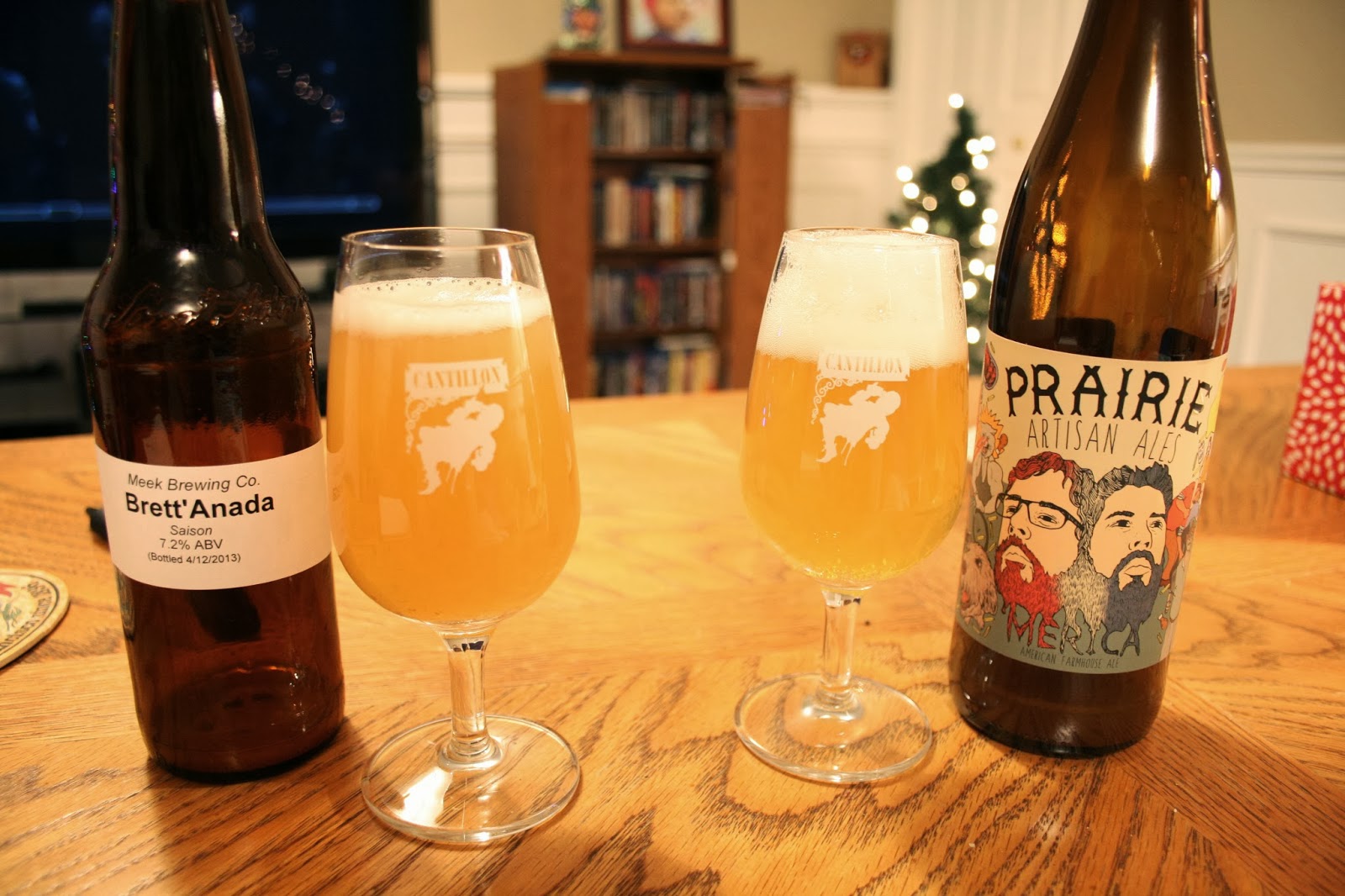
Tasting : 'Merica vs. 'Anada

Ok, I apologize right now for these tasting notes taking as long as they have, because when I originally posted my brew notes for this Prairie Artisan Ales 'Merica clone, the post had a lot of attention. Seems like a lot of homebrewers out there love this beer, and would like to try cloning it themselves.

As mentioned in the original post, I decided against bottling this beer with two strains of Brett, as Prairie does. Instead, I dry-hopped and bottled half the beer "plain", and added Brett bottle dregs (from some commercial beers) to the other half in secondary; after the FG got down to 1.001, I dry-hopped and bottled that half. This is why I've waited to post the tasting notes - I wanted to compare both beers to each other, and to the actual 'Merica itself.

Well, in a nutshell, the beer came out pretty fantastic. Even though my hopping schedule was off (Prairie corrected me AFTER I had brewed the beer and posted the recipe), with the dry-hop being only half of what it should have been, the beer has a HUGE Nelson Sauvin presence, in both aroma and flavor. Wow. I just wanted to shove my nose in this beer and keep it there all day... such a massive blast of tropical berries, with a bit of dank. Nelson may now be my new favorite hop variety.

Now that most of the plain beers are gone, I just started drinking the Bretted version, and honestly there's not a huge difference. I didn't get a lot of Brett character from 'Merica when I first had it, so I'm not too surprised, even though I took a different approach. I actually prefer the non-Brett half, because all that time in secondary diminished the Nelson a bit. Still a great beer, but if you brew this recipe, I encourage you to drop the Brett addition if it means more trouble/money for you.


So, the comparison you see in the picture is with the Bretted version of my homebrew, vs. 'Merica. Below are my notes on my beer, compared to the real deal...

Appearance: Poured with a moderate-large, fluffy white head that has very good retention (despite the picture). Body is a light orange color, and very hazy. The two beers look basically identical; I'd say my homebrew is just a hair darker and hazier.

Aroma: Intensely-fruity, with a strong berry component. Like sticking your nose into a big bowl of tropical fruit, with a touch of dank thrown in. Wonderful-smelling, one of the best-smelling beers I’ve ever brewed. The 'Merica is very similar, but has less fruit/hops and a bit more dankness/funkiness to it... it's hard to place (my wife mentioned "like feet").

Taste: Big berry flavor as well, with just a touch of spiciness - I assume from the yeast - to complement. It’s pretty much all-Nelson for the most part, although I’m sure the fruity character from the yeast is combining with the hop component. Medium-low bitterness, with a dry finish. Again, the 'Merica is very similar, but has less hops and more of that dank/funky character that I can't quite put my finger on.

Mouthfeel: Light-bodied, medium-high carbonation... yet, smooth, and not too prickly. Pretty much bang-on with the 'Merica.

Overall/Final Thoughts: This homebrew came out fantastic... it'd probably be up there in my top 3 or 5 beers I've brewed. I find it very similar to 'Merica, but with a bit more hop presence. However, I can't tell when the bottle of 'Merica I had was bottled, and I purchased it 2 months ago, so it could be an age thing. I also have no idea what yeast strain 'Merica uses; if they bottle condition this beer, it may help to actually culture some yeast from a bottle. However, I'm completely happy with the "clone" the way it came out; I don't even think it'd be necessary to double the dry-hop to match up with Prairie's recipe.

Wednesday, 18 December 2013

Tasting : Raspberry Zombie Printemps


Now, I'm not really sure WHY it took me so long to post the tasting notes for this beer. I mean, look at the picture - I took the damn thing in the summer, for crying out loud!

This was my first time brewing a Saison. A "Super Saison" with a high-ABV I brewed it in August of 2012, and bottled half of it a few weeks later (tasting notes for that portion here). The other half I tried to get a bit creative, aging it on raspberries for over four months. I also pitched the bottle dregs from a delicious Fantome Saison, just to see if I could coax a bit of funkiness into it.

Well, as you can see from the picture, the raspberries definitely came through in the color. I'm pleased to say they came through in the aroma and flavor as well, without making the beer too syrupy or cough medicine-like. I really don't think the Fantome dregs added anything, though, but this doesn't surprised me - the beer's FG was already at 1.004 at that point, and it only dropped a couple points more to 1.002. There just wasn't a lot of sugars left for the dregs to work on, even with the raspberries present.

Still, the beer is pretty tasty, and is shockingly drinkable at 8.9% ABV. It definitely encourages me to work with fruit in a Saison again in the future; and maybe add some Fantome yeast before fermentation has completely finished.

Appearance: Pours with a moderate-sized, white head that begins to fade very quickly, before settling in at 1/2 cm or so. The body is hazy and bright red; very pretty-looking.

Aroma: The raspberries definitely come through, here... the first few bottles smelled a little too-much like some raspberry-flavored cold syrup, but luckily after a bit of time it mellowed out a bit, so it's now not sickening at all. There's a hint of spiciness from the yeast as well. No hop aroma.

Flavor: Again, raspberries. Quite refreshing, even with the high ABV. A bit of alcohol warmth on the way down, but it's not hot at all, and is pretty easy-drinking. Moderate-low bitterness in the extremely dry finish.

Mouthfeel: Medium-light bodied, with high carbonation. Spritzy.

Overall: This beer wouldn't be for everyone; I guess you could call it a fruit Saison if you had to call it something. I like it; again, no need really to pitch the Fantome dregs, but I tried. Next time, pitch the dregs before the fermentable sugars are mostly gone.

Friday, 29 November 2013

Brewing a Mosaic One-Hop Session IPA

With Christmas fast approaching, and along with it, the pile of things to do (family to visit, gifts to buy, beer to drink), you've got to take any opportunity to brew that you can. And last week, one of those opportunities came up, so I jumped on it. I'm a little worried that this will be my last brew day for 2013 - bringing my numbers for this year to an all-time personal low - but hopefully I can sneak in one more before the New Year.

Anyway, once again I only had some dry yeast on hand (US-05), but that's ok because I was in the mood to brew another American IPA. Now is the time of year where the 2013 hop harvest is starting to trickle in to homebrew shops and other online hop suppliers, and I just recently received a couple of new varieties (to me) from Yakima Valley Hops. I've still got quite a lot of some 2012 varieties that I really should be trying to use up (luckily, they're vacuum-sealed and stored in the freezer, so are still smelling and tasting good), but I wanted to try brewing a hoppy beer with as-fresh-as-possible hops. It didn't take me long to decide which hop to showcase: Mosaic.

This picture says a lot, actually...
A fairly new hop variety (it just became commercially available with last year's harvest), Mosaic is a daughter of the Simcoe hop, crossed with a "Nugget-derived male", according to Stan Hieronymus's book, For the Love of Hops. A high alpha-acid hop, it still provides a lot in terms of flavor and aroma. While Mosaic is often known as a very fruity hop, giving notes of "mango, lemon, [and] citrus", the quality that often makes it stand out is blueberry. Mosaic quickly gained in popularity for both homebrewers and commercial brewers, so it shouldn't be too difficult for anyone in a good-beer area to find a product that features it. I was lucky enough to try a homebrewed version of an American IPA brewed solely with Mosaic (from Derek of Bear-Flavored), and it was excellent - I wouldn't say the blueberry jumped out and slapped me, but I could definitely pick it up. Either way, I really liked what the hop added to that beer, and it's been on my must-buy hop list ever since. When I saw that Yakima Valley Hops had the 2013 crop available, I immediately bought a pound. I decided to brew this IPA with all-Mosaic, since it's my first time using it.

I also decided to take a new stab at the American IPA category, shooting for the unofficial (to the BJCP, at least) "sessionable IPA" category. Session IPAs - basically, lower-ABV IPAs that still pack a good hop punch - are becoming more and more popular these days, with lots of commercial breweries selling their own take on the "style", such as the delicious All-Day IPA from Founders. So, isn't a Session IPA, or India Session Ale, as some are calling it, simply an American Pale Ale, you ask? Well, I'd have to say no, because most of the Session IPAs out there are coming in at <5% ABV (with a lot of them following the true "session beer" term and going even lower, less than 4% ABV), which is still lower than your typical APA. Not to mention that these beers are HOPPIER than APAs, for the most part, but that, too, is blurry now, because a lot of APAs out there now are really hoppy. You could also argue that APAs generally have more of a caramel malt-presence than American IPAs.

But, I digress. So, in a nutshell, I decided to brew a Session IPA featuring Mosaic. I threw together a recipe quickly, because this brew day came up quick and I didn't have a lot of time to put more thought into brewing this style of beer... which is unfortunate, because now that I've looked into it a bit (AFTER brewing the beer), there's some changes I would make. I'll explain what approach I took, and what I would change.

For the grist, I wanted to keep it relatively simple, but still add a couple of specialty malts for a bit of character. Along with a large percentage of 2-row, I added some Crystal 40 L, Wheat malt, and Carapils. All should help add some body to the beer, without making it too sweet. I mashed low, at 149 F, to ensure I had a good amount of fermentable sugars. I added some gypsum to the mash to help decrease the pH a bit, and bump up the calcium and sulfate as well.

Now, the hopping. How DO you hop a Session IPA, anyway? Like your standard American IPA? I wanted it to have an assertive bitterness, but not be overbearing. I aimed for roughly 1.0 on the IBU/OG ratio, which is pretty bitter. I still had quite a few of the CO2 hop extract left from my previous order, so I used 5 mL at 60 minutes to provide some IBUs. I then went with an increasing amount of Mosaic near the end of the boil: 1 oz at 10 minutes, 2 oz at flameout (for a 15-minute steep), and 3 oz for the dry-hop. Nothing too crazy, but Mosaic seems to be (from what I've read from others' experiences) a pretty potent hop, so these numbers seemed reasonable, to me.

So, what I would change...
  1. I don't know what I was thinking, but obviously with a session beer that has an OG in the high 1.030s, you probably want to mash higher than 149 F, to give the beer more body. Whoops. I just went with what I usually do for American IPAs, because I like them to finish dry. I also don't like a lot of Crystal malt in this style of beer; another approach would have been to add more specialty malt than usual, to also bump up the body.
  2. I could probably get away with decreasing the late-addition hops. Apparently, with session IPAs you have to be more cautious of adding too many hops. I read something by Mitch Steele that suggested that you're more likely to get grassy flavors with large hop additions. 
I haven't given up hope yet, though. The grist DOES have some Crystal 40 L, Carapils and Wheat malt to provide some body, and 149 F definitely isn't the lowest mash temp I've seen. Unfortunately, my OG came in several points below target, but we'll see where it finishes at. Here's hoping that the beer doesn't come across as too thin; I plan on carbing a bit lower than usual for an IPA to make up for the likely-lower body.

Recipe targets: (5.5 gallons, 80% efficiency) OG 1.048, FG ~1.010, IBU ~50, SRM 6.2, ABV ~4.9%

Grains & Other:
2.95 kg (72.2%) Canadian 2-row

454 g (11.1%) Munich malt
454 g (11.1%) Wheat malt
227 g (5.6%) Crystal 40 L

Hops:
Hop extract - 5 mL @ 60 min (equivalent to 28 g 10% AA hop)

Mosaic - 28 g (12.7%) @ 10 min
Mosaic - 56 g (12.7%) @ 0 min (with a 15-minute steep)
Mosaic - 84 g dry-hop for 5 days

Misc.: 1/2 tab Irish moss @ 5 min

Yeast: US-05 Safale, rehydrated

Water: Fredericton city water, carbon-filtered; 6 grams gypsum in the mash


- Brewed on November 18th, 2013, by myself. 60-minute mash with 12.6 L of strike water, mashed in at target temp of 149 F. Sparged with 5.5 gallons of 168 F water for final volume of ~6.75 gallons.

- SG low at 1.035 (target 1.039). 60-minute boil. Final volume ~5.5 gallons. Steeped flameout hops for 15 minutes, then started chilling. Chilled down to 62 F, then poured/filtered into Better Bottle. OG low at 1.044; volume also seems a bit low in BB, maybe only 4.5 gallons or so. Aerated with 45 seconds of pure O2 and pitched one pack of rehydrated yeast. Placed BB in laundry room, ambient temp ~66 F.

- 19/11/13 - In early afternoon, temp 66 F, airlock bubbling q 2 seconds.

- 20/11/13 - In AM, big krausen, temp 68 F, bubbling almost every second.

- 21/11/13 - In AM, temp up to 70 F, but bubbling slowing to q 3 seconds. Moved BB into the water-heater room to keep the temp up to 70 F or so.

- 28/11/13 - Gravity reading of 1.010.

- 3/12/13 - Added dry-hops directly to primary.

- 8/12/13 - Bottled with 95 g table sugar, aiming for 2.3 vol CO2 for 4.5 gallons, with a max temp of 70 F reached.

- 6/1/13 - Posted the tasting notes... definitely should have mashed higher, as the body is too thin, but it still made a great-smelling and tasting beer!

Thursday, 28 November 2013

Tasting : Schnee Tag! 2.0 (Schwarzbier)

The second of the two lagers brewed this year, this beer is my second shot at the Schwarzbier style. My first attempt turned out pretty great; I was really happy with the malt character, mixed in with some coffee flavors and aromas, without the burnt qualities you get in other dark beers like Stouts.

I brewed this beer shortly after the Vienna Lager; I washed the yeast (Wyeast Munich Lager II) from that beer and pitched the slurry into this one. This is a great way to a) get more than one batch out of one pack of yeast, b) avoid having to build up another big starter for a lager, and c) ferment and lager two beers at virtually the same time, maximizing the use and space of your fermentation chamber (for more on my approach to brewing lagers, check here).

I didn't make many changes this time around from the first Schwarzbier recipe... a bit with the grist, hopping, and I messed with the water chemistry some, but that's it. I wish I had held on to one bottle from that batch; it's been a few years, but I still would have liked to compare it to the new one. Either way, I'm happy with it... once again, enough coffee and chocolate character to be tasty, but none of the burnt, really roasted flavors you get from beers with lots of roasted malt. Definitely an excellent beer to get non-dark-beer-drinkers into drinking darker beers!

Appearance: Poured with a moderate-large, light tan head, creamy and long-lasting. Fades very slowly to a full-finger. Body is black and opaque at first-glance, but shows excellent clarity with ruby highlights when held to the light.

Aroma: Sweet malt aromas (Munich-like), and milk chocolate. Not really getting any roast.

Taste: A touch of roast character in the flavor, but the Munich malt sweetness, bit of caramel, and milk chocolate win out. Perhaps some very slight noble hop character. Medium-light bitterness in the finish. Clean. No flaws, no diacetyl.

Mouthfeel: Medium-bodied, moderate carbonation.

Overall: Pretty tasty, easy-drinking... could probably benefit from a bit more roast character. Otherwise, very close to what I was going for.

Wednesday, 27 November 2013

Tasting : The Sound of Zombies (Vienna Lager)

Ok, continuing on with the tasting notes. I brewed a lot of hoppy beers in 2013, and naturally, these are the beers I got to first when it came to posting my thoughts on the results. Not that I got to most of them quickly enough, but I got there. There's still a bunch of beers I've brewed over the last year (or more) that I HAVEN'T posted on yet, but these are beers that aren't in danger of fading as quickly as the APAs and IPAs that were big on hops.

First off is my first attempt at a Vienna Lager, one of the two lagers I brewed earlier this year using one of Wyeast's private collection yeasts, the 2352 Munich Lager II. I brewed the beer in March, began lagering it in early May, and bottled it in July. I've been drinking it since the summer, with more emphasis in the fall thanks to the style's close similarity to an Oktoberfest.

I think the beer came out pretty well. Vienna Lager is one of those styles that isn't going to jump out and smack you in the face, like a really good IPA, DIPA, or sour beer. But if you pay attention to what you're drinking, you can easily appreciate a well-brewed one, with its malt complexity and balancing bitterness.

The Vienna and Munich malts are definitely present, here... the beer is quite malty, but it doesn't finish really sweet - I'd say it's fairly balanced, maybe tilting a bit towards the sweet side, but luckily it's not cloying at all. For some reason the carbonation is a bit higher than I had aimed for, but it's not a big problem. All-in-all it's a decent Vienna Lager recipe, and the yeast seemed to work well for the style, too... but I think if you wanted to brew it now, using another one of the Lager yeast strains would give you just as good of an end-result.

Appearance: Pours with a moderate-large, white head that shows great retention, finally fading to a full-finger. The body is dark amber, leaning into red-colored, with excellent clarity.

Aroma: Strong bready malt, a touch of sweetness of the caramel variety. No hop aroma. Pretty clean.

Taste: Again, mostly a bready-malt flavor. Maybe just a touch of spiciness from the later hop addition, but it's pretty minimal. Finishes with a moderate-low bitterness, and enough dryness to make the beer feel pretty balanced.

Mouthfeel: Medium-light bodied, with medium-high carbonation.

Overall: Pretty decent. I like the character from the Munich and Vienna; I think for what the style is supposed to be, that this came out well enough. I'd like to decrease the carbonation and bump up the body a bit.

Wednesday, 13 November 2013

Tasting : Belmade Pale Ale (APA with Belma and Cascade)

I have a lot of homebrew tasting notes to get caught up on, so you'll have to excuse a potential flurry of posts; actually, this isn't really a bad thing since I've been pretty terrible at posting in general, lately.

This beer is the American Pale Ale I brewed in September, which I hopped with equal amounts of Cascade and Belma hop pellets. Except for a very small bittering addition, most of the hops were added at flameout (3 oz each) and in the dry-hop (1.25 oz each). I wasn't completely sure what to expect, but was ultimately aiming for a medium-strength, medium-bodied APA with a good amount of fruity hop presence in the aroma and flavor.

For the most part, I think I hit that goal. More details below, but the beer is definitely fruity and citrusy. What the beer definitely could use more of is bitterness; in hindsight, I should have either let the hops steep longer than I did, or maybe thrown in a 10-minute addition to up the IBUs a bit. You CAN get IBUs from flameout additions, but you have to add a lot of hops, and I guess make sure to let them steep long enough. How long, exactly? Well, I still haven't found anything concrete that says "x" amount of minutes with "y" amount of hops gives you "z" amount of IBUs. Maybe a good blog post for the future...

Still, it's definitely a tasty APA, and at 5% ABV (along with a low-perceived bitterness) makes for some easy-drinking.


Appearance: Pours with a moderate-sized, slightly off-white head that shows pretty good retention. Fades to 1/4-finger. Body is golden with really good clarity.

Aroma: Definitely getting some of that now-expected Belma character... strawberries, and some citrus fruit from the Cascade. A touch of malt sweetness, but the hops dominate.

Taste: Similar to the aroma, big hop flavor of strawberries and citrus. The beer finishes nicely balanced, tilting towards the dry side. Medium-low bitterness, needs to be higher. No flaws detected.

Mouthfeel: Medium-bodied, medium carbonation. Smooth.

Overall: Nice APA; I'd consider brewing it again if I had a lot of Belma on hand sometime, but as mentioned, I'd either steep the flameout hops longer, or more likely add maybe 0.5-1 oz of Belma and Cascade at 10 or 5 minutes.