Showing posts with label London Ale III. Show all posts

Friday, 14 July 2017

Grapefruit Milkshake IPA (w/ Azacca, Citra and Mosaic)

Last fall, I brewed my first Milkshake IPA (and in true me fashion, posted about it almost 3 months later... sigh), Orange Creamsicle IPA. With half a pound of lactose powder, vanilla bean, orange zest, and hopped with plenty of Azacca, Equinox and Galaxy, it came out really tasty. It wasn't QUITE where I wanted it to be, as I felt that it could use more vanilla (I had used half a vanilla bean), but otherwise I really enjoyed it.

Originally going up in February, that post is now my third-most-viewed post of all time (and close to passing to #2). I've been blogging since November of 2011, so when a post is viewed that many times in five months, it really says something. And no, I'm not saying it says something about my writing! It shows that this is a "style" that is really taking off in North America. And it shows that when your blog is referenced, even briefly, on The Mad Fermentationist, your popularity increases exponentially! Where were you in junior high school, Mike Tonsmeire, huh? Huh?

Brewing a beer like this again was a definite thing for me. Aside from being obviously juicy, fruity, tropical, etc. from the zest and hop additions, the vanilla and lactose work surprisingly well, giving the beer a very smooth, silky mouthfeel, without being cloyingly sweet. So, in early April I brewed up another Milkshake IPA, with a few changes this time around.

The grist I kept almost the same, with only one change: originally, I had a mix of 2-row and Maris Otter (emphasis on the 2-row), but I started thinking afterwards, why do that with a beer of this style? I understand that if you want a bit more malt complexity, Maris Otter is great, but in a beer that has lactose powder, vanilla bean, fruit, and a boatload of hops... somehow I think anything that Maris Otter adds is going to get lost. And with it's slightly higher price, I couldn't justify it. So the majority of the grist is 2-row, with close to 15% Flaked Oats, and a bit of Carapils and Acid malt.

Hops. The changes I made here were purely out of experimentation, not because I wasn't happy with the three varieties I used the first time around. This time around I kept the Azacca, and switched out the Equinox and Galaxy for Citra and Mosaic. You're talking about two awesome varieties being replaced by... two awesome varieties. I love all four of those hops and would be happy using any or all of them in a beer. I couldn't remember recently combining Citra and Mosaic together, so thought this would be a good opportunity. Citra and Mosaic were used at 10 minutes, and for a hop steep. A large dose of Azacca for the first dry hop, then more Citra for a second.

For the vanilla bean, this was a simple adjustment. Half a bean (scraped and chopped, soaked in vodka for a week or so before packaging, with the resulting tincture being added to the serving keg) gave some vanilla presence the first time, but not enough. A friend who tried mine brewed his own version and added a whole bean, and it was spot-on. So, a full bean it is!

Finally, the fruit. There were plenty of options here, ranging from a combination of zests to whole fruit. I had fully intended on adding mango into secondary after fermentation was complete, but ultimately I decided on more zest... and not a fruit I normally would have thought of for a beer like this - grapefruit. But, anyone who's had Grapefruit Sculpin from Ballast Point knows that it's a pretty delicious beer (at least, it was the last few times I had it), and grapefruit is a descriptor you can find in several hop varieties, so I gave it a shot. I used almost twice the amount of zest that I used for orange in the last beer, keeping in mind that the bitterness of the beer may be accentuated by the grapefruit.

Fermented (with London Ale III, of course), dry-hopped, kegged, and consumed (mostly, there's a few bottled-from-the-tap beers left), this beer came out pretty a-ok. The one vanilla bean is, I can confirm with certainty now, the way to go for a 5 gallon batch. The level of vanilla in both the aroma and taste is pretty much just where I'd want it to be for this beer. Of course, the juicy, fruity tropical hops are the stars of the show, with a touch of residual sweetness from the lactose (I still think 1/2 lb is enough). I get a bit of grapefruit, but I wonder if the large dry-hop additions aren't overshadowing the zest? The Brew Bucket smelled very strongly of grapefruit after I had racked to the keg, but I don't get near that aroma in the actual beer. And I do think the bitterness for this one is a bit too high; since the IBUs are about where the last one was, I'm guessing maybe the grapefruit is increasing the perception of bitterness even more.

Changes for next time: dial the IBUs back a bit if using grapefruit zest, but more likely, I'd go with a different fruit. The beer is still quite enjoyable, but I think the orange zest from the last beer worked better. And, of course, I'll probably tweak the hops even more, just because! But this is turning into a pretty solid recipe, and I'd recommend most of what you see below.

Recipe Targets: (5.5 gallons, 75% efficiency) OG 1.067, FG ~1.014, IBU ~54, SRM 4.2, ABV ~7%

Grains & Sugars:
4.65 kg (75.8%) Canadian 2-row
900 g (14.7%) Flaked Oats
180 g (2.9%) Carapils
180 g (2.9%) Acid malt
227 g (3.7%) Lactose powder (added during the boil)

Hops:
Polaris - 8 g (17% AA) @ 60 min
Citra - 28 g (11.5% AA) @ 10 min
Mosaic - 28 g (10.5% AA) @ 10 min

Citra & Mosaic - 42 g each @ 0 min (with a 15 min hop steep)

Azacca - 104 g dry-hop for 5 days (in primary)

Citra - 80 g dry-hop for 5 more days (in primary)

Misc:
17 g grapefruit zest (in primary with Citra dry hop)
1 vanilla bean (scraped and chopped, soaked in vodka for a week, strained and added in serving keg)

Yeast: Wyeast 1318 London Ale III (~240 billion cells)

Water: Fredericton city water, carbon-filtered; 3 g Gypsum and 7 g calcium chloride added to mash

- Brewed in early April, 2017, by myself. 50-minute mash with 16 L of strike water; mash temp on target at 150 F. Mashed-out for 10 minutes with 8.5 L of boiling water to 168 F. Sparged with ~3 gallons of 168 F water for final volume of ~6.75 gallons.

- 60-minute boil; added the lactose in the final 20 min. Final volume ~5.5 gallons; OG a bit low at 1.065. Chilled to 64 F, then poured into Brew Bucket (from SS). Aerated with 90 seconds of pure O2, pitched yeast at 64 F.

- Fermentation active by the next day and over 2-3 days (temp got as high as 72 F).

- 8/4/17 - Fermentation started slowing, added first dry hop.

- 13/4/17 - Added second dry-hop and grapefruit zest.

- 20/4/17 - Kegged beer (with vanilla bean-infused vodka), carbed at 30 PSI for 36 hours.


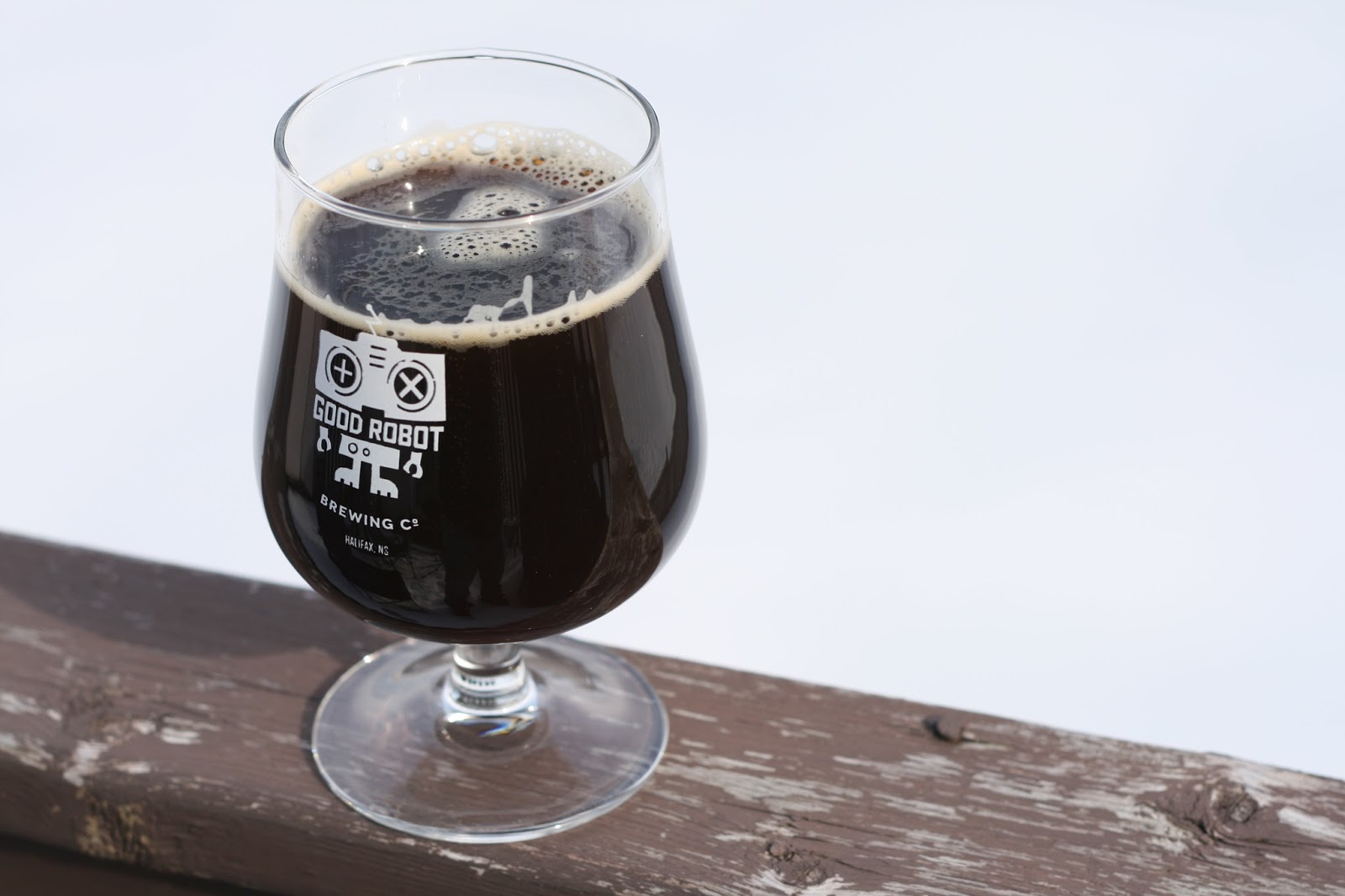
Appearance: Pours much like the last: moderate-large sized, stark white head that shows great retention. Body is pale yellow, and completely cloudy.

Aroma: Bright and full of juicy, tropical fruit; followed by some vanilla, and a touch of grapefruit. Not really getting any malt character (that's ok).

Taste: Like the aroma suggest, plenty of juicy fruit goodness from the hops! Much better level of vanilla this time around (definitely noticeable, but not sickening), and the grapefruit does come through a bit as well. Finishes with a moderate bitterness.

Mouthfeel: Medium-bodied, medium carbonation. Very smooth and creamy.

Overall: Very nice; I give the hop and fruit edge to the last beer, and the vanilla to this one. Hoping that my next attempt will be even closer to where I want.

Thursday, 9 February 2017

Orange Creamsicle IPA - my first attempt at a "Milkshake" IPA

With the number of commercial breweries at an all-time high, it's not surprising that new beer styles are popping up on a fairly regular basis. I use the word "styles" very loosely, of course; some people don't really like seeing that word used when these beers aren't actually official styles, at least according to the BJCP or other organizations. Me? I don't really care; if you want to call your beer a "Purple Yak Juice IPA" style, go for it. As long as I don't have to drink it.

One style I've been hearing about for months now is the Milkshake IPA. I believe Tired Hands was either the first, or at least one of the first, to start brewing such a beer (as to how that got started, I suggest you Google it... it's a pretty funny story!). But even Atlantic Canada is starting to hop on the Milkshake train, with at least two breweries releasing their own: Tide & Boar in Moncton, New Brunswick, has released several iterations with different fruit (such as Peach Ale Shake), and Nova Scotia's Big Spruce Brewing currently has their take on the style out, Liquid James Brown.

So what exactly is a Milkshake IPA? It takes the growing popularity of the Northeast/New England IPA (cloudy, pale-coloured, creamy, and super-hoppy without high bitterness) to the next level...
  • Lactose powder is added to the beer to give some residual sweetness, and bump up the mouthfeel even more.
  • Vanilla bean is usually added to bring the aromas/flavours associated with vanilla milkshakes.
  • Fruit is often added (but not always), bringing even more to the aroma and flavour.
Of course, you need to add lots of hops in whirlpool/dry hop additions; Flaked Oats are often used to help the beer get plenty cloudy; and it's quite common to see London Ale III used for fermentation, in true classic-Northeast IPA style. Some brewers even add flour to the mash (and maybe even the boil?) to enhance cloudiness, but I dunno... this seems like an unnecessary step to me.

The more I read about Milkshake IPAs, the more I wanted to brew one, and not because I thought it was a slam-dunk style. If anything, this type of beer strikes me as one that could be either really tasty, or a complete mess. There's a lot of different ingredients working together! If you add too much lactose, your beer could be TOO full-bodied, and maybe a bit too sweet (although lactose is only 1/6 as sweet as table sugar, I believe). Too much vanilla? That's an ingredient that could overwhelm the hops pretty easily. But I was intrigued enough to give it a try on my own, even though I didn't really have anything to go on. Giving it some more thought, I moved towards making this beer orange-heavy; combined with the vanilla, this would give it an orange creamsicle-ness in the aroma and taste - I hoped, anyway.

I started with the grist, putting together a recipe that looked like it would work well for a Northeast-style IPA: 2-row and Maris Otter make up the base, with a good amount of Flaked Oats (~15%) to provide the creamy mouthfeel and haze; I also added a little bit of Carapils and Acid malt. The lactose powder is of course meant to be added in the boil; I didn't really know how much to go with, here. With the Flaked Oats already boosting the body, I was worried that too much lactose would overdo it, not to mention the potential to add too much sweetness. The only time I've brewed with lactose in the past was for a couple of Sweet Stout recipes, where I added a pound for each 5 gallon batch. I decided to halve it for this beer, figuring it'd be better to go too light than too high.

Now, for a truly orange creamsicle-type aroma, I would add Galaxy and Citra to this beer. Orange characteristics are present in plenty of different hop varieties, but I find it particularly strong in these two. However, I didn't have a lot of Galaxy or Citra on hand. What I DID have a lot of were two other varieties I really enjoy, Equinox and Azacca. I've seen "tangerine" and "citrus" used when describing Azacca, and Equinox definitely has some other citrus characters that I thought would work well, so this was the combo I chose. I went with my fairly-standard approach of an ounce each at 10 min, a good amount for a hop steep/whirlpool addition, and then two separate dry-hop additions (with the second dry hop made up of Equinox, and the remaining Galaxy in my inventory). With a touch of Polaris at the beginning of the boil, the IBUs come in at a calculated mid-50s range, which seemed perfect to me. With the majority of the 10 oz of Azacca and Equinox being added after flame-out, I was going for lots of fruity, citrusy hop aroma and flavour.

After fermentation with LAIII was complete, I dry-hopped the beer in primary for 5 days, then racked to my DH keg (which has two filters surrounding the dip tube) along with more hops. This was where I also added the orange zest; I went on the seemingly-heavy side, adding 9 g zest (that's about 0.5 g/L) in a sanitized, mesh bag, weighted down with some marbles, and held suspended in the keg by some dental floss. After 4-5 days in this keg (I roused the hops frequently by picking up the keg and basically turning it back and forth a few times every day), the beer was pushed via C02 to the serving keg.

This is when I added the vanilla bean, another ingredient that I was worried about adding too much. Instead of adding a full bean as I've done in the past with other beers, I went with a half. I suspected this may be at the low end, but again, I didn't want the vanilla too strong, where it could start hiding the hops. I had scraped and chopped the vanilla bean about a week previous, and soaked it in a bit of vodka for that period (this method had worked well in my recent Belgian Dubbel). That liquid was then strained into the serving keg before transferring the beer onto it.

After chilling and carbing the beer, I had my first taste... and was quite happy, especially considering it was a first attempt with several things I thought could have went wrong. Because I've been behind on blogging, this beer has now kicked, but many people got to try it, and feedback was good. The beer was definitely cloudy, with a very smooth, creamy mouthfeel. The aroma and taste had a lot of hop character - plenty of citrus, fruit, and yes, some orange - with some slight sweetness coming through... but thankfully, not too much. Bitterness was medium-low, right about where I wanted it.

In terms of what I'd like to see changed, the vanilla character was definitely too low. Yes, there was some there, but I think for this style there needed to be more. A friend had brewed a Milkshake IPA as well, which I got to try after I had brewed mine. He had added two vanilla beans to his, and while the beer was tasty, the vanilla character was too strong, and definitely overwhelmed the hops (this was easy to confirm because he had split the batch, with half getting no vanilla at all). I'd say you could safely add one vanilla bean, and have a better chance of hitting that sweet spot. Finally, the beer could be a bit drier; not sure why, but my final gravity was several points high at 1.022. Keep in mind that high number is because of the lactose, which isn't fermented by the yeast, but it still would have been a better beer if it had finished at 1.018, as the recipe called for.

Ultimately, this was a good beer, and I think a pretty decent recipe. Azacca and Equinox sure aren't the easiest hops to find, but I'm sure there's a multitude of substitutions you could make and still have a great beer... maybe even better! Hopefully some of you try this recipe, and have equally good results.

Recipe Targets: (5.5 gallons, 75% efficiency) OG 1.068, FG ~1.018, IBU ~54, SRM 4.6, ABV ~6.8%

Grains & Sugars:
2.9 kg (47.2%) Canadian 2-row
1.75 kg (28.5%) Maris Otter
900 g (14.7%) Flaked Oats
180 g (2.9%) Carapils
180 g (2.9%) Acid malt
227 g (3.7%) Lactose powder (added during the boil)

Hops:
Polaris - 8 g (17% AA) @ 60 min
Azacca - 28 g (7.8% AA) @ 10 min
Equinox - 28 g (13.4% AA) @ 10 min

Azacca & Equinox - 42 g each @ 0 min (with a 15 min hop steep)

Azacca & Equinox - 28 g each dry-hop for 5 days (in primary)

Equinox & Galaxy - 42 g each dry-hop for 4 more days (in DH keg)

Misc:
9 g orange zest (in DH keg)
1/2 vanilla bean (scraped and chopped, soaked in vodka for a week, strained and added in serving keg)

Yeast: Wyeast 1318 London Ale III (~240 billion cells)

Water: Fredericton city water, carbon-filtered; 3 g Gypsum and 7 g calcium chloride added to mash

- Brewed on November 16th, by myself. 50-minute mash with 16 L of strike water; mash temp on target at 150 F. Mashed-out for 10 minutes with 8.5 L of boiling water to 168 F. Sparged with ~3 gallons of 168 F water for final volume of ~6.75 gallons.

- Pre-boil gravity at 1.053. 60-minute boil; added the lactose in the final 20 min. Final volume ~5.5 gallons; OG a bit low at 1.066. Chilled to 64 F, then poured into Better Bottle. Aerated with 90 seconds of pure O2, pitched yeast at 64 F.


Appearance: Pours with a moderate-sized, white head; nice retention, some sticky lacing as the beer recedes. Body is a beautiful light-orange colour, very hazy/cloudy.

Aroma: Lots going on here - interesting mix of orange, tropical fruit, and light vanilla. No alcohol.

Taste: I'd say in decreasing order of intensity, I get tropical fruit hop character, orange, and vanilla, with a lingering low amount of sweetness. Very smooth. Medium/medium-low bitterness in the finish.

Mouthfeel: Medium-full bodied, medium carbonation.

Overall: This turned out better than I had really expected; obviously, luck was a big factor here. I'd love to experiment with this style - different fruit, different hops - but I'd definitely keep the grist, mash schedule, and yeast as-is.

Thursday, 26 January 2017

Northeast Double IPA (with five hop varieties)

Because five hop varieties is better than four, right?!?

No, of course it isn't, and anyone who reads this blog even semi-regularly probably knows that I don't usually use more than 2-3 hop varieties in any beer, with a few exceptions (namely clone recipes that I put together, where I know that the beer in question contains more than a couple of different hops).

The day after brewing my Experimental Sour entry for the 4th Annual Big Spruce Home Brew Competition - a Gose dry-hopped with Chinook and grapefruit zest - I brewed my entry for the Imperial IPA category. I don't normally do back-to-back brew days, but in this case I didn't have a lot of choice. It's difficult brewing these styles of beers for competitions - you really have to time it well, so that your beer is definitely ready in time to have it entered, but also, you don't want it ready TOO early, when you're talking about a style that is better fresh.

I should say right off that if you're brewing a DIPA for a BJCP-certified competition, brewing it in the style of a Northeast version - pale-coloured, cloudy, low bitterness - probably isn't the best idea, if you're really trying to win. Why enter if you're not trying to really win? Great question, you've got me in a box here. In this case, I guess I just really wanted to brew what I like to drink; with several bottles going to the competition, that's a lot of beer leftover. And I'm just no longer a fan of sweet-tasting, Crystal-laden, extremely-bitter DIPAs. So, I thought I'd brew a beer that I knew I'd like (on paper, anyway), enter it, and see what the judges thought.

The grist you see below is basically an amalgamation of several hoppy recipes I've brewed and enjoyed: 2-row and Pilsner malt, with almost equal amounts of Flaked Oats, Carapils and Wheat malt, plus my usual ~2% of Acid malt for mash pH adjustment purposes. Mashed low at 149 F to keep the beer dry, it is, as you can see, purposefully devoid of any real Crystal malts, resulting in a calculated SRM of just 4.5. The BJCP lists the range for DIPA as 6-14, which is pretty wide. Whenever I pour a new-to-me DIPA and see it on the higher end of that range, I cringe, as I'm usually expecting a Crystal-y, low-hop aroma to follow (which isn't always the case, of course, but...). I also added a good portion of table sugar to help dry out the beer further, which I boiled in a bit of water, cooled, and added to the carboy when primary fermentation showed signs of slowing.

As I mentioned above, I don't normally use more than 2-3 hop varieties in a beer, but I had come up with a combination that I was looking to try. I've been enjoying Chinook lately (which I used in the mentioned Gose and a 100%-Chinook Session IPA), and have always been a fan of Columbus (CTZ), so I decided to throw an ounce of each in at 10 minutes. At flameout, more Chinook for a hop steep, along with one of my favourites, Galaxy. After that steep, and when my immersion chiller began its job, I added two other favourites, Nelson Sauvin and Simcoe. I knew from my own experience and many commercial beers that these hops work together well, so I finally went with a single, fairly-large dry-hop addition of the big three, Galaxy, Nelson and Simcoe. With a small Polaris addition at the beginning of the boil, the total calculated IBUs comes in around 65, at the low end of the BJCP range of 60-120.

It probably comes as no surprise that I fermented this beer with London Ale III, which seems to be the go-to yeast now for many northeast hoppy style beers; I'm no exception, as I think it's a great strain for hoppy beers. Once again, I knew that the resulting cloudiness could easily be a negative factor for the judges, if they were judging strictly by-the-book. However, I also know that a lot of BJCP judges probably enjoy a DIPA that is cloudy and pale... and I've never had any problems with a beer coming out cloudy with LAIII - it's pretty much a guarantee when I ferment with it. Throw in an addition of Flaked Oats, and it's probably going to be even cloudier.

This one was brewed in mid-October, the day after the Gose, and kegged on November 8th (Election Day). I definitely didn't have to leave it this long before kegging, but I was doing my best to time its readiness for the competition. I was, from the start, quite happy with how it turned out - yes, it was cloudy, and yes, the bitterness wasn't extreme, but the beer had a very nice (to me) blend of tropical fruit and pine. Creamy, smooth mouthfeel, slightly warming from the alcohol, but still goes down easy. Was it the best DIPA I've ever brewed? No, but it was far from the worst, too.

Like my Gose, however, this beer did not place in the competition. While it received better scores than the Gose did, the judges commented that the beer's colour was too light, and that it wasn't bitter enough. And they're exactly right, by BJCP standards. So I definitely was not surprised by the results. Luckily, though, I really liked the beer! It hung around on tap for a couple of months before finally kicking just the other day.

So, for a DIPA that I brew for me, this was a good beer. I'd definitely brew another DIPA with the same grist, and maybe play around with the hops a little (of course), and likely dial it back to 3 varieties instead of 5. But if you've got these ones on hand and were looking for a new DIPA to brew, I think I can safely recommend this one.

Recipe Targets: (5.5 gallons, 75% efficiency) OG 1.074, FG ~1.014, IBU ~65, SRM 4.5, ABV ~8%

Grains & Sugars:
2.8 kg (42.9%) Canadian 2-row
1.8 g (27.6%) Bohemian Pilsner
500 g (7.7%) Flaked Oats
475 g (7.3%) Carapils
475 g (7.3%) Wheat malt
125 g (1.9%) Acid malt
+ 350 g (5.4%) Table sugar (added when fermentation slows)

Hops:
Polaris - 7 g (17.7% AA) @ 60 min
Chinook - 28 g (13.7% AA) @ 10 min
CTZ - 28 g (10.9% AA) @ 10 min

Chinook & Galaxy - 42 g each @ 0 min (with a 20 min hop steep)

Nelson Sauvin & Simcoe - 28 g each when started chilling

Galaxy, Nelson Sauvin, Simcoe - 42 g each dry-hop for 5 days (in primary)

Yeast: Wyeast 1318 London Ale III

Water: Fredericton city water, carbon-filtered; 8 g Gypsum and 10 g calcium chloride added to mash

- Brewed on October 18th, 2016, by myself. 50-minute mash with 15 L of strike water; mash temp on target of 150 F. Mashed-out for 10 minutes with 8.25 L of boiling water to 168 F. Sparged with ~3.25 gallons of 168 F water for final volume of ~6.75 gallons.

- Pre-boil gravity at 1.055. 60-minute boil. Final volume ~5.5 gallons; OG 1.074 (taking future sugar additions into account). Chilled to 64 F, then poured into Better Bottle. Aerated with 90 seconds of pure O2, pitched yeast at 64 F.

- High activity in the airlock the next morning after pitching; unfortunately, it was quite warm outside during this period, and I didn't try to keep the temps down with water, ice, etc., so over the next couple of days the temperature climbed to 75 F - much higher than my usual fermentation. Luckily, it was pitched low and climbed only gradually.

- When fermentation began to show signs of slowing, the sugar was added in two halves (about 12-16 hours apart) after being boiled and cooled in water.

- 31/10/16 - FG 1.015. Dry-hopped in primary the next day.

- 8/11/16 - Kegged and force-carbed for 36 hours at 30 PSI.


Appearance: Pours with a light-golden colour in the body, medium-sized white head, sticky and holds on for awhile before fading. Very hazy.

Aroma: Nice blast of tropical fruit, pine, with some of that Nelson-specific white wine character coming through. No real malt character here, it's all hops, as wanted and expected.

Taste: Again, hops all the way, but I find the malt supports them enough so that it doesn't come across as astringent or overbearing. Lots of fruit, juicy. Medium bitterness in the finish, dry.

Mouthfeel: Medium-bodied, creamy; medium carbonation.

Overall: I really enjoyed this beer; I'm a big fan of the creamy body yet dry finish, and the hop combo works quite well.

Friday, 26 August 2016

Kohatu Session IPA

Nearing the end of my pre-summer brewing step-up (meanwhile, summer is just about over - typical), I decided to brew another beer in my one-hop Session IPA series. While it hadn't been that long since my last one (in March, an all-Nelson Sauvin beer), this is a style - and experiment - that I really enjoy brewing, and even though I've done five different beers in this group already, I have plenty of other hop varieties that I want to try in it.

One of these hops is Kohatu, a variety I've never used in a beer before. Originating in New Zealand, I split a pound of pellets with a friend last fall, pretty much always with the intention of using it in a single-hop beer. Described on the Bear-Flavored Ultimate Guide to Hop Varieties (I use this all the time; thanks Derek!) as having "intense floral characters, grapefruit, pine needles, and tropical fruit", it sounded pretty good to me; kind of like a mash of Chinook and Simcoe, with another fruity Southern Hemisphere variety thrown in. Summer is the perfect time for low-ABV beers with these characteristics, no? Ok, any time of year is good for these beers, really.

Apparently Kohatu is a descendent of Hallertau Mittelfruh; it's been available commercially for the last few years or so. It seems to range in the 5-7% AA zone; digging around a bit more online, I was getting the impression that opinions vary on just how "intense" its characteristics are. That shouldn't surprise me, really, but more brewers than not described is as less punchy than hops like Citra, Nelson Sauvin, Azacca, etc. etc., so I kept this in mind when planning the recipe.

Partially because I was lazy, but mostly because the Nelson Sauvin Session IPA turned out so tasty, I used the exact same grist as last time. This is actually the grist for the very-popular Russian River Row 2, Hill 56 clone that has been circulating for some time (my attempt at that beer is here); for most of my Session IPAs, I had fine-tuned a recipe of my own, but with the Nelson one I decided to go with this grist, and was happy with it for that beer. The key is to aim for a mash temp of 153-155 F, so that you can help boost the body a bit.

Also with the other Session IPAs, I had come up with a hopping schedule I felt worked well: a little bit of Polaris or hop extract at the beginning of the boil, then one ounce of whatever hop was featured at 10 min, a two ounce addition at flameout for a 15-minute hop steep/whirlpool, and a three ounce dry hop. This time, however, I bumped up the last two additions - I had 8 oz total of Kohatu, so I decided to just use all of it in this batch. Therefore, three oz at flameout, and four for the dry hop.

Once again, as in the Nelson Sauvin Session IPA, I decided to ferment this batch with London Ale III. While all of the others used US-05, I was really happy with how the LAIII worked in the last batch - fruity, juicy, great mouthfeel, and of course, hazy! I also tinkered with the water chemistry, aiming for the "more chloride than sulfate" approach, which I've had good results with.

The brew day went normal, no issues, and fermentation was going strong around 24 hours after pitching the yeast slurry. I kegged the beer a couple of weeks after brewing it, and was drinking it a few days later. I was a little unsure how I felt about it at first, but after settling into its own after several days, I started enjoying it. Is it my favourite one-hop Session IPA I've brewed? No, but it's not my least favourite, either. Kohatu definitely has some of the characteristics mentioned above - it definitely has a light tropical fruit note in the flavour, and a light amount of pine as well. There's also this light spicy character that is pretty interesting, and works well with the other flavours and aromas. I think you could describe Kohatu as complex, if not intense... does that make sense?

As you can see, the key word here is "light"; I definitely would consider Kohatu to be less-punchy than some other varieties. Based on my experience, in the Southern Hemisphere hop category, I'd put it somewhere between Summer and Nelson Sauvin. So, it works well on its own, but may be better put to use with at least one other hop to bolster it a bit. Mind you, this is the only time I've brewed with it, so take my thoughts with a grain of salt (actually, I urge you to always do that!). Either way, a hop variety that I would gladly use again, and a tasty beer that ended up being perfect for summer.

Recipe Targets: (5.5 gallons, 80% efficiency) OG 1.048, FG ~1.013, IBU ~34, SRM 4.5, ABV ~4.5%

Grains:
2.3 kg (57.1%) Bohemian Pilsner
1.35 kg (33.5%) Maris Otter
160 g (4%) CaraRed (20 L)
120 g (3%) Carapils
100 g (2.5%) Acid malt

Hops:
Polaris - 6 g (20% AA) @ 60 min
Kohatu - 28 g (6.4% AA) @ 10 min

Kohatu - 84 g @ 0 min (with a 15 min hop steep)

Kohatu - 112 g dry-hop for 5 days (in primary)

Misc: 1/2 tab Irish Moss at 5 min

Yeast: Wyeast 1318 London Ale III (with a starter, ~175 billion cells)

Water: Fredericton city water, carbon-filtered; 5 g Gypsum and 8 g calcium chloride added to mash

- Brewed on June 13th, 2016, by myself. 50-minute mash with 13 L of strike water; mash temp on target of 153 F. Mashed-out for 10 minutes with 5.5 L of boiling water to 165 F. Sparged with ~4 gallons of 168 F water for final volume of ~6.75 gallons.

- Pre-boil gravity at 1.040 (target 1.039). 60-minute boil. Final volume ~5.5 gallons; OG a bit high at 1.049. Chilled to 64 F, then poured into Better Bottle. Aerated with 60 seconds of pure O2, pitched yeast at 64 F.

- Plenty of activity by the next morning, reaching its peak that evening with a temp of 70 F. Started slowing down after a couple of days - but the krausen remained thick and milkshake-like even a week later (pretty common for LAIII).

22/6/16 - Added dry hops into primary; FG 1.011. Racked to keg five days later and started force carbing.


Appearance: Pours with a moderate-sized, white head with fairly good retention - fades to 1/4 finger or so after a couple of minutes. Body is light golden, with a decent amount of haziness.

Aroma: I wish I could describe it better, but it's kind of a mix of fruit (grapefruit as advertised) and spice, and slightly floral. Surprisingly has quite a lot going on, even if it's not what you would describe as "punchy".

Taste: Mainly a light fruity character accompanied by light spice. This isn't the phenolic spiciness that you see with Belgian yeast, it's something different. Luckily it's mild - it doesn't taste like someone raided the spice cabinet and dumped it in the beer. Medium-light bitterness in the finish.

Mouthfeel: Medium carbonation, medium-light bodied; smooth.

Overall: A tasty beer, and an interesting hop. I'm curious to what it would be like used with some other variety(ies); depending on what else you added, would the Kohatu be drowned out, or complement the other? Something I'd buy again in the future to experiment with more!

Thursday, 5 May 2016

Nelson Sauvin Session IPA

It's been awhile since I've brewed a new entry in my series of one-hop Session IPAs; while I did rebrew the Equinox Session IPA a few months ago, the last new entry was almost a year ago, when I brewed one with Summer hops. While not a bad beer, it was the least enjoyable out of all of them (Mosaic and Equinox were both great, El Dorado was quite good); it was the first and only time I've brewed with Summer, and the hop aroma and flavour was extremely mild compared to the other Session IPAs I've brewed. I always enjoy having a sessionable, hoppy beer on tap, so it was definitely time for me to re-visit this series, and I had a lot of hop varieties I was anxious to try out.

Before choosing a hop, however, I decided to make this a completely different Session IPA from the other four I had brewed. For those, I was happy to have dialled in a grist, mash temp, hop schedule, and yeast that I felt were all where I wanted them to be for a beer like this. The grist was made up of ~70% 2-row, 11% each Munich and Wheat malt, 5.5% Crystal 40 L, and ~2% Acid malt. I mashed high (~155 F) to keep the body up, which is of course always a challenge when you brew beers in the 4-4.5% ABV range (or lower). I fermented all of the Session IPAs with US-05, which I had been using for basically all of my hoppy beers then.

But, I've really been enjoying fermenting hoppy beers with London Ale III; if you follow along with this blog, you can definitely attest to that. My last six hoppy beers have all been fermented with this strain, and I love how it works with the hops I've used, giving a really fruity beer with a fantastic, creamy mouthfeel. I wanted to try using this strain in a Session IPA, of course, but felt that I didn't really need a grist with 30% specialty malt; I was pretty sure a simpler grain bill with the proper mash temp would be sufficient with LAIII.

It was easy for me to decide on a grist after picking out the yeast strain. Even though I've only used it twice now, for a simple, delicious malt bill that pairs great with hops and LAIII, I feel that you can't go wrong with the Row 2, Hill 56 clone: Pilsner and Maris Otter, light Crystal and Carapils, and a bit of Acid malt. I used it recently in an APA with Azacca and Galaxy, and that beer was one of my favourites I've brewed in a while. I scaled down the recipe to an OG of 1.048, and decided to aim for a mash temp of 154 F; while not completely sure, I was pretty confident that it would give enough body in the beer.

There, everything decided! Oh wait, the hops. While I had many varieties on hand that I had never used on their own before, I couldn't help but be drawn back to maybe my favourite variety, Nelson Sauvin. Ah, what a wonderful hop. I know I don't have to tell you that, but I can't help it. It's so delicious. And surprisingly, I had quite a lot of it on hand, so I was really interested in brewing another one-hop beer with it; the first one was a completely different beer, my Prairie 'Merica clone, a SMaSH Saison. I really loved that beer, and it was two and a half years ago that I brewed it, so it was settled - Nelson Sauvin Session IPA it is. I kept the hop schedule for this beer the same as what I had used before: a little bit of a bittering addition at 60 (I used Polaris, and only 4 g, to get ~9 IBUs), then Nelson at 10 minutes (1 oz), at flameout for a 15-min steep (2 oz), and a dry-hop (3 oz). Six ounces total for the batch, definitely nothing crazy, but I've had great results with this method, and Nelson is pretty expressive to say the least.

Aside from fermenting with LAIII, I added some Gypsum and calcium chloride to my mash as I have done for all hoppy beers over the last six months or more. While I may not have everything completely dialled in yet, I feel like I'm getting pretty close, for my tastes anyway. Aiming for a chloride:sulfate ratio of about 1:1, with both numbers in the 100-150 ppm range, seems to work really well. If you haven't tested your water or tracked down a water report, I suggest you do. You don't necessarily have to be a water expert; obviously, the more you know, the easier it is to understand and tweak, but if you're into hoppy beers (and I assume you are if you're reading this), this higher-chloride-than-we-used-to-think-was-a-good-idea approach really does help in brewing some tasty beers.

Well, now that I'm drinking this beer, I definitely have a decision to make about future Session IPAs, because I really like how this turned out. That's easy to say when you're brewing with Nelson, but aside from how well the hop comes through in this beer, I think I may prefer this style with the R2H56 grist and fermenting with LAIII. The beer looks fantastic, pale-gold-coloured and hazy, just like I like it to look; huge tropical aroma (I admit I wouldn't know what a gooseberry smells like, but if this truly is it, then I gotta buy me some gooseberries to string into a necklace so I can wear it all day long); I admit the flavour isn't quite as punchy as I expected from the aroma, but it's still very good. Smooth and creamy, as are so many beers (I've found) when fermenting with LAIII.

I also think that ~6 oz is enough hops for this style of beer; I've had other homebrews that used more hops, and they didn't strike me as hoppier in either aroma or flavour, really. I'm a firm believer now that there is a too-many-hops point for beer; whether this is due to hop-flavour-overload/contrasting, pH changes with increasing dry-hopping, or something else, I don't know, but there it is. If this beer could use any changes at all, the only one I would make would be a longer hop steep, which would likely bump up the flavour intensity a little bit. Otherwise, I'm happy with this, and at the calculated ABV of 4.3%, it's perfectly sessionable, and about right where I want a hoppy beer to be in terms of appearance, aroma and flavour.

It's just too bad that Nelson Sauvin is so damned expensive and hard to get...

Recipe Targets: (5.5 gallons, 80% efficiency) OG 1.048, FG ~1.013, IBU ~35, SRM 4.5, ABV ~4.5%

Grains:
2.3 kg (57.1%) Bohemian Pilsner
1.35 kg (33.5%) Maris Otter
160 g (4%) CaraRed (20 L)
120 g (3%) Carapils
100 g (2.5%) Acid malt

Hops:
Polaris - 4 g (20% AA) @ 60 min
Nelson Sauvin - 28 g (10.5% AA) @ 10 min

Nelson Sauvin - 56 g @ 0 min (with a 15 min hop steep)

Nelson Sauvin - 84 g dry-hop for 5 days (in primary)

Misc: 1/2 tab Irish Moss at 5 min

Yeast: Wyeast 1318 London Ale III (with a starter, ~175 billion cells)

Water: Fredericton city water, carbon-filtered; 7 g Gypsum and 7 g calcium chloride added to mash

- Brewed on March 21st, 2016, by myself. 50-minute mash with 13 L of strike water; mash temp a bit low at 153.5 F. Mashed-out for 10 minutes with 5.5 L of boiling water to 168 F. Sparged with ~4.25 gallons of 168 F water for final volume of ~6.75 gallons.

- Pre-boil gravity at 1.038 (target 1.039). 60-minute boil. Final volume ~5.75 gallons; OG a bit low at 1.047. Chilled to 64 F, then poured into Better Bottle. Aerated with 60 seconds of pure O2, pitched yeast at 64 F.

- Good airlock activity by the next morning; 24 hours after that, it had slowed significantly; temp never got higher than 68 F.

- 4/4/16 - FG 1.013. Added dry hops into primary.

- 10/4/16 - Racked beer to keg, set in keezer overnight to bring temp down, then force-carbed at 30 PSI for 36 hours before dropping down to 10 PSI.


Appearance: Pours with a moderate-sized, white fluffy head that shows good retention, eventually fading to 1/4-finger or so. Beautiful, light-golden colour for the body, quite hazy.

Aroma: Yeah, that's Nelson alright! Tons of fruit, very berry-like, maybe just a touch of dank. It's basically all hops in the aroma, and I'm ok with that.

Taste: Same; lots of berry fruitiness, very juicy, as expected. Finishes with a medium bitterness, dry and refreshing. Nice supporting malt character, just a light breadiness that works perfectly.

Mouthfeel: Medium-light bodied, moderate carbonation. Very smooth and creamy.

Overall: I don't use the word crushable, but if I did, I'd certainly use it here. Up there with the Equinox for my favourite Session IPAs I've brewed so far.

Wednesday, 30 March 2016

Brown IPA with CTZ, Galaxy, & Simcoe, fermented with London Ale III

About a year and a half ago, I brewed my first Brown IPA. This was right around the time that the draft of the 2015 BJCP Guidelines had come out, where it was being suggested that Brown IPA become a new category, or more accurately I guess, a sub-category of "Specialty IPA". I won't bore you with the details on how a Brown IPA differs from an American Brown Ale... you can check out the BJCP Guidelines or click on the link for my first brew. In my original beer, I went with a five-malt grist, hopped fairly aggressively with Citra, CTZ and Nugget. I liked it: with a toffee/caramel sweetness, it had a prominent nose of earthy, spicy hops (Nugget made up the majority of the additions), and finished fairly dry with a moderate-high bitterness.

But this is kind of a tough style to brew, simply because I don't think I've had many Brown IPAs. And really, I don't know if I want to. That sounds bad, but there's something about this style that I just can't get excited about. God knows I love hoppy beers, and I'll happily brew and drink any variety of American IPAs, Session IPAs, APAs, etc. I really enjoy a well-crafted Red IPA or Black IPA... so why is it that I can't get excited about a Brown IPA? Is it because I haven't had many, or because it's one of those styles that seems like it was created as an afterthought? Maybe the whole 114 categories of IPA and counting is starting to wear a bit thin? I don't know, and maybe even suggesting such things is blasphemous. But I know how to really test this out... brew another one!

Sure, why the hell not? I was looking to mix things up anyway, so I decided to revisit this recipe. Here's where I made a mistake: because I made the decision to go this route a bit too-close to brew day, I simply used the same grist as with the first beer (but with a little Acid malt added for the mash pH). I should have re-read my post, because that grist gave a beer that was too dark. The style SRM range is 11-19, and the grist I selected brings it in to 23.That's slightly below Black IPA territory, but that's really not a big deal... I'm certainly not using a lot of dark, roasted malts in this beer. It's mostly 2-row, a couple of caramel-type malts, and some Victory and Chocolate malt as well. I also added some Gypsum and calcium chloride as usual, and aimed for a mash temp of 151 F, trying to keep the body medium-light, with a mostly-dry finish.

I wanted to approach the hops differently for this beer. While the first Brown IPA did have some CTZ and Citra - so, you're getting some fruit character - Nugget, as mentioned, made up the majority. I initially went that route because I thought the combination would work well in this style, and it did. But this time around I wanted to go more in the direction of an APA or American IPA; read: fruity, citrusy. I chose three varieties: CTZ again, because I feel it really does work well in this style of beer, and Galaxy and Simcoe, to hopefully really boost the tropical fruit, and maybe add some pine as well. I followed my general schedule: a bit of Polaris at 60 to ~17 IBUs, then an ounce each of CTZ and Simcoe at 10, followed by some Galaxy and Simcoe for a hop steep, CTZ and Simcoe after starting the chiller, and an ounce each of all three in the dry hop (plus a little more Galaxy to use up the rest of that package).

As I've done many times over the last few months, I fermented this beer with London Ale III. The first beer was fermented with US-05, but I've been using LAIII a lot lately, with good results, and honestly, I really wanted to brew a Brown IPA and ferment it with this strain, if only to see how many people would get angry when I posted a pic of the resultant beer, all cloudy and brown. If some people get upset about a beer that looks like orange juice, imagine their reaction if it literally looks like shit!

Ok, I'm kidding. And actually, while I'm on the side of those who get excited when they see an IPA that looks like pulpy juice, there IS something different about seeing a darker beer with the same haze/cloudiness. Juice is one thing. Mud is another. But it wouldn't bother me to the point of not drinking it, that's for sure, especially if it was delicious!

Where was I? Oh, the beer. So, yeah, that's the recipe. When I brewed it I was under my target gravity by 4 points (my efficiency has definitely been lower lately; maybe an issue with my grain mill?), but as usual, I wasn't too bothered. The FG was also higher than expected, at 1.017, so overall the beer did come in at quite a lower ABV than expected. I dry-hopped the beer in primary for 5 days, then kegged it.

While, again, I don't feel like I have a lot of beers to compare this to, I'm pretty happy with how it came out, and I think I like it a little better than my first Brown IPA. Sure, the grist is the same, but I think the hops selected here do work better - there's a nice piney and slightly dank overtone to it, but it's a little more fruity than the first beer. I definitely don't think the Galaxy comes through like it would in a paler beer, but it works. Still too dark, naturally (actually, being such a dark brown prevents it from looking muddy!), but the high breadiness and very light chocolate comes through in the aroma and flavor as I was hoping. The bitterness comes across as in the medium range, with a fairly dry finish. Overall, though, the beer is quite smooth and creamy.

In the end, though, I don't think I'm a big fan of Brown IPAs. While I've definitely embraced Black, Red, White, and Belgian takes on the IPA style, Brown is definitely at the bottom of the list for me. Could be because I haven't had a really great example of one, could be because it's just not for me. I'll continue to try commercial (and other homebrew) versions as they're available to me, but I won't be rushing out to brew one again any time soon.

And no, it's not because it's a cloudy, brown beer!

Recipe Targets: (5.5 gallons, 75% efficiency) OG 1.066, FG ~1.013, IBU ~58, SRM 23, ABV ~6.9%

Grains:
5.1 kg (82.7%) Canadian 2-row
325 g (5.3%) Caramunich II (45 SRM)
265 g (4.3%) Chocolate malt
235 g (3.8%) Victory malt
165 g (2.7%) Crystal 60 L
75 g (1.2%) Acid malt

Hops:
Polaris - 7 g (19.8% AA) @ 60 min

CTZ - 28 g (13.4% AA) @ 10 min
Simcoe - 28 g (12% AA) @ 10 min

Galaxy - 28 g @ 0 min (with a 15 min hop steep)
Simcoe - 28 g @ 0 min (with a 15 min hop steep)

CTZ - 28 g @ 0 min (when begin chilling)
Simcoe - 28 g @ 0 min (when begin chilling)

CTZ - 28 g dry-hop for 5 days (in primary)
Galaxy - 37 g dry-hop for 5 days (in primary)
Simcoe - 28 g dry-hop for 5 days (in primary)

Misc: 1/2 tab Irish Moss at 5 min

Yeast: Wyeast 1318 London Ale III (with a starter, ~250 billion cells)

Water: Fredericton city water, carbon-filtered; 7 g Gypsum and 7 g calcium chloride added to mash

- Brewed on January 26th, 2016, by myself. 50-minute mash with 15 L of strike water; mash temp a bit low at 150 F. Mashed-out for 10 minutes with 7.75 L of boiling water to 165 F. Sparged with ~3.5 gallons of 168 F water for final volume of ~6.75 gallons.

- Pre-boil gravity low at 1.050 (target 1.054). 60-minute boil. Final volume ~5.75 gallons; OG low at 1.062. Chilled to 62 F, then poured into Better Bottle. Aerated with 75 seconds of pure O2, pitched yeast slurry at 64 F.

- Fermentation was off and pacing by the next morning, going strong over the first few days with the temps staying comfortably in the 67-68 F range. The krausen, as usual for LAIII, was thick and milkshake-like for many days after fermentation signs stopped in the airlock.

- 18/2/16 - Added dry hops into primary, FG 1.017.

- 22/2/16 - Racked into CO2-purged keg, set in keezer to bring temp down and began force carbing the next day.


Appearance - Poured with a medium-sized head that fades after a few minutes to a thin film on top of the beer. Body is a very dark brown colour, and seems virtually opaque when held to the light.

Aroma - Quite balanced, with the toffee-like, chocolatey malt character melding well with the piney, dank, slightly fruity overtones from the hops. Otherwise clean, no flaws.

Taste - Very nice flavour blending here: light chocolate, dark bread, toffee, with similar hop character noted in the aroma. Finishes slightly dry, but balanced well with the sweetness, medium bitterness. Smooth.

Mouthfeel - Medium-bodied, medium carbonation, creamy.

Overall - I enjoy this beer, even if it's far from my favorite IPA style. If I brewed it again, I'd try to drop the color by at least several SRM points, and maybe dial the bitterness back by 5-10 IBUs. I wouldn't mind also switching up the hops again, maybe even dropping the CTZ in favor of another fruity variety, such as Azacca or something similar.

Wednesday, 2 March 2016

American Pale Ale with Azacca and Galaxy, fermented with London Ale III

In 2014, I brewed the widely-available clone recipe of Russian River's Row 2, Hill 56, a Simcoe single-hopped American Pale Ale. I had been looking to brew something for my older brother's wedding, and I had heard good things about this beer. Simcoe is a great hop, and despite being used in relatively-small amounts in this recipe (only 4 oz for a batch; compared to a lot of hoppy recipes nowadays - my own included - that's really not that much!), the beer had a great aroma and flavour, and was enjoyed by non-beer-drinkers and beer geeks alike.

Since then, I've always meant to brew that recipe again, except change up the hop(s) used. I know other homebrewers have used that recipe to feature other varieties, continuing the trend of single-hopped beers. But for me, I more just wanted to stick with the grist and go from there. I don't know why the grist seems to work so well, but it does. The combination of Pilsner malt and Maris Otter (instead of just using 2-row, which is pretty common in APAs) works really well at providing enough of a slightly-bready malt character to the beer, topped off with a little bit of light Crystal (~20 L) and Carapils. As usual for my system, Acid malt is also added to bring the mash pH down to the 5.4 region; I've been doing this consistently now, and I've been quite happy with the effect it's having (I fully acknowledge that a blind-tasting has not been done to confirm this!).

So, with the grist already decided, I had a hell of a bunch of hops to pick from. I've made several hop orders since late fall, and along with quite a bit left from last year's crop, there were all sorts of options. I wanted this beer to be REALLY juicy; ever since I was lucky enough to have tried Scaled Up, a DIPA from Trillium Brewing, a month or so ago (have you tried this beer? It's amazing!), I've been craving hops even more than usual. Damn these delicious beers for spoiling me! Luckily, many of the hop varieties I have in my freezer should be more than satisfactory, so, what to pick?

Ultimately, I settled on two varieties, to keep things relatively simple. And I picked two that are becoming two of my favourites as I use them more and more - Azacca and Galaxy. I really don't think you can go wrong with either one, and as I was giving it some thought, I realized that I hadn't actually used them together before. Travesty! But what better beer to showcase how these two blend than a fairly simple APA? And how could these not work together, right? They've definitely got to be two of the more-tropical, fruity, citrusy varieties out there, in a world with one heck of a lot of fruity hop types.

I didn't follow the hopping schedule for R2H56; I went with what I almost always use now for hoppy recipes that I develop on my own: a small bittering charge at 60 minutes (to only 10-15 IBUs; in fact, I'm starting to drop this altogether in some beers), an ounce at 10 minutes, then large WP and post-chilling additions, along with a dry-hop of 3 oz total. I've had good results with this method, and don't usually stray too far. The ratio is skewed slightly towards Galaxy (5.5 oz vs. 3.5 oz of Azacca), but only because I had more Galaxy on hand.

For fermentation, I went once again with London Ale III. I've brewed several different variations on the IPA style with this strain now, and you can count me as yet another believer... it is truly great with hoppy beers. It doesn't attenuate as highly as US-05, usually finishing for me to 1.013-1.014, giving the beer a nice, creamy mouthfeel without tasting under-attenuated. I find the beers I brew with this strain come out very hazy/cloudy in true Hill Farmstead/Trillium fashion, but that's ok with me! I know not everyone is thrilled by a hazy beer, but many of the best hoppy beers I've had have been cloudy, so I kind of expect that, now.

The brew day for this beer was uneventful, everything going smoothly. Fermentation was going strong by the next day - normal for my experience with London Ale III - and after 10 days or so I dry-hopped the beer in primary for about a week, then transferred to a keg and started carbing. I was really looking forward to this beer.

And what a tasty beer this is! I have to say, if Azacca and Galaxy were easier to get, this would be my new house APA. I've made very few beers juicier than this - big blast of tropical fruit and citrus, with maybe just a touch of pine in there. Lately, as the keg is getting down, the beer looks and tastes a lot like OJ, and of course I mean that in a good way. Creamy, smooth body, but it still finishes quite dry with a moderate bitterness. It's definitely been one of the best-received of my homebrews; it's rating on Untappd is the highest of any I've brewed, tied with my Equinox Session IPA.

Ok, so it's no big deal that I've confirmed what we all would have guessed: Azacca and Galaxy work great together, especially when fermented with London Ale III. But hey, I'm still glad I took the time to try it!

Recipe Targets: (5.5 gallons, 75% efficiency) OG 1.056, FG ~1.013, IBU ~45, SRM 5.2, ABV ~5.6%

Grains:
2.9 kg (57.7%) Bohemian Pilsner
1.65 kg (32.8%) Maris Otter
200 g (4%) CaraRed (20 L)
150 g (3%) CaraPils
125 g (2.5%) Acid malt

Hops:
Polaris - 5 g (19.8% AA) @ 60 min

Galaxy - 28 g (12% AA) @ 10 min

Galaxy - 56 g @ 0 min (with a 15 min hop steep)
Azacca - 28 g @ 0 min (with a 15 min hop steep)

Galaxy - 28 g @ 0 min (when begin chilling)
Azacca - 28 g @ 0 min (when begin chilling)

Galaxy - 42 g dry-hop for 5 days (in primary)
Azacca - 42 g dry-hop for 5 days (in primary)

Misc: 1/2 tab Irish Moss at 5 min

Yeast: Wyeast 1318 London Ale III (with a starter, ~200 billion cells)

Water: Fredericton city water, carbon-filtered; 7 g Gypsum and 7 g calcium chloride added to mash

- Brewed on January 13th, 2016, by myself. 50-minute mash with 15 L of strike water; mash temp on target of 151 F. Mashed-out for 10 minutes with 7.5 L of boiling water to 166 F. Sparged with ~3.25 gallons of 168 F water for final volume of ~6.75 gallons.

- Pre-boil gravity 1.044. 60-minute boil. Final volume ~5.75 gallons; OG 1.055. Chilled to 62 F, then poured into Better Bottle. Aerated with 60 seconds of pure O2, pitched yeast slurry at 64 F.

- Active fermentation by the next day, continued for 2-3 before settling down. Dry-hopped in primary on January 25th; FG 1.013. Kegged on February 1st.


Appearance: Pours with a moderate-sized, white creamy head (not normally as large as in that picture) that fades to about 1/2-finger and sticks around. Body is a light-orange colour, and very hazy/cloudy.

Aroma: Big punch of orange juice, along with a tropical fruit character that I unfortunately can't pick apart to actually name which fruit(s). Very little malt character.

Taste: A little more malt presence here - lightly bready, maybe a touch of wheat character? - but still mostly juicy, fruity hops. Bitterness in the finish comes across as medium-light, to me.

Mouthfeel: Medium-light bodied, very creamy, moderate carbonation. Smooth.

Overall: A great beer, made great by great hops. Will brew again, and don't think I'd change anything... at least not to a large degree.

Tuesday, 23 February 2016

100% Citra-hopped Session Red IPA, fermented with London Ale III

For my last homebrew batch of 2015, I didn't have too much trouble coming up with what to brew. I never have problems with ideas, it's more often a case that I can't decide WHICH one to go with. Here, however, I had just brewed a new Imperial IPA for giving away (well, mostly) as Christmas gifts, and I was looking to have a couple of session beers on tap. I actually rebrewed my Equinox Session IPA, but wanted another. Looking back at some of the hoppy, session beers I've brewed, the "Baby Zoe" - a clone of Maine Beer Co. Zoe, but dialled back to a sub-5% ABV - stuck out as one of my favorites.

So, I planned on brewing another Session Red IPA, so to speak. But I didn't want to do the exact same recipe... quite the contrary. I used the idea to come up with one that was completely different in grist, hops and yeast. I've been having mostly good luck with my series of one-hop Session IPAs, and I liked the idea of trying a single hop in a darker grist. Would the hop come through with similar characteristics as in a pale beer? I didn't know; I don't really recall trying many Session Red IPAs at all, let alone a single-hopped one, so I picked a hop that I loved, and was quite familiar with: Citra. Hey, if you're a homebrewer and like hops, you're familiar with Citra.

But first, as always, the grist. My first intention was to simply copy the grist I had used for the Baby Zoe; I liked it, and had used in a couple of other beers. But I remembered that the grist for another Red IPA clone recipe I brewed once - Blazing World, from Modern Times - was also quite good. I have actually been wanting to do a "Baby" recipe of that beer as well, so it made sense to give it a try in this beer, in case I never got around to doing a smaller Blazing Worlds. It's a simpler recipe than what's involved for Zoe: a large portion of Maris Otter for the base, almost 15% Munich for extra breadiness, and then a bit of Roasted Barley and Carafa II to darken. I also added close to 2% Acid malt for mash pH purposes (and some calcium chloride and Gypsum, of course). Pretty straight-forward, giving a calculated SRM around 11.

I took a slightly different approach to the hopping schedule as well. Yes, it's all Citra, of course, but I dropped the 60-minute addition. I've been keeping the IBUs in a lot of my hoppy beers relatively low, with most of them coming from late or whirlpool additions, but I still usually add a little bit of a high-AA hop at the beginning of the boil. This time around, I made no additions until the 10-minute mark, where I threw in 1 oz. Another ounce at 5 minutes, then a steep of 3 oz, and another 3 oz for the dry-hop. That's half a pound of Citra in a ~4.5% ABV beer, which I assumed would be enough. But would it be the super-tropical, sometimes-cat-pee aroma that I was used to?

As for fermenting the beer, normally I'd use something neutral like US-05. But I've been having a lot of fun with London Ale III for my last bunch of hoppy beers, and I wanted to try using it in this one. If I had been really curious as to how a low-ABV, Red IPA with all-Citra would taste, I wouldn't have changed another variable, let alone the yeast. Oh well!

Once fermentation was complete, I left it alone for a few more days before taking a gravity reading and throwing the dry hops into the primary fermentor. After another five days, I kegged the beer and started carbonating. As usual, I started sampling the beer a bit too early; I can't help it, I always have such a hard time waiting for a beer to be "ready", and it doesn't matter what it is! But with this beer, I find it's been tasting virtually the same since I started drinking it in early January.

In a nutshell, I like this beer. I like that it's low-alcohol, but thankfully doesn't come across as too thin (mind you, more body WOULD be preferable; my target mash temp of 155 F was missed by a couple degrees, since I was tackling too many things that morning and got distracted). I enjoy the malt presence - there's some toffee and caramel in there, but it's not too sweet for a Red IPA. I do think I prefer the Zoe clone grist, however, so will likely stick closer to that in future beers of this style. The Citra does come through quite a bit, but definitely not so much as in a pale beer, as I mostly expected. I actually find that it's more dank than fruity; I know others have noticed this in beers heavy in Citra, and since it's a single-hop beer, I shouldn't be surprised. But I brewed a Kern River Citra DIPA clone in 2012 - that single-hop beer had far more fruitiness to it than this one.

My only real complaint is that the head isn't very dense; it disappears soon after pouring the beer. If I brewed it again I may add some wheat malt, but I haven't really had issues with that before. The beer is also very hazy, but I've been getting that a lot with many of my recent heavily-hopped, London Ale III-fermented beers, and I'm ok with it. If you're looking to try something new with your Citra, give this one a go, especially if you're into sessionable Red IPAs.

Recipe Targets: (5.5 gallons, 75% efficiency) OG 1.048, FG ~1.014, IBU ~40, SRM 11, ABV ~4.5%

Grains:
3.5 kg (81.7%) Maris Otter
625 g (14.6%) Munich
75 g (1.8%) Acid malt
45 g (1.1%) Roasted Barley
38 g (0.9%) Carafa II

Hops:
Citra - 28 g (11.1% AA) @ 10 min
Citra - 28 g @ 5 min

Citra - 84 g @ 0 min (with a 15 min hop steep)

Citra - 84 g dry-hop for 5 days (in primary)

Misc: 1/2 tab Irish Moss at 5 min

Yeast: Wyeast 1318 London Ale III (with a starter, ~200 billion cells)

Water: Fredericton city water, carbon-filtered; 4 g Gypsum and 4 g calcium chloride added to mash

- Brewed on December 14th, 2015, by myself. 50-minute mash with 13 L of strike water; mash temp low at 153 F (was aiming for 155 F, but got distracted). Mashed-out for 10 minutes with 5 L of boiling water to 163 F. Sparged with ~4.25 gallons of 168 F water for final volume of ~6.75 gallons.

- Pre-boil gravity a bit high at 1.041 (target 1.039). 60-minute boil. Final volume ~5.5-5.75 gallons; OG 1.049. Chilled to 62 F, then poured into Better Bottle. Aerated with 60 seconds of pure O2, pitched yeast slurry at 64 F.

- Fast and efficient fermentation over the next couple of days. FG on Dec. 26th was 1.014; added dry hops on this date in primary. Racked into CO2-purged keg on January 2nd.


Appearance: Pours with a small-moderate-sized off-white head that fades very quickly, leaving only a thin film on the beer. The body is a dark red color, and quite hazy.

Aroma: Pleasant blend of toffee-sweet malt character and a mixture of fruity and dank from the Citra. The sweetness is there, as expected, but luckily it's well-balanced thanks to the hops.

Taste: That malty sweetness (caramel, toffee) comes up first, surrounded immediately by mostly-dank hops. Some fruit, but I find the taste has the dankness dominate. It finishes slightly sweeter than a paler hopper beer, as expected; moderate bitterness.

Mouthfeel: Medium-light bodied, moderate carbonation (bordering on moderate-low).

Overall: Enjoyable. Would like to see more body and a denser head, but I enjoy the easy-drinking nature of the beer and the slightly-altered Citra presence. A worthy experiment, and another sessionable beer I could see myself brewing again.