Monday, 17 June 2013

Brewing a Witbier, with Belma hops

Last July I brewed one of my favorite summer beer styles, a Belgian Witbier (recipe here). It was my second attempt at this style, and it turned out a lot better than my first try, which was, unfortunately, overly phenolic. I was happy with the recipe, which was taken (and altered slightly) from Jamil's Brewing Classic Styles. The beer was refreshing, creamy, and had a good amount of coriander presence without being TOO spicy, which is my main complaint about a lot of Witbiers available commercially.

So, with summer fast-approaching, I wanted to do a re-brew of this recipe to have in time for the warmer weather. From my tasting notes from last summer, the main issue I wanted to fix with this beer was to boost the amount of citrus (namely, orange) character. After a bit of research and thinking, I decided to make the following changes as well:
  • Use real, grated orange peel - I had used dried sweet orange peel for the last batch; this source is easier, in that you just have to weigh it out, as opposed to grating several oranges. However, I felt using the real thing would give a better-quality orange character, so I grated about 1 oz of navel orange zest, twice the amount of orange peel from the previous recipe.
  • Skip the protein rest - While some sources recommend a protein rest (at about 122 F) when using high amounts of unmalted grain, a lot of other brewers say that a single saccharification rest is sufficient. Since time was an issue, I decided to go with a single rest at 154 F and see how it worked out for me.
  • Increase the amount of acid malt - Just a slight bump to bring the mash pH down a bit more.
  • Change the water chemistry - Only slightly... 2 grams each of calcium chloride and Gypsum to the mash, mainly to bring the calcium into a better range for yeast health.
  • Add the orange zest and coriander later - You don't want to boil either for very long, as you don't want the aromatics boiled off. I added them with 5 minutes remaining in the boil for the last recipe; this time, I went even later, at 2 minutes.
  • Change the hop variety and schedule - Probably the biggest variation from the previous recipe. Bitterness and hop flavor/aroma are a very minor part of your classic Witbier, but I wanted to try a hop that I've never used before - Belma. I made three small additions, one at 60 minutes, and then again at 10 minutes and flameout.
Belma is a hop grown and offered exclusively by Hops Direct last fall. They describe it as being very clean, and having a "very orange, slight grapefruit, tropical pineapple, strawberry, and melon aroma". It was sold for a pretty cheap price, and those lucky enough to have snagged some are encouraged to send feedback. I've read reviews, blog posts, etc. since it has become available, and even got to try an American IPA single-hopped with it by a friend of mine, and it's definitely the strawberry that seems to stick out the most. I got to thinking that maybe this type of hop would work in a Witbier... maybe the strawberry will go nicely with the orange and coriander? Maybe not; maybe it'll ruin the beer. Well, only one way to find out! The additions I made were nothing large... just a small bittering addition, and then 1/2 ounce each for the other two.

On a side note, it's nice mixing up brew days between clones (which I seem to be brewing a lot lately), and beers whose recipes you've formulated/tweaked yourself. After this crowd-friendly Witbier, however, it's time to move back to something hoppy!

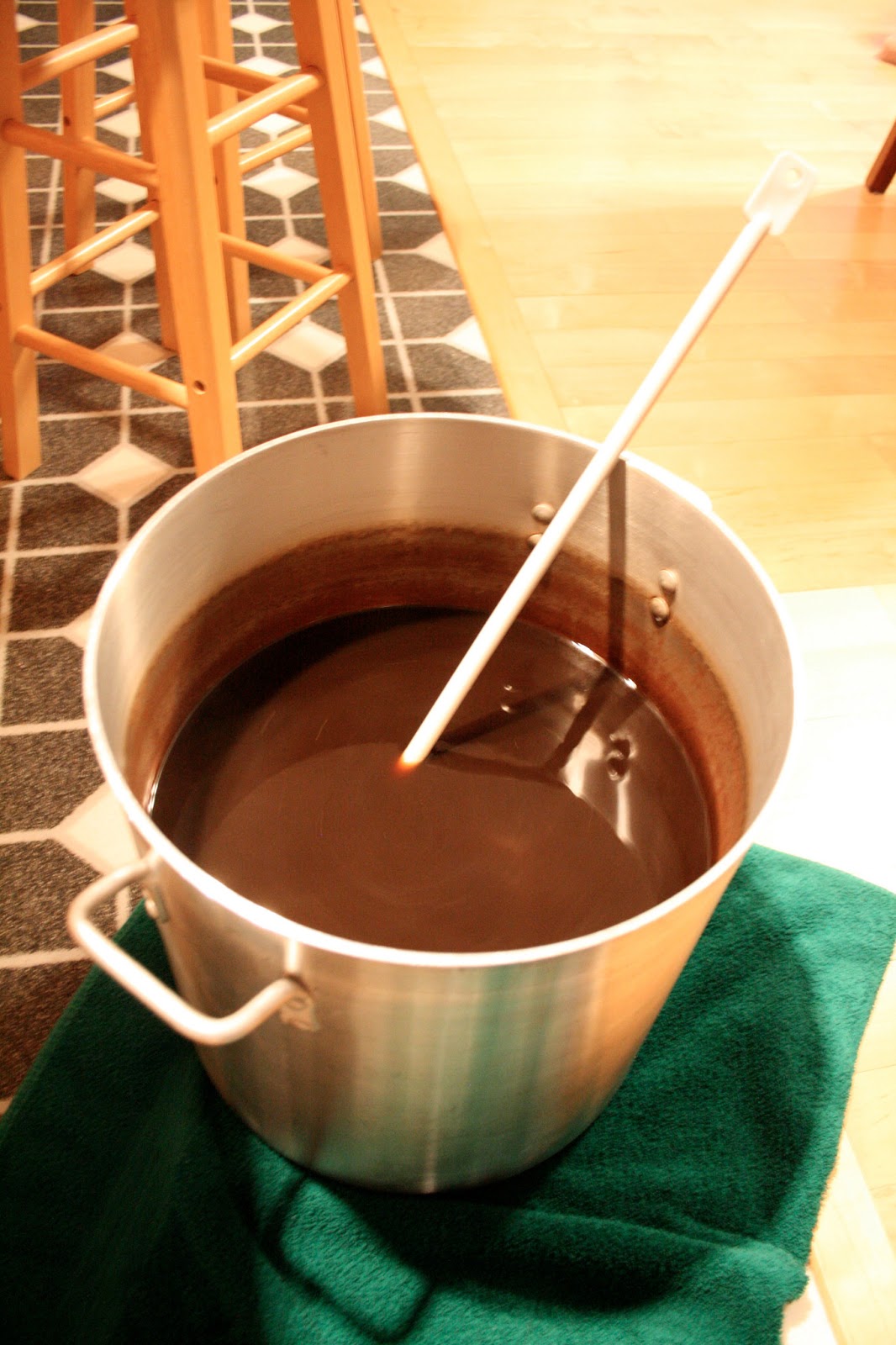
Note: While I've been getting slacker about taking pictures of my brew day, please excuse the more severe lack this time... my camera messed up early, so I only got in one!

Recipe targets: (5.5 gallons, 70% efficiency) OG 1.048, FG ~1.012, IBU 15, SRM 3.5, ABV ~4.7%

Grains:
2.18 kg (46.2%) Pilsner malt
2 kg (42.3%) Flaked wheat
341 g (7.2%) Flaked oats
204 g (4.3%) Acid malt
227 g Rice hulls to help prevent a stuck sparge

Hops:
Belma- 7 g (9.8% AA) @ 60 min
Belma - 14 g @ 10 min
Belma - 14 g @ flameout

Misc.:
Sweet Orange Peel - 30 g @ 2 min
Coriander seed, ground - 14 g @ 2 min

Yeast: Wyeast 3463 Forbidden Fruit (PD Apr 20/13, with a 1.7 L starter)

Water: Fredericton city water, carbon-filtered; 2 g Gypsum and 2 g calcium chloride, in the mash

- Brewed on June 2nd, 2013, by myself. 50-minute mash with 16.35 L of strike water, mashed in at target temp of 154 F. Mashed-out for 10 minutes with 6.5 L of boiling water, resulting temp 168 F. Sparged with ~4 gallons of 168 F water for final volume of ~7.4 gallons in the kettle.

- SG at target of 1.035. 90-minute boil. Chilled to 65 F in about 30 minutes with immersion chiller. Poured ~5 gallons into Better Bottle. OG low at 1.045, for some reason. Aerated wort with 60 seconds of pure O2. Pitched yeast and set BB in laundry room sink with cold water and a bit of ice.

2/6/13 - Already some activity in the airlock by the evening, temp at 66 F.

3/6/13 - Vigorous airlock activity in the morning, bubbling about twice per second, temp holding at 66 F. By evening, temp had risen slightly to 68 F, but activity already slowing to every 2 seconds or so.

4/6/13 - Airlock activity seems to be about complete already. Temp 68 F. Moved out of laundry sink.

23/6/13 - Just took a gravity reading... this bastard is stuck at 1.019! Let this be a lesson never to wait too long to check on your beer's progress. I roused the yeast a bit, but I think I'm way too late to save this one.

3/7/13 - FG 1.019, couldn't get it to drop. Temp 70 F. Bottled with 120 g of table sugar, aiming for 2.5 vol CO2 (would normally go to at least 3 vol, but want to minimize bottle bomb risk) with max temp of 70 F reached.

25/9/13 - Finally posted the tasting notes from July. A tasty, refreshing beer, but the Belma hops didn't add as much character as I'd like, and the beer is definitely overcarbed from the high FG.

Friday, 24 May 2013

Beginner Tips : Wort Aeration

Oxygen is the enemy. This is hammered into the brains of all homebrewers. We're told of the importance of not splashing beer too much during the mash, not splashing the beer at all when racking from the primary fermentor, leaving as little headspace as possible in secondary fermentors, blanketing the beer with CO2 when kegging, etc. Oxygenating beer at these stages can lead to stale, "cardboard-like" flavors, and can decrease the beer's shelf life after packaging.

Of course, there is one time when you WANT to oxygenate your beer: when the wort has been cooled, right before you pitch your yeast. While fermentation is anaerobic (meaning oxygen is not required), yeast DO require oxygen for reproduction. So, you want to have some oxygen available in the just-cooled wort for the yeast to use for producing the cell walls for their offspring. The idea is that, at the very beginning of fermentation, the yeast use up the oxygen, reproduce to higher numbers, and then actively ferment the sugars in the wort into alcohol and CO2, making beer.

If we don't add enough oxygen into the wort before fermentation begins, there are a lot of problems that can result. Common ones (and I've had my share of these) include:
  • Under-attenuation and stuck fermentations
  • Slower fermentation starts, and therefore a higher likelihood of infection
  • Longer fermentation times
  • Yeast stress and off-flavors
  • Lower viability for re-used yeast generations

In the excellent book, "Yeast: The Practical Guide to Beer Fermentation", by Chris White (of White Labs) and Jamil Zainasheff, the authors conclude (from various studies) that 8-10 ppm is the ideal oxygen concentration to have in wort for optimal yeast growth. As homebrewers, there are basically three methods available to use to aerate our wort:

1) Shaking the fermentor - Every homebrewer has used this method at some point. And a lot of veteran homebrewers STILL oxygenate their wort by shaking. In fact, up until my Maine Beer Company Zoe clone a few weeks ago, this is how I've aerated every single past batch. How long you shake, and how much headspace you have in the fermentor will determine how much oxygen you get into the wort. With lots of both, "Yeast" reports that a maximum of 8 ppm of oxygen can be achieved. However, keep in mind that with a 6-6.5 gallon fermentor, and ~5.5 gallons of wort, you don't really have a lot of headspace to work with when you're relying on shaking.

2) Aquarium pump with sintered stone - I haven't used this method, but know some people that do. From what I've heard, it can take quite a while to fully oxygenate wort this way (up to 30 minutes). As with shaking, greater than 8 ppm of oxygen cannot be achieved no matter how long you run the pump.

3) Pure oxygen - The preferred (and most expensive) route, and the only way to get up to (and beyond) 10 ppm of oxygen. This is the method I used for the Zoe clone, through the "Oxygen Aeration System" through Williams Brewing. This involves a stainless steel aeration stone and wand, tubing, and a regulator for a standard small oxygen tank (that you can purchase at most hardware stores). Simply sanitize the stone and wand, drop it in your fermentor, turn on the oxygen till you see bubbling for 30-60 seconds, and the yeast is ready to be pitched.

Of course, there's few homebrewers out there who will spend the large sum of money to buy equipment to measure just how MUCH oxygen they're getting into their wort. Regardless of which aeration method you use, you're guessing at what you're putting in. Even though the Williams system has the regulator to control the oxygen flow, you don't know for sure where to turn the regular knob so that you're getting, say, 1 L of oxygen per minute.

Do you have to worry about getting too MUCH oxygen in your wort? Definitely not if you're shaking or using an aquarium pump. If you're using pure oxygen, it's still probably not a worry. However, "Yeast" does say that really high amounts of pure oxygen can result in "high levels of fusel alcohols, increased acetaldehyde, and other flavor problems". This would be difficult to do accidentally on a homebrew level, however; you'd have to have the oxygen turned on for a significantly longer time to get really high levels that would be detrimental to your beer.

When about aerating really high-gravity beers? It's simply stated in "Yeast" that with beers with OGs higher than 1.092, aeration methods other than pure oxygen simply won't do. In fact, the authors suggest that for all beers with an OG above 1.083, aerate TWICE. That is, before pitching the yeast, and then another dose of oxygen 12 to 18 hours after pitching (this allows the yeast one cell division). This second dose was shown in a study to help speed up fermentation speed and attenuation.

Generally speaking, if you're brewing a low-to-mid-gravity beer, you're probably ok to aerate by shaking, if you put a lot of effort and a good amount of time into it. But when you're brewing bigger beers, or lagers, and you really want to ensure you're getting the right amount of oxygen -> healthier, happier yeast -> better beer, you're better off using pure oxygen. I finally made the move to pure oxygen because I've had many batches (especially "bigger" beers) where I've had trouble hitting my target FG, and now that I've consumed over 60 types of my homebrew, I'm picking up on off-flavors that could be attributed to under-aeration. I felt this was a small investment to make for healthier yeast and (hopefully) better beer.

Wednesday, 22 May 2013

Tasting : Hicken (Hill Farmstead James clone)

This has to be a record for me, posting tasting notes for a beer less than 2 weeks after it's been bottled! Of course, this should always be the case when I'm reviewing a beer that has a big hop-component, but a) I sometimes get a bit lazy, with other things going on, and b) I'm hesitant to rush into it, until I'm sure how I feel about a beer. But with this, a clone recipe of the Black IPA, James, from Hill Farmstead that I brewed last month, I wanted to get this down immediately. I opened the first bottle only 5 days after it had been bottled, and it blew me away.

This beer was all I hoped it would be, and more. As I mentioned in the recipe post, it's been over two years since I tried James in Vermont, so I wasn't really sure what to expect - whether I successfully cloned it or not. I'm assuming that I HAVEN'T (based on the huge success of Hill Farmstead's beers), unless I completely fluked out. Whatever, this beer is delicious! Definitely one of the best beers I've brewed, and one of the best Black IPAs I've had, commercial or homebrew. The hop aroma is HUGE, flavor is fantastic, and it's creamy while still finishing fairly dry. The roast/chocolate character is JUST there, but the hops clearly dominate - exactly what, I think, a good Black IPA should have.

Of course, the first time I brew a batch smaller than 5 gallons (with all the hop sludge and such, I bottled just about 3 gallons), it would result in a great beer. I will definitely brew it again. There's a slim chance I'll be in Vermont in the fall, so maybe I'll be extra lucky and get to try some HF James again. In the meantime, if you're looking for a great Black IPA recipe, I recommend giving this one a try. Thanks again to Mitch Steele for writing the IPA book that provided the bulk of this recipe!

Appearance: Poured with a moderate-large, light tan creamy head that shows excellent retention; eventually fades to 1/2-finger. Sticky lacing left on the sides of the glass. Body appears black at first glance, but when held to the light you can see it’s more of a very dark brown. Opaque.

Aroma: Strong aroma of citrusy, dank hops. There’s a bit of chocolate in the background, but the hops stick out the most, with a hint of pine in there as well. As it warms, the alcohol comes through slightly.

Taste: There’s just a small bit of roast/chocolate that hits at first, but like the aroma it gives way to a big hop flavor. While you can definitely get the citrus in there, I’d say the dank aspect comes out ahead. Finishes with a firm, moderate-high bitterness. Creamy and easy-drinking.

Mouthfeel: Medium-bodied, with moderate, maybe even moderate-low carbonation.

Overall: Very delicious. I think the first bottle I had three days ago actually tasted and smelled fresher, however. Too early to really tell that, though, as I’m not 100% sure the beer is done conditioning. I’m ok with the carbonation where it is, however, and I think I prefer it this way. The more I drink this, the more impressed I am with it... certainly can’t remember if it’s even close to James, but I’m really happy with it overall.

Tuesday, 14 May 2013

Tasting : Rising Tide Daymark clone vs. Daymark

It's been a long time since I've done a tasting of an attempted clone beer of mine and been able to actually compare it to the commercial beer. To make things even better, the "Born on" date of the Daymark bottle was March 6, 2013... and my clone was bottled March 13th, so they're pretty close in age. Obviously, doing a taste test of two American Pale Ales that are 2 months old isn't ideal, and I'm totally to blame for that. I've had the Daymark on hand for at least a month now; I just completely dragged my feet about opening both beers at the same time, taking notes, etc. Anyway, on to the comparison!

Appearance: Pretty darn close. Both beers are quite pale, maybe a light gold color, with moderate-large, white sticky heads with great retention. I'd say my clone is a touch lighter in color, with slightly better clarity.

Aroma: Both beers have a pleasant fruity, citrus aroma. My clone is stronger in the hop department, while the Daymark has more of a malty sweet background, and more rye presence as well. Don't get me wrong, the Daymark is still hoppy... I'd say it's better balanced. The clone beer's aroma also has a bit more "dank" character that I expect from Columbus hops now.

Taste: In general, like the aroma, the clone is hoppier... the citrus slaps you in the face a bit more, even at two months old. The Daymark is maltier, and the rye definitely sticks out more. I'd say the Daymark also has a SLIGHTLY higher bitterness in the finish.

Mouthfeel: Very similar... my beer has just a touch more carbonation.

Overall: I'm going to go with 85-90% cloned here. If I brewed it again, I would back off on the dry hop some... maybe cut it down to 1 oz each of Centennial and CTZ. I'd also increase the rye malt to 15%; since Nathan said they use various local sources of rye malt, it could also simply be a manner of taste differences between their rye malt and mine. Not sure. A tasty beer, but not quite up to the caliber of the real thing!

Friday, 10 May 2013

Brewing a Maine Beer Company Zoe clone (No. 3 in the Maine Beer Clone series)

 
When deciding on the third clone for this, my "Maine Beer Clone series" (previous entries were Oxbow's Freestyle #5 and Rising Tide's Daymark), I continued to have a lot of options. Sorry to beat a dead horse by saying that Maine has a lot of awesome breweries, but it's the truth. Despite all this, however, picking what was next was actually very easy... in fact, I would have done this beer even earlier, but I wanted to wait until I thought I had enough info to take a real shot at it. The brewery is Maine Beer Company, and the beer is Zoe, an American Amber Ale in the U.S. West Coast sense - bigger and hoppier than your "typical" Amber.

When I took my first beer-trip to Portland, ME in June of 2009, Maine Beer Company had basically just started as a professional brewery. Started by brothers Daniel and David Kleban, they only had one beer at the time, an American Pale Ale called Spring Peeper. This was actually the first Maine beer I had on this trip, and I was blown away by it. It was, and still is, one of the best APAs I've ever had... super-hoppy in a very citrusy way, bitter but not overly-so, with a supporting malt background. This beer is still available; the name has just been shortened to "Peeper". Since then, every beer that they have released has been awesome, in my opinion... and a lot of other beer drinkers would agree with me. MBC has grown quite a bit since 2009, and they just moved to larger headquarters in Freeport.

The second beer that MBC released was their self-described, "Happy, Hoppy Amber", named Zoe after the daughter of one of the Klebans. At 7.2%, the beer pours a dark red color, has a really nice caramel malt background (with a touch of chocolate), and a pretty large hop presence, citrusy and piney. A delicious beer. I've had a lot of the "bigger" Ambers over the past few years, and Zoe is still probably my favorite of them all. Like I said, I love all of the MBC beers I've tried, and would be happy trying to clone any of them... but I haven't brewed an Amber in a while, and Zoe is the perfect one to try.

I had actually emailed MBC a couple of years ago about help with a Zoe clone, but the only reply I received directed me to the info on their website. The site DOES actually say what the starting gravity is, and what malts and hops they use... enough to start with, but I wanted a bit more, if possible. About 6 months ago, however, I stumbled upon a clone recipe for Peeper on one of the homebrew forums online. Obtained from Dan Kleban, it was very detailed. It was noted that the recipe was given to the homebrewer back when MBC was just getting started, and that it was more difficult to get this much info out of the brewers now. So, I sent a direct message to the person who had posted it, and he sent along the email address that Dan had replied from.

Knowing that emailing a brewer and just saying, "Give me the recipe for your beer, please" is not the way to go about it, I emailed Dan and told him what I was thinking for the recipe. Here's what I originally came up with:

"~42% each 2-row and Marris Otter, 5% each Victory and Munich, 2.5% each Crystal 40 and 80, and maybe 1-2% Chocolate malt. Mash 152 F. Columbus for bittering, Centennial and Simcoe @10 min, lots in the whirlpool, and a good dry-hop of each as well. Maybe 65 IBUs? Ferment with a neutral American Ale yeast at about 68 F."

Now, as I mentioned, I had the list of ingredients from the MBC website. I based the amounts on the Peeper description and the corresponding clone recipe online... basically, they seem to list their grains in decreasing amounts. I knew that Zoe has a touch of chocolate flavor, but nothing severe, so I figured the Chocolate malt was more just to darken the color of the beer a bit. I guessed on the hop combinations and "amounts", but knew (again, from the Peeper recipe) that Dan does large flameout additions; Zoe may not be as hoppy as Peeper, but it can be pretty darn close. Also, Zoe is bitter but not super-bitter, so I thought ~65 IBUs was a fair guess.

I waited for awhile and never heard back. I sent the email a second time, about a month later, just in case, but still never got a reply. Then, about a month ago, I sent a message to MBC through their Facebook site, and they gave me Dan's email... which was different from the one I had been using! Whoopsie. I emailed the new address, and Dan replied almost right away:

"You are remarkably close. Mash a little cooler, 150. Simcoe bittering. Keep Columbus in the late hop additions and DH."

Ok, maybe not as much info as the Peeper recipe, but hey, I had something to work with now!

So, I basically had the grist decided, since Dan didn't suggest any changes there. When developing the hopping schedule, I kept it fairly simple. I went with a bittering charge at 60 minutes of Simcoe (despite my reservations, using a valuable hop like Simcoe for bittering!) to ~36 IBUs... the rest of the bitterness would be from late additions. Originally I had planned on one flavor addition, and a whirlpool addition for a hop steep, but I decided to go with 1/2 oz each of Simcoe, Centennial and Columbus at both 10 and 5 minutes. I really have no idea if MBC uses equal amounts of these hops for flavor and aroma, but I know that they DO use equal amounts of late-addition hops for Peeper, so I chose to follow this lead. Two large flameout additions of all three (one AT flameout for a 10-minute hop steep, the other when I turned on the chiller), and a decent-sized dry-hop to finish off.

Not much left to deal with, here. I DID make a couple of water adjustments. I have no idea what the Portland, ME water analysis looks like, and I didn't bother trying to figure it out, since I would have to find out exactly what MBC does to their water (if anything) when brewing. However, Mike Tonsmeire of The Mad Fermentationist provided a water profile he calls "San Diego - Hoppy" on his blog, from when he was helping Modern Times develop recipes for their year-round beers. A hoppy Amber was one of the beers that Mike helped develop, and I really liked the look of the water profile, so I adjusted my water to meet those targets (basically, increasing calcium, chloride, sodium, and sulfate to moderate levels).

In terms of yeast, "neutral American Ale yeast" means, for us homebrewers, anyway, either Wyeast 1056 American Ale, White Labs WLP001, or US-05 for dry yeast. I suspect that MBC uses a strain with better attenuation than any of these yeast strains, mainly because of the numbers listed on their website. For example:

Peeper: OG 1.047, ABV 5.5%... so, the FG would have to be ~1.005, which is 90% apparent attenuation
Zoe: OG 1.064, ABV 7.2%... FG must be ~1.009; 86% average attenuation

Their other hoppy beers follow along these lines. However, Wyeast 1056 lists an attenuation as between 73 and 77%, which is a lot lower than upper 80s. I personally would have preferred to use 1056 here, but the pack my LHBS had was over two months old and would have required a two-step starter to get the yeast numbers I needed, so I ended up using about 1.5 packs of US-05, rehydrated. I've never had attenuation with US-05 approach 86%, so I really doubt I'll get this beer down to 1.009. We'll see.

This brew marked the first time in a while that I have purchased new equipment. I finally broke down and made a move into wort aeration that doesn't simply involve shaking the carboy. Williams Brewing, an online home oxygen aeration system for sale that's pretty cool - it's simply a stainless steel aeration stone, some tubing, and an oxygen regulator that you hook up to one of those small oxygen tanks that you can buy at hardware stores. However, it's a sure-fire way to get the required amount of oxygen into your wort... shaking can only add so much, and this becomes more of an issue with higher-gravity beers. I plan on posting about wort aeration in the near future, so more on that later.

With a trip to Portland planned (hopefully) for next month, it should be pretty easy for me to find another bottle of Zoe to take back to compare to my beer; this is great, considering the beers I've been trying to clone lately that aren't available nearby at all. I really like this style of beer, so I'm hoping to make tweaks to the recipe over time until it's close to the real thing.

Thanks to Dan Kleban for his help with formulating the recipe!

Recipe targets: (6 gallons, 72% efficiency) OG 1.064, FG ~1.009, IBU 66, SRM 15, ABV ~7.2%

Grains:
2.77 kg (41.75%) Canadian 2-row
2.77 kg (41.75%) Maris Otter
372 g (5%) Munich
372 g (5%) Victory
168 g (2.5%) Crystal 40 L
168 g (2.5%) Crystal 80 L
100 g (1.5%) Chocolate malt

Hops:
Simcoe - 28 g (12.9% AA) @ 60 min
Simcoe - 14 g @ 10 min
Centennial - 14 g (9.9% AA) @ 10 min
Columbus -14 g (14.5% AA) @ 10 min
Simcoe, Centennial, Columbus - 14 g each @ 5 min
Simcoe, Centennial, Columbus - 21 g each @ flameout, 10-minute whirlpool
Simcoe, Centennial, Columbus - 21 g each when started chiller
Simcoe, Centennial, Columbus - 28 g each dry-hop for 7 days

Misc.: 1/2 tab Irish moss @ 5 min

Yeast: US-05, 1&1/2 packages, re-hydrated

Water: Fredericton city water, carbon-filtered; 3 g Epsom Salt, 4 g table salt, 6 g Gypsum divided between the mash and sparge water

- Brewed on May 5th, 2013, by myself. 60-minute mash with 20.5 L of strike water, mashed in a bit high at  151 F. Sparged with ~4.75 gallons of 168 F water for final volume of ~7.25 gallons in the kettle.

- SG a touch low at 1.051 (target 1.052). 60-minute boil. Chilled to 65 F in about 20 minutes with immersion chiller. Poured ~5 gallons into Better Bottle. OG 1.063. Aerated wort with 60 seconds of pure O2. Pitched yeast and set BB in laundry room sink, ambient temp about 68 F.

6/5/13 - In AM, airlock bubbling q 2 seconds or so, temp 64 F. By PM, temp had increased to 68 F, and airlock was bubbling every second.

7/5/13 - In AM, activity has increased, airlock bubbling probably twice per second; temp had increased to 72 F. By PM, starting to slow down at every second, temp still at 72 F.

8/5/13 - Steadily slowing throughout the day, bubbling every 5 seconds by the evening, temp dropped a bit to 70 F.

23/5/13 - Added dry hops into primary.

30/5/13 - FG 1.013. Bottled with 120 g table sugar, aiming for 2.5 vol CO2 with a max temp of 72 F reached.

25/6/13 - Tasting notes from a week ago, compared to the real Zoe... came out really great, very similar to Zoe.

Sunday, 28 April 2013

Brewing a Hill Farmstead James clone

What can I say about Shaun Hill and Hill Farmstead Brewery that hasn't already been said? I could talk about Hill's experience at The Shed Brewery in Stowe, Vermont before he decided to open his own brewery on his family's farm in Greensboro, VT. Maybe get into explaining how, since then, he's brewed some of the most delicious, highly-rated beers on a small scale, causing people from all over the United States (and a lot farther) to travel to Greensboro to get a taste of them. Ranging from extremely hoppy APAs and IPAs to exotic Belgian-influenced ales, it seems that a sub-par beer from Hill Farmstead doesn't even exist. I could go on to say that Hill Farmstead has recently been selected as the #1 brewery IN THE WORLD on Ratebeer.com, despite the fact that brewery production (after expansion) will be maxed out at 3000 bbl/year (compared to almost 1,000,000 barrels from Sierra Nevada, one of the largest craft breweries) and that the beers are rarely found outside of Vermont.

Whoops. See how easy it is to ramble when discussing great beer? Anyway, there are a lot of brewers who are driving themselves crazy trying to figure it out: what is Shaun's secret? There's a lot of speculation... is it the well-water on the farm? Something specific with technique, especially minimized oxygen pick-up during beer transfer to really let the hops shine? Does he worship/provide sacrifices to some sort of beer god, and if so, where can we find said god?

Realistically, it's probably a combination of factors (except maybe that last one). However you cut it, he knows what he's doing, he's not known to give out TOO much information regarding his practices/recipes when asked, and no, he's not planning on becoming the next Sierra Nevada or Dogfish Head, production-wise, damnit! The man wants to continue to make great beer while enjoying his family's heritage on land that has passed through generations. Can you blame him?

Despite living in Fredericton, NB, I've been lucky enough to have several Hill Farmstead beers, fresh on tap, from a "ski" trip (ok, a 3-day beer trip with one day of skiing) I took to Vermont a little over two years ago. Spending three days in Montpelier, I was introduced to Hill Farmstead beer at The Three Penny Taproom (still hands-down probably my favorite beer bar in the U.S.) with Edward, a fantastic American Pale Ale. A lot of HF's beers are named after past Hill family members; the next "Ancestral series" beer I had on that trip was James, a Black IPA named after Hill's uncle. Dark, creamy, slightly roasty (but not burnt) and extremely hoppy, this beer was the best Black IPA I had ever had... and may still be to this day, if it was a little more familiar in my mind.

Enough rambling. When I read Mitch Steele's IPA book a few months ago, I was happy to see that one of the recipes included was for a clone of James. Now, I'm not 100% sure where Steele got these recipes from, but I get the impression that at least SOME of the information, if not most/all of it, is straight from the brewers themselves. So, I'm going to assume that Shaun Hill had input into this recipe. Now that I'm finally getting around to brewing it, there were several changes I made, based on ingredients I lacked, or on discrepancies I found in the recipe:

1) The OG - the recipe in Steele's book calls for a target OG of 1.072, and a FG of 1.020, which would give an alcohol level of ~6.8%. On the Hill Farmstead website, however, the gravity is specifically listed as 16 P, or 1.065, and the ABV as 6.6%. Therefore, I decided to aim for an OG of 1.065 and FG of 1.015.

2) The hops - after a small Columbus addition as a FWH, the first bittering charge is listed as Simcoe at 60 minutes. I had two issues with this... the first being that a 60-minute addition really shouldn't add too much to the beer in terms of flavor, and Simcoe is just so hard to find! Being Hill Farmstead, I would be happy to follow their lead; secondly, however, the Hill Farmstead website lists the hops for James as being only Columbus and Centennial. After much deliberation, I decided to sub the 60-minute addition with Columbus, aiming for the same bitterness as the Simcoe would have provided.

3) CO2 extract - I didn't have any, or even ordering access to it anytime soon, so I omitted it. The 60, 45 and 10-minute additions in the book call for the hop used and then "plus CO2 extract". This extract provides bitterness without adding to the hop sludge in the kettle. Sounds great, but not having any, I had no choice but to go with just hop pellets, again adding enough to hit the target IBUs for the beer.

4) The Crystal malts - The book calls for 4% CaraHell (I subbed with Carapils, as close to the 10 L of Carahell as I could get) and 1.5% CaraAroma (subbed with Crystal 150 L). Probably pretty good replacements on my part, or at least, again, as close as I could get.

5) The dark ingredients - 5% Carafa Special III is required... I had almost enough Carafa Special II, and a bit more Carafa Special I (both are just a bit less dark than the III). The recipe also included a small amount (1.1%) of Sinamar extract (adds dark color without burnt flavors), which I can't get, so I simply increased the amount of Carafa Special to compensate.

More changes then I like to make with a clone recipe, but hopefully the resulting beer will be minimally affected. What I DO find odd is that with my recipe, the calculated color of the beer is about 27 SRM. In the book, James is listed as 87 SRM... that's a huge difference! I understand the Carafa Special III is darker, and the Sinamar extract may add to that, but with a combined grist amount of only 6%, I wouldn't think a difference of 60 points would be the result! I didn't change anything as a result, but 27 SRM is really more of a dark brown than black.

Unlike many recipes in Steele's book, there is no mention of water treatment, which is really unfortunate since Hill Farmstead's possible water composition is discussed online more than anything else regarding their beers. Mike Tonsmeire (of The Mad Fermentationist) has said that Shaun Hill suggested that chloride is an important addition for his hoppy beers, in addition to sulfate. Knowing very little, I didn't want to just start throwing in salt additions for the sake of it, so I just went with a small amount of both calcium chloride and calcium sulfate, to bump up the calcium, chloride, and sulfate slightly (since levels are low in my brewing water anyway).

Now, what about the yeast? The book says to use an English Ale yeast... of course, there's quite a few of those available. The hoppy beers I've had from Hill Farmstead don't appear to exhibit a lot of the typical yeast character you expect to see from certain English yeasts, such as the Fuller's strain from Wyeast (1968), so I chose the Wyeast 1098 British Ale strain. I've always liked this strain when used in American-style beers - the attenuation is quite good, and, like the website says, it allows the malt and hop character to dominate.

For the first time in 60 batches of homebrew, I plan to make less than a 5.5 gallon batch. Part of me really hates to do this... you're basically doing almost the same amount of work for a smaller batch, but you end up with less beer. However, I have quite a lot on hand now (yeah, poor me), and I plan on brewing a lot of hoppy beers over the next few months. Since these beers are really all best fresh, I don't want to end up with a stockpile of hoppy beers that are 3, 6, 9 months old. So, I've scaled down this recipe to a 4 gallon batch.

For more info regarding Shaun Hill and his brewery, check out this interview from Embrace the Funk.

Recipe targets: (4 gallons, 75% efficiency) OG 1.065, FG 1.015, IBU 120, SRM 27, ABV 6.5%

Grains:
3.76 kg (86.5%) Canadian 2-row
239 g (5.4%) Carafa Special II  
177 g (4%) Carapils
86 g (2%) Flaked Oats
68 g (1.5%) Crystal 150 L
29 g (0.6%) Carafa Special I

Hops:
Columbus - 7 g (14.5% AA) FWH
Columbus - 27 g @ 60 min
Centennial - 24 g (9.9% AA) @ 45 min
Centennial - 24 g @ 10 min
Columbus - 57 g @ 0 min
Centennial - 31 g @ 0 min
Columbus & Centennial - 28 g each dry-hop for 7 days

Misc.: 1/2 tab Irish moss @ 5 min

Yeast: Wyeast 1098 British Ale (production date March 13/13; with a 1.75 L starter)

Water: Fredericton city water, carbon-filtered; 3 g Gypsum and 3 g calcium chloride added to the mash

- Brewed over two days on April 18th and 19th, 2013, by myself. 50-minute mash with 13 L of strike water, mashed in at target of 152 F. Mashed out for 10 minutes with 6.5 L of boiling water, resulting temp 168 F. Sparged with ~2.5 gallons of 168 F water for final volume of ~5.25 gallons in the kettle (a bit higher than target of 4.9 gallons).

- SG low at 1.048 (target 1.053). 60-minute boil. Chilled to 62 F in about 20 minutes with immersion chiller. Poured/filtered into Better Bottle. OG low at 1.062. Pitched yeast starter, aerated by shaking well for several minutes before and after pitching. Set in laundry room sink, ambient temp about 65 F.

20/4/13 - In AM, temp low at 64 F, but airlock is already bubbling q 1-2 seconds, big krausen. By the afternoon, the temp had crept up to 68 F and airlock activity was very vigorous.

22/4/13 - I returned from being away two days, and the krausen had already settled completely, and no activity was visible in the airlock. Gravity at 1.019. Hopefully it'll drop another few points in the coming weeks.

5/5/13 - Dry-hopped in primary (no secondary fermenters available at the time).

12/5/13 - FG 1.016. Bottled with 67 g table sugar, aiming for 2.2 vol CO2 for 3.5 gallons, with a max temp of 68 F reached.

22/5/13 - Wow, came out really great. The hops are citrusy and dank, with a bit of roasted character coming through - just enough. Tasting notes here.

Thursday, 18 April 2013

Black IPA: Some info and brewing tips

In anticipation of my upcoming brew day where I'll be tackling a clone of Hill Farmstead James, a Black IPA, I thought I'd write a short post on brewing this style. I've done some reading on the subject, and I've had quite a few different commercial Black IPAs, but I've never actually BREWED one myself. So, I'm certainly not an expert or anything close to it on the subject; I more wanted to jot down some important notes on what one should consider when brewing a Black IPA, mostly for my own good. If anyone has anything to add, from personal experience, their own readings, etc., by all means let me know!

This style has to be one of the most oxymoronic (a black pale ale?), most-argued-about, fastest-growing beer styles out there right now. Aside from the fact that it can be referred to by at least four different names (usually Black IPA or Cascadian Dark Ale, but sometimes also as India Black Ale or American Strong Black Ale), throw in that the REGION of the United States that it is brewed in will often dictate what it is called: Black IPA in the east, and Cascadian Dark Ale in the Pacific Northwest. It's certainly not as simplified as that, but basically there are arguments over who started the style (generally agreed to be the late Greg Noonan, of the Vermont Pub and Brewery), how it should look, taste, and smell, and the best way to brew it.

Mitch Steele of Stone Brewing Co. addresses these issues quite well in his book, IPA: Brewing Techniques, Recipes and the Evolution of India Pale Ale. He writes that he can see Black IPA and Cascadian Dark Ale (CDA) eventually evolving into two different styles. In the book, Jeff Bagby of Pizza Port in California makes some helpful distinctions between the two:

Cascadian Dark Ale - more dark brown than black, possessing some dark malt flavors; while a hoppy character is certainly present, it lacks the huge hop aroma and high bitterness seen in Double IPAs, and the alcohol strength is usually limited to 5.5-7% ABV.

Black IPA - often stronger, more bitter, and with very high hop aromas and flavors; while very dark in color, the dark malt character is virtually absent; basically, it lives up to its name - an American IPA that is black.

Keep in mind these comparisons are by no means "official"; at least, not yet. In fact, Black IPA/CDA still isn't officially a beer style category in the BJCP. It IS listed in the Great American Beer Festival guidelines, however, under the name American-Style Black Ale (yep, another name).

So, what characteristics do you aim for when brewing this style of beer? Despite the various arguments, you'd be pretty safe going for the following:

- Dark-brown to black in color.
- Moderate to very strong hop aroma.
- Minimal roast flavors and aromas... you're not trying to make a hoppy porter or stout, here. No burnt flavors or high astringency.
- Strong hop flavors (similar to those in the aroma) and high to very-high hop bitterness.
- A fairly dry finish; not quite as dry as the best American IPAs and DIPAs, but well-attenuated enough that the beer isn't syrupy or overly-sweet.
- Medium to medium-high alcohol level, ~6-8% ABV.

I think one of the most important points to hit is the minimal roast flavors/aromas... you really have to limit the amount of chocolate malt, roasted barley, etc. that you put in this beer (if you add any at all). I've had some commercial and homebrewed Black IPAs that really just tasted like a very hoppy stout. The best Black IPAs have a bit of roasted character to them, but it's nothing too strong; similar to a Schwarzbier, for example. Many sources also claim that a lot of roast character simply clashes with the hop flavors from American varieties.

If you're looking to brew a Black IPA, here are some brewing tips that I've accumulated from a few sources:

- Target an OG in the American IPA range, ~1.056-1.075.
- Limit your use of Crystal malts to <10%, and darker malts even less than that (~<5%).
- Substitute all or the majority of dark malts with a dehusked variety, such as Carafa Special or Midnight Wheat, or a black malt extract (e.g. Sinamar). These will give you the dark color you need, without the accompanying burnt flavors and astringency. Cold-steeping your dark grains is also an option to cut down on those characteristics.
- Aim for a fairly low FG, ranging from 1.010-1.016. Use a lower mash temp to get there (148-152 F), and use a small amount of adjuncts if you need to get a bit lower.
- Hop aggressively. Steele recommends hopping the beer like you would a DIPA, regardless of the alcohol strength and OG.
- Use American-variety hops that showcase citrusy, piney, and dank flavors/aromas, such as Columbus, Cascade, Centennial, Chinook, Amarillo, Simcoe, and Citra.
- For dry-hopping, Steele lists a range of 2.5-5 oz per 5 gallon batch... pretty high, and definitely within DIPA territory.

While a lot of what I've summarized above is still confusing since many brewers have their own take on this "style", it's interesting to see where everyone is taking it in its still-early stages. Maybe someday soon Black IPA/CDA will settle down into real, defined BJCP guidelines, but for now it's definitely still open to interpretation! I've already read of a few people brewing a "Belgian Black IPA"; I have no doubt "English Black IPA" has already been attempted by others (if not, I just claimed the name!).

Over the next couple of days, I'll be brewing the Hill Farmstead James recipe (more or less) from Steele's book. Shaun Hill was definitely one of the brewers who helped make the style popular early on, if not on quite as grand a scale as Stone's Sublimely Self-Righteous. I'll be posting the brewing notes for this recipe very soon.