Sunday, 28 April 2013

Brewing a Hill Farmstead James clone

What can I say about Shaun Hill and Hill Farmstead Brewery that hasn't already been said? I could talk about Hill's experience at The Shed Brewery in Stowe, Vermont before he decided to open his own brewery on his family's farm in Greensboro, VT. Maybe get into explaining how, since then, he's brewed some of the most delicious, highly-rated beers on a small scale, causing people from all over the United States (and a lot farther) to travel to Greensboro to get a taste of them. Ranging from extremely hoppy APAs and IPAs to exotic Belgian-influenced ales, it seems that a sub-par beer from Hill Farmstead doesn't even exist. I could go on to say that Hill Farmstead has recently been selected as the #1 brewery IN THE WORLD on Ratebeer.com, despite the fact that brewery production (after expansion) will be maxed out at 3000 bbl/year (compared to almost 1,000,000 barrels from Sierra Nevada, one of the largest craft breweries) and that the beers are rarely found outside of Vermont.

Whoops. See how easy it is to ramble when discussing great beer? Anyway, there are a lot of brewers who are driving themselves crazy trying to figure it out: what is Shaun's secret? There's a lot of speculation... is it the well-water on the farm? Something specific with technique, especially minimized oxygen pick-up during beer transfer to really let the hops shine? Does he worship/provide sacrifices to some sort of beer god, and if so, where can we find said god?

Realistically, it's probably a combination of factors (except maybe that last one). However you cut it, he knows what he's doing, he's not known to give out TOO much information regarding his practices/recipes when asked, and no, he's not planning on becoming the next Sierra Nevada or Dogfish Head, production-wise, damnit! The man wants to continue to make great beer while enjoying his family's heritage on land that has passed through generations. Can you blame him?

Despite living in Fredericton, NB, I've been lucky enough to have several Hill Farmstead beers, fresh on tap, from a "ski" trip (ok, a 3-day beer trip with one day of skiing) I took to Vermont a little over two years ago. Spending three days in Montpelier, I was introduced to Hill Farmstead beer at The Three Penny Taproom (still hands-down probably my favorite beer bar in the U.S.) with Edward, a fantastic American Pale Ale. A lot of HF's beers are named after past Hill family members; the next "Ancestral series" beer I had on that trip was James, a Black IPA named after Hill's uncle. Dark, creamy, slightly roasty (but not burnt) and extremely hoppy, this beer was the best Black IPA I had ever had... and may still be to this day, if it was a little more familiar in my mind.

Enough rambling. When I read Mitch Steele's IPA book a few months ago, I was happy to see that one of the recipes included was for a clone of James. Now, I'm not 100% sure where Steele got these recipes from, but I get the impression that at least SOME of the information, if not most/all of it, is straight from the brewers themselves. So, I'm going to assume that Shaun Hill had input into this recipe. Now that I'm finally getting around to brewing it, there were several changes I made, based on ingredients I lacked, or on discrepancies I found in the recipe:

1) The OG - the recipe in Steele's book calls for a target OG of 1.072, and a FG of 1.020, which would give an alcohol level of ~6.8%. On the Hill Farmstead website, however, the gravity is specifically listed as 16 P, or 1.065, and the ABV as 6.6%. Therefore, I decided to aim for an OG of 1.065 and FG of 1.015.

2) The hops - after a small Columbus addition as a FWH, the first bittering charge is listed as Simcoe at 60 minutes. I had two issues with this... the first being that a 60-minute addition really shouldn't add too much to the beer in terms of flavor, and Simcoe is just so hard to find! Being Hill Farmstead, I would be happy to follow their lead; secondly, however, the Hill Farmstead website lists the hops for James as being only Columbus and Centennial. After much deliberation, I decided to sub the 60-minute addition with Columbus, aiming for the same bitterness as the Simcoe would have provided.

3) CO2 extract - I didn't have any, or even ordering access to it anytime soon, so I omitted it. The 60, 45 and 10-minute additions in the book call for the hop used and then "plus CO2 extract". This extract provides bitterness without adding to the hop sludge in the kettle. Sounds great, but not having any, I had no choice but to go with just hop pellets, again adding enough to hit the target IBUs for the beer.

4) The Crystal malts - The book calls for 4% CaraHell (I subbed with Carapils, as close to the 10 L of Carahell as I could get) and 1.5% CaraAroma (subbed with Crystal 150 L). Probably pretty good replacements on my part, or at least, again, as close as I could get.

5) The dark ingredients - 5% Carafa Special III is required... I had almost enough Carafa Special II, and a bit more Carafa Special I (both are just a bit less dark than the III). The recipe also included a small amount (1.1%) of Sinamar extract (adds dark color without burnt flavors), which I can't get, so I simply increased the amount of Carafa Special to compensate.
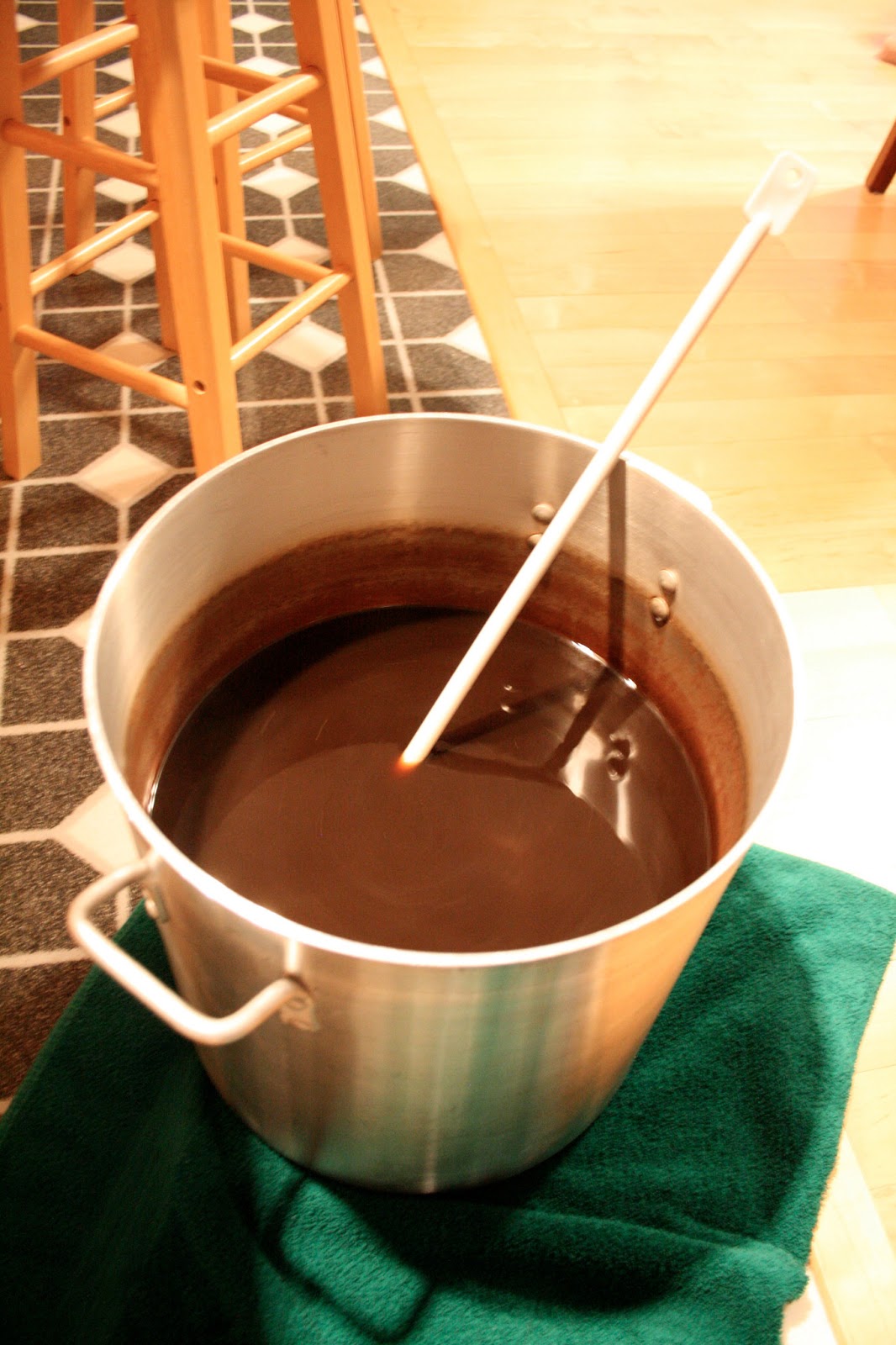
More changes then I like to make with a clone recipe, but hopefully the resulting beer will be minimally affected. What I DO find odd is that with my recipe, the calculated color of the beer is about 27 SRM. In the book, James is listed as 87 SRM... that's a huge difference! I understand the Carafa Special III is darker, and the Sinamar extract may add to that, but with a combined grist amount of only 6%, I wouldn't think a difference of 60 points would be the result! I didn't change anything as a result, but 27 SRM is really more of a dark brown than black.

Unlike many recipes in Steele's book, there is no mention of water treatment, which is really unfortunate since Hill Farmstead's possible water composition is discussed online more than anything else regarding their beers. Mike Tonsmeire (of The Mad Fermentationist) has said that Shaun Hill suggested that chloride is an important addition for his hoppy beers, in addition to sulfate. Knowing very little, I didn't want to just start throwing in salt additions for the sake of it, so I just went with a small amount of both calcium chloride and calcium sulfate, to bump up the calcium, chloride, and sulfate slightly (since levels are low in my brewing water anyway).

Now, what about the yeast? The book says to use an English Ale yeast... of course, there's quite a few of those available. The hoppy beers I've had from Hill Farmstead don't appear to exhibit a lot of the typical yeast character you expect to see from certain English yeasts, such as the Fuller's strain from Wyeast (1968), so I chose the Wyeast 1098 British Ale strain. I've always liked this strain when used in American-style beers - the attenuation is quite good, and, like the website says, it allows the malt and hop character to dominate.

For the first time in 60 batches of homebrew, I plan to make less than a 5.5 gallon batch. Part of me really hates to do this... you're basically doing almost the same amount of work for a smaller batch, but you end up with less beer. However, I have quite a lot on hand now (yeah, poor me), and I plan on brewing a lot of hoppy beers over the next few months. Since these beers are really all best fresh, I don't want to end up with a stockpile of hoppy beers that are 3, 6, 9 months old. So, I've scaled down this recipe to a 4 gallon batch.

For more info regarding Shaun Hill and his brewery, check out this interview from Embrace the Funk.

Recipe targets: (4 gallons, 75% efficiency) OG 1.065, FG 1.015, IBU 120, SRM 27, ABV 6.5%

Grains:
3.76 kg (86.5%) Canadian 2-row
239 g (5.4%) Carafa Special II  
177 g (4%) Carapils
86 g (2%) Flaked Oats
68 g (1.5%) Crystal 150 L
29 g (0.6%) Carafa Special I

Hops:
Columbus - 7 g (14.5% AA) FWH
Columbus - 27 g @ 60 min
Centennial - 24 g (9.9% AA) @ 45 min
Centennial - 24 g @ 10 min
Columbus - 57 g @ 0 min
Centennial - 31 g @ 0 min
Columbus & Centennial - 28 g each dry-hop for 7 days

Misc.: 1/2 tab Irish moss @ 5 min

Yeast: Wyeast 1098 British Ale (production date March 13/13; with a 1.75 L starter)

Water: Fredericton city water, carbon-filtered; 3 g Gypsum and 3 g calcium chloride added to the mash

- Brewed over two days on April 18th and 19th, 2013, by myself. 50-minute mash with 13 L of strike water, mashed in at target of 152 F. Mashed out for 10 minutes with 6.5 L of boiling water, resulting temp 168 F. Sparged with ~2.5 gallons of 168 F water for final volume of ~5.25 gallons in the kettle (a bit higher than target of 4.9 gallons).

- SG low at 1.048 (target 1.053). 60-minute boil. Chilled to 62 F in about 20 minutes with immersion chiller. Poured/filtered into Better Bottle. OG low at 1.062. Pitched yeast starter, aerated by shaking well for several minutes before and after pitching. Set in laundry room sink, ambient temp about 65 F.

20/4/13 - In AM, temp low at 64 F, but airlock is already bubbling q 1-2 seconds, big krausen. By the afternoon, the temp had crept up to 68 F and airlock activity was very vigorous.

22/4/13 - I returned from being away two days, and the krausen had already settled completely, and no activity was visible in the airlock. Gravity at 1.019. Hopefully it'll drop another few points in the coming weeks.

5/5/13 - Dry-hopped in primary (no secondary fermenters available at the time).

12/5/13 - FG 1.016. Bottled with 67 g table sugar, aiming for 2.2 vol CO2 for 3.5 gallons, with a max temp of 68 F reached.

22/5/13 - Wow, came out really great. The hops are citrusy and dank, with a bit of roasted character coming through - just enough. Tasting notes here.


Thursday, 18 April 2013

Black IPA: Some info and brewing tips

In anticipation of my upcoming brew day where I'll be tackling a clone of Hill Farmstead James, a Black IPA, I thought I'd write a short post on brewing this style. I've done some reading on the subject, and I've had quite a few different commercial Black IPAs, but I've never actually BREWED one myself. So, I'm certainly not an expert or anything close to it on the subject; I more wanted to jot down some important notes on what one should consider when brewing a Black IPA, mostly for my own good. If anyone has anything to add, from personal experience, their own readings, etc., by all means let me know!

This style has to be one of the most oxymoronic (a black pale ale?), most-argued-about, fastest-growing beer styles out there right now. Aside from the fact that it can be referred to by at least four different names (usually Black IPA or Cascadian Dark Ale, but sometimes also as India Black Ale or American Strong Black Ale), throw in that the REGION of the United States that it is brewed in will often dictate what it is called: Black IPA in the east, and Cascadian Dark Ale in the Pacific Northwest. It's certainly not as simplified as that, but basically there are arguments over who started the style (generally agreed to be the late Greg Noonan, of the Vermont Pub and Brewery), how it should look, taste, and smell, and the best way to brew it.

Mitch Steele of Stone Brewing Co. addresses these issues quite well in his book, IPA: Brewing Techniques, Recipes and the Evolution of India Pale Ale. He writes that he can see Black IPA and Cascadian Dark Ale (CDA) eventually evolving into two different styles. In the book, Jeff Bagby of Pizza Port in California makes some helpful distinctions between the two:

Cascadian Dark Ale - more dark brown than black, possessing some dark malt flavors; while a hoppy character is certainly present, it lacks the huge hop aroma and high bitterness seen in Double IPAs, and the alcohol strength is usually limited to 5.5-7% ABV.

Black IPA - often stronger, more bitter, and with very high hop aromas and flavors; while very dark in color, the dark malt character is virtually absent; basically, it lives up to its name - an American IPA that is black.

Keep in mind these comparisons are by no means "official"; at least, not yet. In fact, Black IPA/CDA still isn't officially a beer style category in the BJCP. It IS listed in the Great American Beer Festival guidelines, however, under the name American-Style Black Ale (yep, another name).

So, what characteristics do you aim for when brewing this style of beer? Despite the various arguments, you'd be pretty safe going for the following:

- Dark-brown to black in color.
- Moderate to very strong hop aroma.
- Minimal roast flavors and aromas... you're not trying to make a hoppy porter or stout, here. No burnt flavors or high astringency.
- Strong hop flavors (similar to those in the aroma) and high to very-high hop bitterness.
- A fairly dry finish; not quite as dry as the best American IPAs and DIPAs, but well-attenuated enough that the beer isn't syrupy or overly-sweet.
- Medium to medium-high alcohol level, ~6-8% ABV.

I think one of the most important points to hit is the minimal roast flavors/aromas... you really have to limit the amount of chocolate malt, roasted barley, etc. that you put in this beer (if you add any at all). I've had some commercial and homebrewed Black IPAs that really just tasted like a very hoppy stout. The best Black IPAs have a bit of roasted character to them, but it's nothing too strong; similar to a Schwarzbier, for example. Many sources also claim that a lot of roast character simply clashes with the hop flavors from American varieties.

If you're looking to brew a Black IPA, here are some brewing tips that I've accumulated from a few sources:

- Target an OG in the American IPA range, ~1.056-1.075.
- Limit your use of Crystal malts to <10%, and darker malts even less than that (~<5%).
- Substitute all or the majority of dark malts with a dehusked variety, such as Carafa Special or Midnight Wheat, or a black malt extract (e.g. Sinamar). These will give you the dark color you need, without the accompanying burnt flavors and astringency. Cold-steeping your dark grains is also an option to cut down on those characteristics.
- Aim for a fairly low FG, ranging from 1.010-1.016. Use a lower mash temp to get there (148-152 F), and use a small amount of adjuncts if you need to get a bit lower.
- Hop aggressively. Steele recommends hopping the beer like you would a DIPA, regardless of the alcohol strength and OG.
- Use American-variety hops that showcase citrusy, piney, and dank flavors/aromas, such as Columbus, Cascade, Centennial, Chinook, Amarillo, Simcoe, and Citra.
- For dry-hopping, Steele lists a range of 2.5-5 oz per 5 gallon batch... pretty high, and definitely within DIPA territory.

While a lot of what I've summarized above is still confusing since many brewers have their own take on this "style", it's interesting to see where everyone is taking it in its still-early stages. Maybe someday soon Black IPA/CDA will settle down into real, defined BJCP guidelines, but for now it's definitely still open to interpretation! I've already read of a few people brewing a "Belgian Black IPA"; I have no doubt "English Black IPA" has already been attempted by others (if not, I just claimed the name!).

Over the next couple of days, I'll be brewing the Hill Farmstead James recipe (more or less) from Steele's book. Shaun Hill was definitely one of the brewers who helped make the style popular early on, if not on quite as grand a scale as Stone's Sublimely Self-Righteous. I'll be posting the brewing notes for this recipe very soon.

Monday, 15 April 2013

Tasting : Zombie Freestyle (Oxbow Freestyle #5 clone)

Bottle label
I've said it before, but it's really nice getting advice from a brewer on how to clone a beer of theirs that I've tried. The problem, of course, is when I finally get to try my clone, and I can't remember much in the way of specifics about the actual commercial beer. It's made even more difficult when said beer is pretty much a one-off, limited-release product.

And that's the problem I have with this beer, a "Black Wheat Saison" (brewing notes here). Chances of me ever getting to try a real Oxbow Freestyle #5 again are probably extremely low. The notes that Tim Adams (co-owner/brewmaster) gave me were very helpful, and I think I did the best I could in terms of substituting a couple of the ingredients. So, regardless of clone-closeness, how did the beer actually turn out?

Overall, I like it. It's different, that's for sure. In the end, I didn't quite hit the FG I was aiming for, but Wyeast 3724 is notoriously picky, and I chose to brew this beer during the coldest time of the year. Brilliant. I DID have a heating belt on the Better Bottle, raised the ambient temp, and even ran a damn space heater for days, for crying out loud (which I'm sure didn't help my power bill). Doing all this, I was able to keep the temp of the beer probably in the mid-80s, but I was away for a period of that and had to unplug everything, so the temp dropped to the low 70s, and then I turned all the heat back on, and it went up, etc. Not the most ideal conditions, but the yeast slowly did their work and I got to a reasonably low number. In fact, if you look at the apparent attenuation, with 77% I was within the range that Wyeast mentions is realistic for this yeast.

In the end, I'm happy with how this beer came out, regardless of whether I'm close to Freestyle #5 or not. A recipe I'd recommend to anyone looking for an easy-drinking, smooth, ~5% Saison... that's black. Thanks again to Tim Adams of Oxbow for all the help! Anyone visiting Maine, seek out Oxbow beers... you won't be sorry!

Appearance: Poured with a medium-sized, tan, creamy head. Retention isn’t as good as I’d expect for the style... fades to a thin film. Body is black and opaque.

Aroma: A mesh of wheat tartness and spicy... at first, I was unsure if it could be described as phenolic. Upon further sampling, I think it's due to the yeast, and the large hop addition at the end of the boil.

Taste: There definitely is a strong spicy character to this beer, that again strikes me as yeast-related. The finish is moderately bitter, maybe even medium-light, with some - again - spicy hop flavor. Slightly tart and crisp, likely from the high amount of wheat malt.

Mouthfeel: Medium-light bodied, with moderate carbonation.

Overall: If I couldn’t see it, I definitely wouldn’t guess it’s as dark as it is. The Aromatic malt, large hop flameout addition, and Dupont yeast are probably adding more to the aroma and flavor than anything else. Fairly enjoyable; smooth and easy-drinking.

Thursday, 11 April 2013

Brewing a Schwarzbier

After brewing a Vienna Lager a few weeks ago, and recently transferring it to secondary for lagering, I followed my usual practice of reusing the yeast to immediately brew another lager. My deep freezer easily has room for two carboys, so I like to have two lagers going at the same time while I can. The Wyeast 2352-PC Munich Lager II description has a lot of different lagers listed that would be ideal to brew; while many interested me, one in particular caught my eye: Schwarzbier.

Schwarzbier (also commonly known as a Black Lager) was the first style of lager I had ever brewed (over two years ago, recipe and tasting notes here), and was actually the beer that made me realize that all dark beers are not created equal. A dark beer (but actually not usually black), if well-made it should be slightly to moderately roasty in a bitter chocolate kind of way, but NOT burnt-tasting or smelling. A Munich-like malt character should be present, with medium bitterness in the finish. And, of course, it should have your classic clean lager character, i.e. no diacetyl or fruity esters present. At a moderate strength of about 5% ABV, Schwarzbiers are meant to be easy-drinking.

My first attempt at a Schwarzbier resulted in, after 60 batches as of this month, still one of my favorite homebrews of mine to date. The recipe was from Brewing Classic Styles - actually, there are two recipes for this style in that book; I went with the one that yields a slightly-more-roasty beer. The beer really did come out great, if a little undercarbonated due to an oversight on my part - roasty, but not burnt, with a great malt presence, quite creamy, and very clean. Here, I had used the Wyeast 2124 Bohemian Lager, which I've always been very happy with.

So, because I was so happy with the beer, there are very few changes, other than the yeast, that I made with the "new" recipe. In terms of the grist, I replaced the Carafa Special II with Midnight Wheat, mainly because I have such an abundance of MW. I can't imagine this change would be very detectable in the final product, since both are huskless dark grains, and the amount is a scant 100 grams. I also made a minor change in the hop additions: the original recipe called for three additions of Hallertau; unfortunately, I didn't have enough on hand for the whole recipe. Since the perceived hop character in a Schwarzbier is actually quite low anyway, I used an addition of WGV at 60 minutes. WGV is a UK hop available from Hops Direct; they describe it as an aroma hop with a "spicy, herbal and earthy aroma". I made up the other two additions with my remaining Hallertau, aiming for a slightly-higher IBU of around 30... the main change I wanted to make with my first Schwarzbier attempt was to increase the bitterness slightly, so hopefully this will help.

The final change I made was actually messing with the water chemistry a bit. After some searching online, I found a water profile by Randy Mosher for "Ideal Mild/Dark Lagers", which basically required that I increase my water's calcium, sulfate, sodium, and chloride. With some tweaking, I was able to actually get quite close to my targets by adding small amounts of gypsum and table salt directly into the mash. With Schwarzbier, you're not really looking for an excessive amount of anything in the water; everything should be relatively balanced.

I'm interested to see how this beer turns out, mainly because if I manage to keep the fermentation clean and steady, it should be fairly easy to detect changes in the beer from the different yeast. Because it's a medium-strength beer, I'll probably only lager it for a maximum of 2 months, so I should be drinking it by the end of June at the latest.

Recipe targets: (5.5 gallons, 80% efficiency) OG 1.051, FG 1.013, IBU 30, SRM 27, ABV 4.9%

Schwarzbier on the left, Vienna Lager on the right
Grains:
2.16kg (49.1%) Munich malt
1.7 kg (38.7%) Pilsner malt
168 g (3.8%) Caramunich II (45 L)
168 g (3.8%) Chocolate malt
100 g (2.3%) Midnight Wheat
100 g (2.3%) Roasted Barley

Hops:
WGV - 28 g (7.8% AA) @ 60 min
Hallertau - 21 g (2% AA) @ 20 min
Hallertau - 21 g @ 0 min

Misc.: 1/2 tab Irish moss @ 5 min

Yeast: Wyeast 2352-PC Munich Lager II  (~1 cup slurry, cultured two days earlier)

Water: Fredericton city water, carbon-filtered; 7 g Gypsum and 4 g table salt added to the mash

- Brewed April 4th, 2013, with Mom and Jill. 50-minute mash with 14.5 L of strike water, mashed in a bit low at 153 F (target 154 F). Mashed out for 10 minutes with 6 L of boiling water, resulting temp low at 163 F. Sparged with ~4.25 gallons of 168 F water for final volume of ~7.5 gallons in the kettle.

- SG 1.039 (target 1.038). 90-minute boil. Chilled to 48 F in about 45 minutes with immersion chiller. Poured into Better Bottle. OG a bit high at 1.053. Pitched yeast slurry, aerated by shaking well for several minutes before and after pitching. Set in fermentation chamber with temp set at 51 F.

6/4/13 - 8/4/13 - Small, thick krausen, with bubbling in the airlock about 4-5 times per 10 seconds.

9/4/13 - Bubbling down to q 5 seconds by AM, so took the Better Bottle out of the fermentation chamber to raise the temp for a diacetyl rest. By the evening, bubbling had increased to its previous rate, and temp was up to 60 F.

11/4/13 - Placed BB back in ferm chamber, will drop temp gradually back to 52 F or so over the next couple of days.

2/5/13 - Racked to secondary. Will lower the temperature of the fermentation chamber by 1 F every 12 hours or so until down to 38 F for lagering.

21/7/13 - FG only got down to 1.018. Bottled with 110 g table sugar (and ~1/4 pack dry Nottingham yeast, rehydrated), aiming for 2.5 vol CO2 for 5 gallons with max temp of 60 F reached.

28/11/13 - Tasting notes here... turned out about where I wanted it to be; dark, malty, a bit of chocolate. A little bit of roast character wouldn't hurt.

Tuesday, 12 March 2013

Brewing a Vienna Lager

I just brewed a Rising Tide Daymark clone (a "Rye Pale Ale"), and I have plans to tackle a Hill Farmstead James (Black IPA) clone, and maybe a Maine Beer Co. Zoe or Peeper clone in the near future. Lots of hoppy beers in the works. Now, while I love hoppy beers, I still really enjoy having some more-balanced and maltier styles on hand. I also recently ordered a special release yeast from Wyeast, the 2352 Munich Lager II, so it was the perfect opportunity to brew a lager again, and a hopefully easy-drinking one at that.

Wyeast describes the 2352 as follows:

"From a famous brewery in Munich, this strain is a low diacetyl and low sulfur aroma producer. An excellent choice for malt driven lagers."

They list a lot of different beer styles that they recommend brewing with this yeast (one of which is simply "Lager"... a little vague). A lot of these styles caught my eye, especially Oktoberfest. After having good success with my last Oktoberfest, I was really tempted to do a re-brew of the recipe and try this new yeast. However, always a sucker for trying a new style, I decided to go with a style very similar to Oktoberfest, yet not mentioned specifically by Wyeast: Vienna Lager. 

If you look at the description of Vienna Lager vs. Oktoberfest on the BJCP website, it's really not easy to tell the two apart. Both beer styles are classified as European Amber Lagers (actually, they're the ONLY European Amber Lagers). Malt-forward beers that finish clean and fairly dry, both are brewed with the intention that if you wanted to drink several, you'd be able to... easily. Neither is usually brewed past 5.5-5.8% ABV, and while not exactly hopped weakly, the balance is definitely more towards the toasty/bready flavors of the malt. Keep in mind that neither style is supposed to have a caramel or roasted character in the flavor or aroma.

So what IS the difference between the two styles? It's actually pretty difficult to tell, even when you look at statistics for each beer (e.g. IBU, SRM, ABV, etc.), but apparently Vienna Lager is generally supposed to have a "lighter malt character" than Oktoberfest. Vienna Lagers are also typically a bit weaker in ABV, a bit darker in color, and finish a bit drier. Realistically, though, you could brew one and claim that it's the other, and you'd probably get away with it.

It's hard to find Vienna Lagers that are available commercially, especially in North America. While it seems like almost every brewery eventually brews an Oktoberfest, beers that are actually designated Vienna Lagers are few and far between. I'd say the most well-known (and possibly most-respected) Vienna Lagers is Eliot Ness, by Great Lakes Brewing Company in Clevelend, OH. A little unusual in that it clocks in at 6.2% ABV, but I've heard a lot of good things about this beer. Just another beer I've always wanted to try! One commercial Vienna Lager I've had is made by the brewery at the Trapp Family Lodge in Stowe, VT... it's been awhile, but I remember it as being pretty tasty. I've also seen some sources claim that Sam Adams Boston Lager is a Vienna Lager, but opinions seem to differ.

Being new to Vienna Lagers, I turned to Brewing Classic Styles for a recipe, as I often do for my first crack at a beer style. When compared to my Oktoberfest (the recipe of which also basically came from this book), I was shocked at just how close the recipes are. In hindsight, I really shouldn't have been too surprised, considering the similarities between the two styles. Both grists call for a majority amount of both Vienna and Munich malt, with most of the difference made up with Pilsner malt. The Vienna Lager has more Vienna malt than Munich (I guess this makes sense!), while the opposite is true for the Oktoberfest recipe. The real difference is that the Oktoberfest recipe had a full pound (almost 10% of the grist) of Caramunich II (a Crystal-type specialty malt), while the Vienna Lager simply calls for a very small portion of Carafa Special II, likely just for coloring purposes. Even the hopping schedule for both beers is almost identical.

In terms of ideal water profiles for brewing a Vienna Lager, that's where the real fun comes in! The BJCP site calls for moderately-hard, high carbonate water, and a lot of sources, such as John Palmer, call for water profiles with high amounts of calcium, sulfate, and bicarbonate. An interesting discussion can be found here, where arguments are made about the first Vienna Lager, and whether it was brewed with Vienna groundwater or from water melting down from the Alps. Luckily, someone makes an excellent point by stating that many brewers back then "treated" their water by simply boiling it to drop the temporary hardness, and he gives some numbers for a "boiled Vienna profile" that are quite easy to hit using Fredericton water; just a small addition of magnesium sulfate (Epsom salts) is required.

Ok, sorry for that last paragraph. Water is very important, but it can be really hard to follow all the nuances of it when used in brewing beer! I'll ferment this beer in the fermentation chamber, of course, with the temp set at 52-54 F. The Wyeast 2352 is unusual compared to most lager yeasts; Wyeast lists its temperature range at 52-62 F, which is high compared to other lager yeasts, which ferment optimally in the range of 46-56 F. When fermentation starts to slow, I plan to raise the temp to the low-mid 60s for a diacetyl rest for a couple of days, before dropping back down to ~52 F. I'll then lager the beer in secondary for 1-2 months before bottling.

Not really sure what to expect here, but I'll be happy if I end up with a mostly-balanced, clean, easy-drinking beer that showcases a malt toastiness.

Recipe targets: (5.5 gallons, 80% efficiency) OG 1.050, FG 1.013, IBU 23, SRM 10.5, ABV 4.8%

Multi-layered... and not very appetizing-looking
Grains:
1.98 kg (46.4%) Vienna malt
1.21 kg (28.2%) Pilsner malt
1.02 kg (24%) Munich malt
59 g (1.4%) Carafa Special II

Hops:
Hallertau - 49 g (3.4% AA) @ 60 min
Hallertau - 14 g @ 10 min

Misc.: 1/2 tab Irish moss @ 5 min

Yeast: Wyeast 2352-PC Munich Lager II (PD mid-Jan/13; with a 1.7 L starter, decanted and pitched into another 1.7 L starter... then decanted and pitched into 1 L starter again to wake up the yeast after a month in the fridge)

Water: Fredericton city water, carbon-filtered; 4.5 g Epsom salts added to the mash

- Brewed March 11th, 2013, by myself. 50-minute mash with 14 L of strike water, mashed in target temp of 152 F. Mashed out for 10 minutes with 6.5 L of boiling water, resulting temp 165 F. Sparged with ~4 gallons of 168 F water for final volume of ~7.5 gallons in the kettle. 

- SG 1.039 (target). 90-minute boil. Chilled to 50 F in about 45 minutes with immersion chiller. Poured into Better Bottle, end volume low at about 5 gallons, not sure why. OG at target of 1.050. Pitched yeast slurry, aerated by shaking well for several minutes before and after pitching. Set in fermentation chamber with temp set at 52 F.

13/3/13 - 16/3/13 - With temp set at 52 F for this period, the airlock bubbled at a max of every 2 seconds or so, about the typical "activity" I see for fermenting lagers.

17/3/13 - 20/3/13 - Increased temp to 62 F in fermentation chamber... it took several days to reach this temp, and I'm not sure if this yeast really needed a diacetyl rest or not, but I figured it couldn't hurt. I then decreased the temp by 2 F every 12 hours or so until back to 52 F.

2/4/13 - Racked to secondary.

2/5/13 - Now that Schwarzbier has been racked to secondary, began decreasing the temp of the chamber by about 1 F every 12 hours or so, till settled at 38 F for lagering period.

20/7/13 - FG 1.014. Bottled with 110 g table sugar, aiming for 2.5 vol CO2 for 5 gallons, with max temp of 61 F reached.

27/11/13 - Got the tasting notes up... nice maltiness, with a balancing dryness in the finish.

Saturday, 2 March 2013

Tasting : Nowhere Man (Extra Special Bitter)

While I brewed this beer in early December, I technically could have posted the tasting notes much earlier than now, three months later. ESBs aren't really beers that need to be aged; with a good amount of bitterness and some hop character, they really should be consumed sooner rather than much later, for the most part. I was quite happy with this beer when I first started drinking it, but I decided to wait a couple of weeks to be sure, and it was a good thing I did.

The main reason for this concerns the carbonation level. The beer spent 3 weeks in primary, but the gravity was still high at 1.019 before I bottled it. I've had this happen a few times with other beers in the past, but never had any problems as a result (aside from the beer tasting underattenuated). Well, I find that the flavor of this beer is actually pretty good - the malt character is quite pleasant, and the hop flavor has a really nice bite to it, thanks to the addition of salts to the brewing water. However, it is QUITE over-carbonated. Even after letting the beer settle for a few minutes after pouring (the head alone gives away how wrong the beer is for an ESB), I'd say the carbonation is closer to ~2.5-2.75 volumes of C02, as opposed to the 1.9 volumes that I aimed for. The difference compared to the carbonation level of my Southern English Brown (1.8 vol target) is staggering. As a result, the beer has a mouthfeel closer to an American Pale Ale than an ESB.

Ah, the life of homebrewing. This is my fourth English Bitter that I've brewed, and my fourth that I've been disappointed with. I really feel that I was close with this one, however, as I DID enjoy how the beer tasted and smelled; the other three Bitters had issues in terms of bitterness, possible-infection, etc. At least with this ESB, I have the option of letting the beer settle after pouring, so that some of the carbonation decreases. I'm not 100% sure what went wrong, but I assume it had something to do with the health of the yeast slurry I pitched. I'll likely try the recipe again sometime in the future, and maybe try a different yeast strain, such as the Wyeast 1968 London ESB (really more appropriate for an ESB than the 1028 London Ale, anyway).

Also, a note on the effect of first-wort hopping... obviously the only way to give an unbiased opinion would be to have brewed the exact same recipe without include the FWH addition. However, while the bitterness in this beer is quite high, it DID have a smoothness to it that was quite nice. I admit I'm not sure if this is due to the FWHing, the grist of the recipe, the higher-than-expected FG, or another reason. Either way, I'd be happy to try a FWH addition to a future beer, and would recommend it for others to try who haven't before.

Appearance: Poured with a very large, thick, light-tan head that has excellent retention... way too much head and retention for an ESB. The body is a light amber color, with ok, but not great, clarity.

Aroma: Pleasant aroma of low fruity esters, biscuity malt, and a touch of earthy hop character from the Fuggles.

Taste: The malt character really comes through in this beer... slightly bready and toasty. Some earthy/spicy hop flavor that is pleasantly sharp, likely due to the adjustments made to the water. Moderate-high bitterness in the finish.

Mouthfeel: Medium-bodied, with moderate carbonation.

Overall: I’m quite happy with the overall recipe for this beer, and it’s definitely the best-smelling and tasting English Bitter that I’ve brewed yet. I’m also pleased with how the water tweaking worked out. If the higher-carbonation could be fixed, I think it’d be a very decent ESB.

Monday, 25 February 2013

Brewing a Rising Tide Daymark clone (No. 2 in the Maine Beer Clone series)

When I wrote my post on brewing the Oxbow Freestyle #5 clone, I mentioned that I'd like to start a series of beer clones from different breweries around Maine. As I mentioned in that post, Maine has a great number of excellent breweries that are making very tasty and border-pushing beers. I thought of several breweries that I'd like to contact about providing information for a clone; one of the first that came to mind was Rising Tide Brewing Co., located in Portland.

Owned by husband-and-wife team Nathan and Heather Sanborn, Rising Tide opened their doors in October of 2010. While Heather is in charge of the business side of the brewery, Nathan - a long-time homebrewer before going pro - is the brewmaster. Their first beer was Ishmael, a Dusseldorf Altbier. Over the next couple of years, they added other beer styles to their line-up, including an American IPA, a Black IPA, and a dark Wheat beer. They have also begun producing some seasonal beers, such as Tempest, a Brown Porter with local coffee beans and cold-steeped coffee. All of their beers are available in 22 oz bombers, and/or on tap at many beer bars and restaurants around Maine. They've also recently started distributing beers to Massachusetts, New Hampshire, and Vermont.

I've had all of Rising Tide's regular-release beers, and I've also had their Tempest on tap. They were all really good beers, but my favorite by-far has been their Daymark, an American Pale Ale made with a portion of rye malt; Rising Tide refers to the beer as a Rye Pale Ale. It's a fantastic beer regardless of what you want to call it, with a nice character coming from the rye malt, and a big hop presence both in the aroma and the flavor. Very drinkable at 5.5% ABV, and the bitterness is perfect for a pale ale - present and firm, but not overwhelming. I assume this is a very popular beer for Rising Tide, as it was available at a lot of beer bars and restaurants when I was on a recent trip to Portland.

Shortly after brewing the Freestyle #5 clone, I contacted Nathan by email and asked if he'd be willing to help with a homebrew version of Daymark. He got back to me within a week or so, with the following:

"Sure, I'd be happy to give you a little guidance on the Daymark. What I normally tell people is: 2-row, about 10-15% rye, and a touch of wheat. Centennial and Columbus to 45 ibus, mostly at the end of the boil. More in the whirlpool. Target 1050 starting gravity and mash cool. Ferment with a clean ale yeast and dry hop aggressively.

The most important aspect of the grain bill is the rye, and the character of the rye that you pick up will influence the amount you need to use. Our rye comes from a couple different farms here in Maine and Mass and varies slightly from batch to batch. You'll want to experiment with somewhere between 10 and 15% of the grist as rye."

It's always nice to actually see the recipe for a beer you've tried many times and enjoyed... it's a good way of confirming/negating an opinion you may have already formed about the ingredients or technique. Obviously the Centennial hops provide the citrus character in the beer, while the Columbus, known for giving a pungent, spicy aroma and flavor, would go well with what the rye malt brings to the table. After almost 60 batches of homebrew, I haven't actually worked with rye malt, so I won't give an opinion about whether or not rye malt actually makes a beer spicy (a hot topic on many homebrew forums!).

With Nathan's info, it wasn't too difficult to put together a homebrew recipe for Daymark. I went with ~12.5% rye malt; I know that it came from Canada Malting Co., but that's all. Plus, I have no experience with rye, so I figured middle-of-the-road for Nathan's recommendation should be fine. The rest of the grist I made up with Canadian 2-row, and about 5% Wheat malt. I also added 1/2 lb of rice hulls, since Rye malt is supposed to be a bit tricky to work with, stuck-sparge wise (12.5% isn't a lot, but better safe than sorry). Daymark has always struck me as a fairly dry beer, so I'm going to aim for a mash temp of about 150 F.

Now, the hopping schedule: since the IBUs and perceived-bitterness for this beer aren't ridiculously high, I went with a very small addition of Columbus at 60 minutes. I then added healthy amounts of both Columbus and Centennial in equal portions at both 10 minutes and at flameout, where I let the hops steep for a further 10 minutes as the "whirlpool" step. As a result, the perceived bitterness of this beer will likely be higher than the calculated number of 42 IBUs. Of course, there will also be a fairly-large dry-hop addition of both Columbus and Centennial, as per Nathan's instructions. A total of 3 oz of dry-hops does seem a bit much for an APA, but Nathan DOES say to dry-hop "aggressively", so there it is!

In terms of the rest of the recipe, I'm using US-05 Safale for the yeast, and I'm going to add a small amount of gypsum to the mash, just to bring up the calcium levels slightly. I plan on fermenting the beer at about 68 F (a usual target temperature for clean, American ales) for 2-3 weeks, before throwing in the dry-hop addition. When this beer is complete I'd love to find the freshest Daymark I can get my hands on to compare... as usual in New Brunswick, definitely easier said than done!

Thanks again to Nathan Sanborn for the info!

Recipe targets: (5.5 gallons, 80% efficiency) OG 1.050, FG 1.013, IBU 42, SRM 4, ABV ~5% 

Grains:
3.64kg (82%) Canadian 2-row
568 g (13%) Rye malt
227 g (5%) Wheat malt
227 g Rice hulls

Hops:
Columbus - 8 g (10% AA) @ 60 min
Columbus - 42 g (11% AA) @ 10 min
Centennial - 42 g (6.1% AA) @ 10 min
Columbus - 28 g (14.5% AA) @ 0 min (with 10-min whirlpool)
Centennial - 28 g (9.9% AA) @ 0 min (with 10-min whirlpool)
Columbus - 42 g dry-hop for 7 days
Centennial - 42 g dry-hop for 7 days

Misc.: 1/2 tab Irish moss @ 5 min

Yeast: US-05 Safale dry yeast, rehydrated

Water: Fredericton city water, carbon-filtered; 5 g gypsum added to the mash

- Brewed Feb. 21st, 2013, with Geoff. 50-minute mash with 12.8 L of strike water, mashed in just a touch under the target of 150 F. Mashed out for 10 minutes with 7 L of boiling water, resulting temp 165 F. Sparged with ~4 gallons of 168 F water for final volume of ~6.75 gallons in the kettle.

- SG 1.039 (target 1.041). 60-minute boil. After letting final hop additions steep for 10 minutes, chilled to 62 F in about 25 minutes with immersion chiller. Poured into Better Bottle, end volume low at about 4.5-4.75 gallons due to hop sludge in kettle. OG 1.050. Pitched rehydrated yeast at 62 F, aerated by shaking for several minutes before and after pitching.

22/2/13 - Real activity in the airlock wasn't visible until late evening... the temperature was still pretty low in the morning at about 64 F, so I increased the temp in the room. By the end of the day, the temp had got up to 68 F and the airlock was bubbling steadily every second.

23/2/13 - Bubbling at least once per second in the AM, temp up to 70 F. Starting to slow slightly in the evening. By the next day, airlock activity slowed to every 3 seconds, temp holding at 70 F.

2/3/13 - Gravity reached terminal target, 1.013.

5/3/13 - Added dry hops directly to primary fermenter (no secondary currently available).

10/3/13 - Put fermenter in fermentation chamber with temp set to 50 F, to help the dry hops settle out.

13/3/13 - Bottled with 101 g table sugar, aiming for 2.5 vol CO2 for 4.25 gallons, with max temp of 70 F reached. Also added ~1/4 pack of Nottingham yeast, rehydrated.

14/5/13 - Posted the tasting notes here. Close, but I'd like it to be closer... can't say it's cloned, yet.