Showing posts with label Fortunate Islands. Show all posts

Thursday, 21 May 2015

Modern Times Fortunate Islands clone - 1/2 fermented with US-05, 1/2 with non-Brett Trois

Back in December, Embrace the Funk reported that the popular White Labs yeast strain WLP644 Brettanomyces Bruxellensis Trois was actually Saccharomyces; there was no Brett identified in the culture at all. For a nicely-detailed write-up about how this began and where it headed afterward, check out the post. A lot of homebrewers were fermenting their beers with WLP644 and reporting fantastic results, especially in beers where it was used on its own; most reported that it gave off lots of fruity esters, tropical, pineapple, etc. Shortly after I started writing this post, White Labs released a statement on their own research into the issue; they've concluded that Trois is basically a Sacch strain that "displays many properties similar to Brett", such as pellicle formation, low flocculation, and certain flavor characteristics. As a result, they're reclassifying the strain as a "wild Saccharomyces", and renaming it Saccharoymyces brux-like Trois.

Some people are irritated about this news, and other people don't care - they feel that the strain is still great, so who cares if it's Brett or not? Up until now, I had never used this yeast, but if I had I think I would be in the latter group. It's all about the end result, right? Not to mention that now, you don't have to worry about contamination of any of your equipment with Brett (if you're the type to worry about such things; and if this strain is a "wild" Sacch, is there still a worry about contamination?).

All the talk about Troisgate made me want to brew with Trois; not because of the arguments online, but because of the descriptions of the IPAs people have been brewing with it. Ed posted about his experiences back in February, and that was when I decided it was finally time to give it a try myself. Luckily, a friend was ordering some yeast and other supplies from an online homebrew shop, so I had a chance to order a vial without paying an equal amount in shipping. The question was: what do I brew?

I never have a shortage of hoppy beer recipes to brew; like probably every other homebrewer, I'm constantly thinking about what to try next, adding to an ever-growing list of new beers to clone, new recipes to try that I created from scratch, and beers that I've brewed before, and want to do again. The latter category, unfortunately, doesn't get tackled as often as I'd like. But when I was scrolling through the beers in this list, something caught my eye: Modern Times Fortunate Islands. This is an easy-drinking, super-hoppy American Wheat Ale that I cloned a couple of summers ago (before I had tried the commercial beer itself), and I loved it. Brewed with lots of late-addition hops (mainly Citra, with some Amarillo as well), it's very tropical, and has a really nice supporting malt character from some CaraVienne and the high proportion of Wheat malt. The more I thought about it, the more I thought that it would be a perfect beer to brew with Trois... maybe the yeast would make the beer even MORE tropical-tasting?

But, there was a bit of a problem. White Labs packages Trois as they do their all-Brett vials... that is, with the equivalent of 2-3 billion cells. Not the 100 billion cells that you see in Saccharomyces strains from Wyeast, for example. Two to three billion. Even for a 1.048 beer, that's a lot to step up. Talking with Ed about it, he suggested doing a small batch, and then I'd have plenty of Trois slurry to use for other beers. Great idea, but then I took it a bit further... what if I brewed a full batch (6 gallons), and split the wort into two: ferment one with US-05 as before, and the other with Trois? This way, I could compare the two side-by-side and see just how much extra fruitiness Trois offers in this beer, if any.

So, that's exactly what I did. I performed the hour-long mash as usual (at 155 F, it helps provide quite a good amount of body in an otherwise-refreshing beer), vorlaufed, drained into the kettle, sparged, boiled, and added the hops as usual. The original recipe actually called for a full 5 mL of hop extract to be added at the beginning of the boil; I did this the first time, and thought the higher IBUs worked well with this beer. But this time, I decided to cut back a little just to see the effect; I had planned on adding 3 mL, but realized too late that I only had 2 mL left in the syringe, so the IBUs will probably be significantly less with this batch (but still at ~35, really not low for a low-ABV wheat beer). There are no hops added until flameout, where lots of Citra and Amarillo are dumped in for a hop steep, and again when the chiller is turned on. I'm sure I don't have to tell you how amazing the wort smelled by the time pitching temp was reached.

After the temp was in the low 60s, I simply gave a slight stir to the wort (to ensure there was an equal amount of trub going in each fermentor) and poured half into one Better Bottle, and half into another. Both were aerated with 60 seconds of pure O2 each, and the yeasts were pitched. The White Labs website says the ideal fermentation temps for Trois are between 70-85 F; now, I'm not sure if this should be updated or not. I know others have used Trois and definitely weren't fermenting in the high 70s or beyond. But, to be sure, I set the BB with Trois in my water heater room, a small space with a baseboard heater controlled by a digital thermostat, and set it to 68-70 F. The US-05 fermentor, however, was set in my laundry sink, where the ambient temp was probably around 64 F.

Fermentation started relatively quickly for both beers; obviously, the Trois beer had more active fermentation at the beginning, as the temp kept steady in the high 60s and quickly reached 70-72 F, while the US-05 beer stayed in the low 60s for the first couple of days, before fermentation really took off. Trois finished faster, as expected, with US-05 a couple of days behind. After 10 days or so (no pellicle developed in this time; mind you, it probably takes longer than a week and a half, if it develops at all?), I took a FG reading - both finished at 1.013 (as you can see from the picture below, the US-05 beer dropped much clearer). I then dry-hopped directly in primary, twice, for 5 days at a time. Ideally, I would have moved both beers to "dry-hop kegs", as is my current routine for hoppy beers, but I only have one dry-hop keg, and I wanted to keep the procedure as consistent as possible between beers. At the time, I was also unsure if I was kegging the beers or bottling them, so dry-hopping in primary was my safest bet.
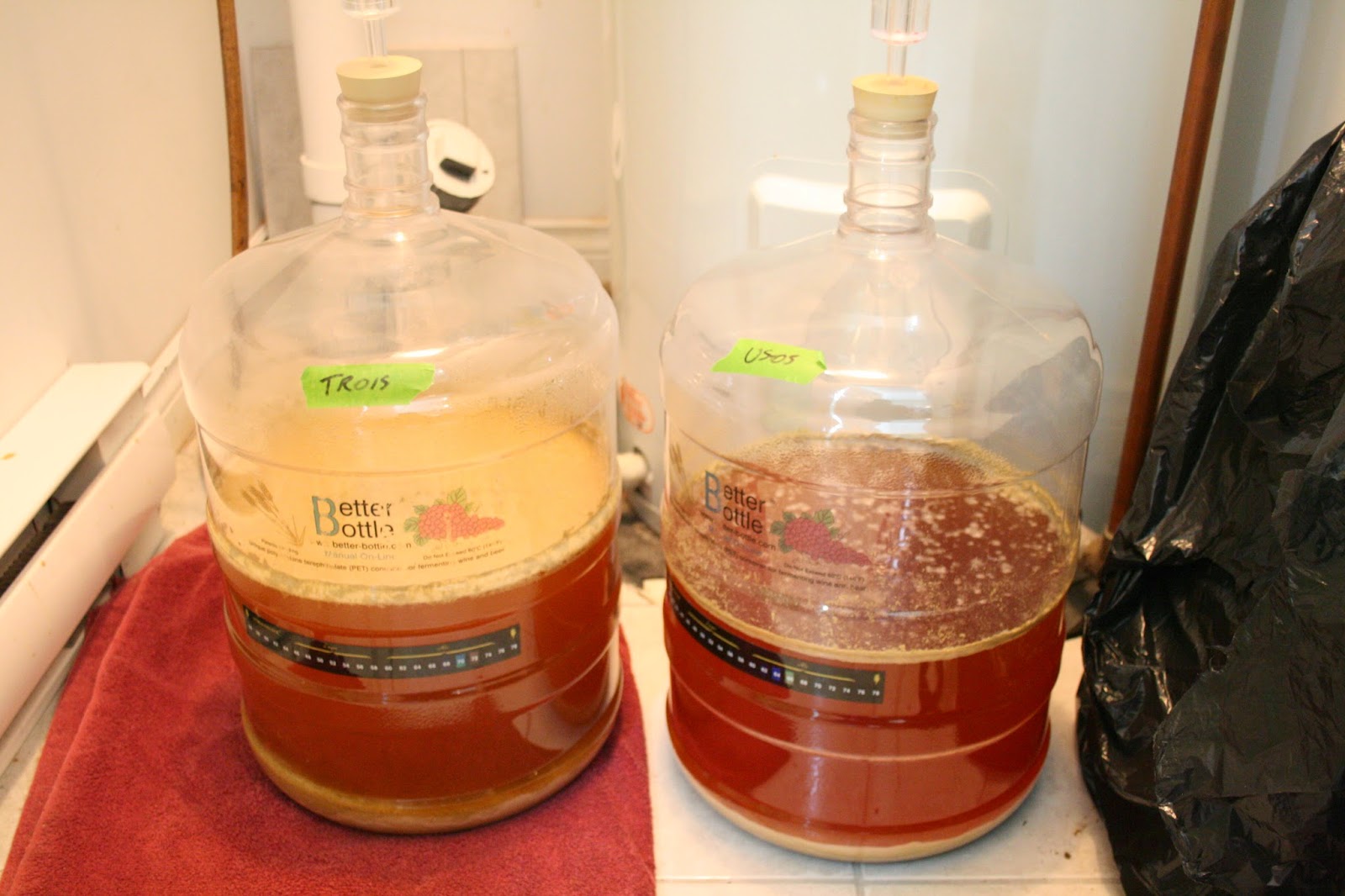
One week after pitching
I ended up kegging both, as I had two free taps in my keezer. The tasting notes for both beers are below; really, they came out pretty similar. That being said, I think most people could definitely tell the difference between the two, and I've had several friends try the beer, all of whom had no problem telling the beers apart. The general consensus is that the Trois-fermented beer is slightly better, with a bit more tangy, juicy fruitiness to it, but the US-05 version is pretty great, too. Personally, I find the US-05 beer has a bit more of a "bite" to it in the finish; not sure why - like I said, both beers finished at 1.013 - but there it is. Just my opinion.

Whether you have access to Trois or not, this is still a great recipe... one of the perfect hoppy summer beers, in my opinion. Big on hop aroma and flavor, low on alcohol. But if you DO have Trois, I find it gives the beer a slightly small push towards greatness, even from where it was before.

Now, White Labs, how about packaging more than 2-3 billion cells of Trois in a vial?

Recipe Targets: (6 gallons, 73% efficiency) OG 1.048, FG ~1.012, IBU ~35, SRM 5.3, ABV ~4.7%

Grains:
2.6 kg (54.1%) Wheat malt
1.7 kg (35.3%) Canadian 2-row
330 g (6.9%) CaraVienne
80 g (1.7%) Acid malt
100 g (2.1%) Rice hulls

Hops:
Hop extract - 2 mL @ 60 min (or 11 g of a 10% AA hop variety)

Citra - 56 g (12.4% AA) @ 0 min (with a 10 min hop steep)
Amarillo - 28 g (7.9% AA) @ 0 min (with a 10 min hop steep)
Citra - 56 g @ 0 min (when start chilling)
Amarillo - 28 g @ 0 min (when start chilling)

Citra - 56 g dry-hop for 5 days (in primary)
Amarillo - 14 g dry-hop for 5 days (in primary)
                                                                          *Both dry-hop additions halved for each fermentor
Citra - 56 g dry-hop for 5 more days (in primary)
Amarillo - 14 g dry-hop for 5 more days (in primary)

Misc: 1/2 tab Irish Moss at 5 min

Yeast: US-05 Safale (1/2 pack, rehydrated) for half the wort, WLP644 Brett Trois (with a 900 mL starter, stepped up with another 1.5 L)

Water: Fredericton city water, carbon-filtered; 5 g Gypsum and 5 g calcium chloride added to mash

- Brewed on March 22nd, 2015, by myself. 50-minute mash with 14 L of strike water, mashed in at target of 155 F. Mashed-out for 10 minutes with 5.5 L of boiling water. Sparged with ~4.5 gallons of 168 F water for final volume of ~7.25 gallons.

- SG on target, 1.040. 90-minute boil. Flameout hops had a 10-minute steep before turning on the chiller. Final volume a bit high at ~6.25 gallons; OG 1.048. Chilled to low-60s F, stirred gently to evenly distribute trub, then poured into two Better Bottles. Aerated each with 60 seconds of pure O2, and pitched decanted yeast starter in one fermentor, and the rehydrated US-05 in the other, at 64 F for each. The Trois fermentor was set in the water heater room (ambient temp ~68 F), US-05 fermentor in laundry room (ambient ~64 F).

- Fermentation for the Trois batch took off quickly, with visible activity complete after only 3 days (temp reached as high as 70 F). US-05 started slower and continued longer, eventually reaching a high of 70 F as well, albeit over several days. FG for both beers was 1.013.

- 2/4/15 - Added first dry-hop addition to primary for both beers.

- 7/4/15 - Second dry-hop addition, also into both primaries.

- 12/4/15 - Racked both beers to kegs, purged with CO2 before and after, set in keezer to chill down overnight. Started carbing the next day.


Appearance: Both poured with a medium-sized, white head that sticks around for a while before fading to 1/4-finger. Bodies are both golden-coloured with pretty good clarity. Seem identical to me.

Aroma: The aroma between the two is quite similar. I find the dankness/cat pee characters of the Citra comes through more in the US-05, while the Trois is slightly more fruity/juicy smelling. Bit of supporting sweetness in both beers, but obviously the hops dominate.

Taste: Trois - Starts off with a touch of sweetness and tartness, and then a really nice tropical fruit character takes over, with some supporting pineapple working with it. Very juicy. Finishes with a moderate-light bitterness, nice balance between dry and sweet.

US-05 - Ditto with the malt character, but the hop flavors are more dank; definitely still fruity from all that Citra, but not quite as tropical as the Trois. Like the Trois, finishes moderate-lightly bitter, but it has a bit more "bite" to it; slightly drier.

Mouthfeel: Both are medium-bodied with moderate carbonation.

Overall: Interesting experiment; at first I was more a fan of the US-05 half, as I didn't think the Trois was overly dominant at the beginning. But after a few weeks, I think I prefer the Trois; I really like the extra juiciness the yeast adds to the beer. That being said, I don't detect any Brett characteristics (funky, barnyard) in the beer at all.

Monday, 19 August 2013

Tasting : Isles of Fortune (Modern Times Fortunate Islands clone)

Ah... it's so nice when you brew a beer and have high expectations for it, and it actually doesn't end up disappointing you in any way! Sorry if that sounds a bit cynical, but often it's the beers I look forward to the most that end up letting me down, at least slightly. But this one hasn't. At all.I knew when I tasted this beer when I took a gravity sample that it was going to be pretty great... the hop aroma was huge before I even dry-hopped it (making me wonder if 4 oz Citra and 1 oz Amarillo in the dry-hop may be unnecessary?).

The real Modern Times Fortunate Islands (described as a "hoppy wheat") hasn't even been available to the public for very long now, but this clone that I brewed last month has everything I would hope to find in the commercial beer... which makes me sure that the real thing is all the better! Detailed tasting notes below, but in summary it's a really "tropical" beer - all that Citra and Amarillo really paid off. At 4.8% it's pretty sessionable, extremely hoppy (especially in the aroma) without being very bitter... a delicious beer. Looking at the tasting notes from Mike Tonsmeire's blog, it seems like the two beers are fairly close, at least in the main points. I'm sure Mike's beer (and Modern Times') came out even better, since they'd be able to keep the hops fresher by flushing with CO2 during fermentation/transfer. Oh, and due to the fact that they're better brewers!

If you can source a good amount of Citra and Amarillo, I highly recommend giving this recipe a try. Thanks again to Mike Tonsmeire and Modern Times for being so open with their recipes!

Appearance: Poured with a stark white, moderate-sized sticky head, that shows good retention, eventually fading to 1/4-finger for the duration of drinking. The body is a dark golden/very light copper color (the glass I poured it in in the picture makes it look darker than it really is), and is extremely hazy - probably due to the lack of Irish Moss, all the wheat malt, and the intense dry-hopping.

Aroma: Huge citrus, tropical fruit presence. Lots of orange and mango. Maybe a touch of malt character in the background, but honestly the hops are so prevalent, it's hard to detect anything else!

Taste: Again, a strong amount of orange and mango at first, but a bit subdued compared to the aroma. The wheat malt and Caravienne come through more after that initial hop hit, and the beer then finishes with more fruit and just a touch of a resiny character, which I wasn't expecting. Moderate to moderate-low bitterness in the finish.

Mouthfeel: Slightly under medium carbonation... I think it would benefit from a bit more, actually. The body is medium-full at least... the wheat malt and high mash temp really came through. This isn't a bad thing with this beer; it actually works very well.

Overall: Great beer; definitely something to have on tap in the summer - it wouldn't take long to go through this beer. Other than a bit more carbonation, there's nothing about it I'd change. I'll definitely be brewing this again!

Saturday, 27 July 2013

Brewing a Modern Times Fortunate Islands clone


If you're any bit a beer geek (and if you're reading this, you probably are... or, you're stalking me), you know that the number of breweries in the U.S. and Canada is at an all-time high point, even compared to pre-prohibition numbers. And the amount of breweries in the planning stages is even more staggering. This is fantastic news for all of us, but as a brewery owner, how do you make your brewery stand out? How do you get people excited about your product... before you even HAVE a product to offer? I spend a lot of time reading - mostly online - about beer and breweries, and there is one brewery that has succeeded in accomplishing this better than any other, in my opinion. That brewery is Modern Times.

Based in San Diego, CA, Modern Times has only had their beers available at bars for the past month or so. However, due to a lot of hard work and smart choices by its owner, Jacob McKean, Modern Times has been well-known and much-anticipated in the brewing world for a year or more. For example:
  • Jacob kept an ongoing blog of the trials and tribulations of getting a brewery up-and-running... we all know it isn't easy, but Jacob's blog made the whole process feel more personal. It wasn't long before I was rooting for him to succeed.
  • He got Michael Tonsmeire involved. Now, Mike's blog is probably the most-read and most-respected homebrewing blog out there, and for good reason. He started developing the recipes for the four regular-release Modern Times beers about a year ago, and kept detailed and open records on the recipes, tastings, and subsequent changes. Again, this made it more personal for those of us following along.
  • The Kickstarter campaign. With a pretty-hilarious video to go with it, this campaign managed to raise $25,000 beyond their $40,000 goal, giving out some classy-looking swag and original awards to backers, of which I proudly am one.
I could go on and on here. Basically, Jacob got a lot of people excited about his brewery, and while Modern Times hasn't been producing beer for very long, I've heard a lot of great things about their products. They brew four regular-release beers: Black House, a coffee stout; Blazing World, an "Amber IPA", or hoppy Amber if that's easier to picture; Lomaland, a sessionable Saison; and Fortunate Islands, a super-citrusy and tropical, easy-drinking American wheat beer.

I've been an avid reader of Mike's blog ever since I got into homebrewing, so I followed along (with a lot of other people) when he was tweaking the recipes for the beers above. They all sound great, and I'd be more than happy trying out the recipes for each on my own. However, for this time of year, it was the Fortunate Islands that attracted my attention the most. With a supporting malt backbone and a boatload of Citra hops, it sounds like the perfect summer beer for hop-lovers! After a couple of variations on the recipe, Mike settled on this one.

Regarding the grist, Mike's recipe is fairly straight-forward, with a little more than half of it being Wheat malt, along with some 2-row and a healthy amount of Caravienne. The mash temp is fairly high at 155 F, mainly to provide some body that was lacking in previous recipes.

A lot of hops; more importantly, a lot of Citra!
The real fun lies in the hopping schedule. There's a single "Hop Shot" of CO2 hop extract at 60 minutes to provide the bulk of the bitterness to the beer. Hop extract is becoming popular with commercial brewers and homebrewers; it provides bitterness without leaving a lot of the hop sludge in your wort by the end of the boil. I'll do a separate, small post on hop extract in the future; for now, if you don't have access to hop extract, just know that 5 mL equals about 10 AAU of hops, or 1 oz of a 10% AA hop.

That's the only hop addition during the boil. However, there's a very healthy 11 oz of hops added afterwards... 8 oz (1/2 lb) of which is Citra! The other 3 oz are another delicious, hard-to-get hop: Amarillo. I'd normally be quite wary of adding this much Citra into one beer, but I was lucky enough to get my hands on a good amount of it a couple of months ago, so I'm willing to sacrifice 8 oz... this time. In Mike's
homebrew process for this beer, he was able to make use of a plate chiller, March pump, and HopRocket... none of which I have. He goes into detail about this on his post... however, I had to improvise. So, the first flameout addition I let steep for 10 minutes, then I turned on my immersion chiller and made the second addition. Won't be as effective as his method, but it'll have to do with what I have available. There's two dry-hop additions at 4 days apiece; pretty massive, coming in at a total of 5 oz... not bad for a wheat beer!

Yeast-wise, this beer requires your standard, clean California Ale-type. I've been using the dry US-05 for the last several batches of APAs and IPAs, but I had the time here to pick up Wyeast's 1056, and make a starter. A single pack of US-05 would work fine, as well. Fermentation should be in the 66-68 F range, but if it gets a bit higher due to summer temperatures, it shouldn't be too much to worry about, especially if you pitch in the mid-60s.

I didn't make much in terms of adjustments to my water. As I've been doing lately (to varying degrees), I added some gypsum and calcium chloride to mainly boost the calcium, and at the same time bring up the sulfate and chloride a bit. I also added Irish Moss as I normally do to most of my beers; the BJCP lists American Wheat as being "brilliant to hazy", so I aimed for clarity.

I'll be drinking this clone before I ever get to try an actual Fortunate Islands... but, maybe not TOO long before? There's a chance I may be making a trip to San Diego in September; if so, I'll be absolutely visiting the Modern Times brewery and trying as many of their beers as I can, wherever I can find them! In the meantime, I'm really hoping this beer has the huge hop aroma that I'm expecting it to have... a lot of hops are riding on it.

Recipe targets: (6 gallons, 73% efficiency) OG 1.048, FG ~1.013, IBU ~48, SRM 5, ABV ~4.7%

Grains:
2.6 kg (55%) Wheat malt
1.795 kg (38%) Canadian 2-row
332 g (7%) Caravienne malt
113 g rice hulls to prevent a stuck sparge

Hops:
Hop extract - 5 mL @ 60 min
Citra - 56 g (14.1% AA) @ 0 min (steep for 10 min)
Amarillo - 28 g (8.9% AA) @ 0 min (steep for 10 min)
Citra - 56 g @ 0 min (when start chiller)
Amarillo - 28 g @ 0 min (when start chiller)
Citra - 56 g dry-hop for 4 days
Amarillo - 14 g dry-hop for 4 days
Citra - 56 g dry-hop for 4 more days
Amarillo - 14 g dry-hop for 4 more days

Misc.: 1/2 tab Irish moss @ 5 min

Yeast: Wyeast 1056 American Ale (PD May 21st; with a 1.5 L starter)

Water: Fredericton city water, carbon-filtered; 5 g Gypsum, 3 g CaCl in the mash

- Brewed on July 9th, 2013, by myself. 50-minute mash with 15 L of strike water, mashed in at target temp of 155 F. Mashed-out for 10 minutes with 5.75 L of boiling water, resulting temp 166 F. Sparged with ~4.5 gallons of 168 F water for final volume of ~7.3 gallons in the kettle.

- SG a couple points above target at 1.041. 60-minute boil. Took about 35 minutes to chill to 64 F using pump/ice water. Poured ~5 gallons into Better Bottle. OG a bit high at 1.050. Aerated wort with 90 seconds of pure O2. Pitched yeast at 66 F and set BB in laundry room sink with cold water.

- 10/7/13 - In AM,  good airlock activity, temp 66 F. Temperature had climbed to 70 F by the evening, bubbling 1-2 times per second in the airlock.

- 11/7/13 - In AM, bubbling every second, temp 70 F. Slowing down by the evening, temp still holding at 70 F.

- 23/7/13 - Added first dose of dry-hops directly into primary.

- 27/7/13 - Added second dose of dry-hops.

- 31/7/13 - Bottled with 120 g table sugar, aiming for 2.5 vol CO2 for 5 gallons, with max temp of 72 F reached.

- Tasting notes... came out really great - huge hop nose, lots of tropical hop flavors... delicious.