Showing posts with label clone. Show all posts

Thursday, 10 November 2016

Brewing a Maine Beer Co. Lunch clone (No. 8 in the Maine Beer Clone series)


Another year, another attempted clone of a Maine beer! It never ceases to amaze me how many awesome breweries this state has. My wife and I took a beer trip to Portland in May; it was our first trip without kids to Portland in about a year and a half... that was a real eye-opener to me, since I regularly used to make it to Portland about four times a year before my daughter was born. With that big of a travel gap, there were a few new breweries that had popped up, and it looks like some more have opened even since then. My point is, there are plenty of great beers brewed in Maine, and therefore plenty of great beers to try to "clone" at home... but I keep coming back to the classics, most of which are brewed by Maine Beer Company.

Lunch was MBC's fourth release (after Peeper, Zoe, and Mean Old Tom), and their first American IPA. Let me tell you, even though it's been years now since they started brewing it, it is still considered - rightly so - a fantastic IPA. Here's how the brewery describes it:

Intense hop flavours and tropical, citrus fruit and pine aromas dominate the flavour profile, balanced by subtle malt sweetness.

That's actually a perfect summation of this beer. If you look at the many pictures snapped of Lunch, you can see immediately that it doesn't look quite as pale-coloured as many IPAs are now; it definitely is on the dark-golden/light-amber side of things. That's not to say this is a sweet beer; it certainly isn't, thankfully. But there's more malt character than a lot of newer breweries put into their hoppy beers. But with Lunch, it all works perfectly. Hoppy, yet balanced. Bitter to a degree, but smooth and easy-drinking. A great beer! And, interestingly, not named after the meal, but after a whale that swims (swam?) off the coast of Maine that had a bite out of its fin, and was named Lunch by the locals as a result.

I've always wanted to brew a clone of this beer. I've done many other MBC clones in my Maine Beer Clone series, and Lunch has been the next one planned for some time. And I'm certainly not the only homebrewer to have tried to clone Lunch; there's plenty of attempts out there that have been documented on blogs, homebrew forums, etc. But this time around, I didn't have to do any work. Nope, no digging, no bugging brewers, no analyzing the beer at all.

You may be wondering, has he developed some sort of a psychic sense when it comes to homebrewing? No, I can assure you that if I had, I would be making better beer. What happened was months ago, someone emailed me and we chatted about at least one of my MBC clones. That person eventually told me that they had been giving a photo taken of the MBC actual brew log, turned to a double-brew day of Lunch. They asked if I'd like a copy; I said sure, even though I admit I was skeptical. But when they sent it along, I had to admit that it looked genuine! I guess only a brewer at MBC could confirm, but it really does appear to be authentic. Everything is there: grist and percentage of each grain, exact hop times, amounts, and alpha acids, pH readings... everything. EXCEPT the dry hop. However, this person told me they had questioned Dan Kleban (MBC's co-owner and head brewer) on this, and that he confirmed they use a total of 2.3 lbs/BBL, shared equally between all three of the hop varieties in the beer (Amarillo, Centennial, and Simcoe).

I've actually had this recipe for months now (maybe even over a year?), but only got around to brewing it in September. I'm no fool; I know that recipe is only part of what makes a beer great, with technique being at LEAST half of it. But I wanted to give it a try! I've had Lunch about ten different times, so I'm at least a little familiar with it, and had an idea what to expect it to look, taste, and smell like. So I finally found the time to fit it in my brewing schedule, and scaled the recipe down from ~400 gallons, to 5.

The grist is made up mainly of 2-row, with small amounts (~4%) of Crystal 40 L, Munich 10 L, and Red Wheat, and an even smaller amount of Carapils. I also threw in some Acid malt as I always do for pale beers, to bring my mash pH into range (MBC's mash pH for Lunch is ~5.4). I will note that I asked Dan Kleban a while back if they did pH adjustments when making large dry-hop additions (e.g. Dinner), and he responded by saying that they didn't do any pH adjustments. I assume this means no adjustments throughout the brewing process at all, and the brew log seems to indicate this; I see no mention of Acid malt, phosphoric acid, etc. The OG I was aiming for was 1.063; Lunch is a 7% ABV beer, and MBC lists their OG as 1.059. Personally, I can't get the attenuation they seem to be getting, so I always aim for several points above their target when brewing one of their beers, to make up for that. I should also note that the Lunch mash temp is listed as 149 F.

As with all their beers, MBC lists on their website the hop varieties used in each. Lunch uses Warrior, Amarillo, Centennial, and Simcoe. Without seeing what is, apparently, the actual recipe for Lunch, I would probably come up with a clone that involved large additions of all three flavour hops, late in the boil (or maybe even just a flameout addition), and a large dry-hop... I would have been half-right.

Check out that hopping schedule! Let me begin by saying their 60-minute addition is actually Warrior, not Centennial; I'm not sure what I was doing. Maybe lowering the IBUs to where I wanted them? Dunno, but if you want to follow the MBC recipe, use 3 grams of Warrior (17.7% AA) at 60 minutes. Otherwise, there are many additions throughout the boil, but they're SMALL additions. I can see why they're not large; it's not like you're going to get much aroma or flavour at 45 or 30 minutes, and they weren't going for high IBUs. Obviously this approach works for them, so while it was against how I normally brew now, I followed their schedule to a tee. Minus the 60-min addition, of course. The flameout addition I used was also changed; MBC lists a whirlpool addition at half of what I have, 12 g of each variety for 5 gallons. I upped it because I assume their whirlpool is longer than 20 minutes at that size, so I made a hopefully-educated guess. A single, large dry-hop (almost 6 oz total), and you're set! Ferment the beer with a neutral American strain, of course (WP001, Wyeast 1056, US-05, etc.).

So, the beer was finally brewed and fermented, with no real issues to report; I admit it felt a little weird adding so few hops before chilling the beer, but I had faith. I pitched a rehydrated package of US-05, and fermentation took off quickly. The FG made it down to 1.011, which was about what I expected. The dry-hops went into primary for about 5 days, and then I kegged the beer and carbonated it with my typical 36-hours-at-30-PSI approach, which usually works well.

This was one of those beers where I really liked it at first, then felt that both the hop aroma and flavours dissipated quickly... and then came back a few days later. I'm still not sure if this is actually a part of the process, or one of my... quirks, but it can certainly be frustrating! Now that the beer (or me) has settled down, I'm enjoying it. While it's certainly not the best IPA I've brewed, it's got a pleasant blend of pine and citrus, with a fairly powerful aroma, and moderate bitterness. But how does it compare to Lunch?

Well, luckily I recently made a trip to Portland, and had a friend pick up a super-fresh (as in, bottled two days before I bought it) bottle of Lunch for me! And now that I've done a side-by-side with these beers, I can say that this recipe will get you VERY close. Complete tasting notes are below, but these beers are extremely similar: they look virtually identical, and the aroma and taste are pretty much spot-on as well. The biggest differences were that my clone smelled a bit hoppier, while the real thing had the edge in the taste department, with a smoother balance between the malt and hops.

If there's one thing this beer has taught me, though, it's that IPA tastes and expectations have changed in the last couple of years. I really enjoy Lunch, but it's not the type of IPA I usually seek out now. It's still a great beer, no doubt about that, but it doesn't really seem to be in line with the REALLY great IPAs out there, such as Bissell Brothers The Substance - hazy/cloudy, super-hoppy, with little perceived bitterness.

But if you're a Lunch fan - and I think most of us still are - give this recipe a try! I don't think you'll be disappointed. And a big shout out to the person responsible for sending it to me; I apologize for losing the email and forgetting your name!

Recipe Targets: (5.5 gallons, 75% efficiency) OG 1.063, FG ~1.011, IBU ~50, SRM 6.9, ABV ~6.8%

Grains:
4.75 kg (82.3%) Canadian 2-row
250 g (4.3%) Crystal 40 L
250 g (4.3%) Munich
250 g (4.3%) Wheat malt
150 g (2.6%) Acid malt
125 g (2.2%) Carapils

Hops:
Centennial - 5 g (9% AA) @ 60 min
Centennial - 7 g @ 45 min
Centennial - 5 g @ 30 min
Amarillo - 4 g (8.7% AA) @ 30 min
Simcoe - 3 g (12.2% AA) @ 30 min
Centennial - 11 g @ 15 min
Amarillo - 6 g @ 15 min
Simcoe - 5 g @ 15 min

Amarillo, Centennial, Simcoe - 24 g each @ 0 min (with a 20 min hop steep)

Amarillo, Centennial, Simcoe - 58 g each dry-hop for 5 days (in primary)

Misc: 1/2 tab Irish Moss at 5 min

Yeast: US-05 Safale (1 pack, rehydrated)

Water: Fredericton city water, carbon-filtered; 5 g Gypsum and 7 g calcium chloride added to mash

- Brewed on September 27th, 2016, by myself. 50-minute mash with 15 L of strike water; mash temp on target of 149 F. Mashed-out for 10 minutes with 8.5 L of boiling water to 168 F. Sparged with ~3.25 gallons of 168 F water for final volume of ~6.75 gallons.

- Pre-boil gravity at 1.050 (target 1.051). 60-minute boil. Final volume ~5.7 gallons; OG low at 1.061. Chilled to 64 F, then poured into Better Bottle. Aerated with 75 seconds of pure O2, pitched yeast at 64 F.

- Airlock bubbling strong by the next morning, continuing on for a few days before slowing down. Temp got up to 72 F during the peak.

- 4/10/16 - FG 1.011; added dry hops into primary.

- 10/10/16 - Racked beer to keg, cooled, and carbed to 10-12 PSI.

Lunch on the left, homebrew on the right

Appearance: Colour is about exactly the same; the homebrew is just slightly lighter in colour, and more clear. In the commercial version, the head lasts longer and there's more lacing.

Aroma: Virtually identical, hard to tell the difference. The homebrew is a bit stronger in the hop department - fruity and citrusy - while the commercial beer has a bit more malt presence.

Taste: Again, extremely close, with the commercial beer having the hops come across as smoother, somehow; lots of hops in both, citrusy and fruity, balanced by a bready malt backbone. Medium bitterness in both.

Mouthfeel: The real thing is slightly creamier. Both are medium-light bodied, moderate carbonation.

Overall: You can tell them apart, but not by much. Doing it blind (the triangle-test would be best) would make it even more difficult. I'm going to give the edge to Maine Beer Co. though, thanks to the smoother body and flavour profile.

Wednesday, 30 December 2015

Hill Farmstead James clone, attempt #3


I'm a big fan of Black IPAs... when they're brewed right. It can be a pretty difficult style to do extremely well; you've got to hit the perfect balance of chocolate and roastiness in the beer (too much and it's a stout, too little and it's just a dark-coloured IPA), along with a decent amount of bitterness (in the medium-high to high zone), and a good amount of hop aroma and flavour. Now that Black IPA is "official" - meaning that it's in the Specialty IPA category of the 2015 BJCP Guide - there's a little bit more to go on when brewing the style, if you're looking to get in the "technically-correct" range. Basically, you want some dark malt character, but not enough to be intense or so that it's clashing with the hops. Hop aroma and flavour can range from medium to high, for the most part.

This is my third Black IPA, and my third (and last) attempt at improving on my Hill Farmstead James clone. The recipe came from Mitch Steele's IPA: Brewing Techniques, Recipes, and the Evolution of India Pale Ale. Hopped entirely with Columbus (CTZ) and Centennial, it's supposed to be a delicious beer. I initially thought I had had it, but realized last year that I had tried Foster, their "Black Wheat IPA". So, while I don't have any idea if my attempts are anywhere close to what James is really like, I continue to try to improve on the beer that I initially brewed over 2 years ago.

The first time I brewed the clone, I had to make some changes to the recipe (mainly in the grist) based on what I had available from my LHBS. When it came to the yeast, everyone knows HF uses an English strain, but which one commercially available is closest? I chose Wyeast 1098 British Ale; I had used it before and liked it. It's actually quite neutral, as English yeasts go, so it seemed like a good choice to start with. I eventually bottled the batch and was really, really happy with how it came out. I thought the roastiness of the beer was right where it should be, and the hops came through very prominently - lots of citrus, bit of earthy dankness... delicious beer overall. Unfortunately, the hop character dropped off very quickly, as it often does in bottled beers.


In my second attempt, I wasn't really looking to change the beer drastically, just maybe slightly improve on it. I was curious what effect a different yeast strain would have on the beer, and I had also started kegging and wanted to package that way; I naturally assumed that the beer would be even hoppier as a result. This time, I fermented with Wyeast 1275 Thames Valley Ale; another clean strain, the description sounded like it had a bit more English character to it. While the beer was still enjoyable, I found that it wasn't quite as hoppy as the first one, even with the dry hop addition going right into the keg. I'm not sure if it was due to the yeast strain, hop freshness, or simply a change in my tastes over the previous year. Whatever was the culprit, I wanted to try one more time.

The recipe is still staying about the same this time, with another small change in the grist: I was completely out of Carafa Special, but I had lots of Midnight Wheat on hand. Both grains lack a husk (meaning you get the dark color and some of the roastiness, but not the acrid character as with other husked, dark grains), so I figured the switch would be negligible in the final product (especially at only 6% of the grist). Otherwise, the grist and hopping schedule were the same as last time. I did change the water chemistry slightly, by increasing the addition of both calcium chloride and gypsum to 10 grams each. This brought the final water profile to ~145 ppm each of chloride and sulfate, an approach with my hoppy beers I've been taking lately (I'm admittedly not completely sold on this target yet, however).


For fermentation this time, I went with Wyeast 1318 London Ale III. I've used this strain several times for hoppy beers (as have a lot of other homebrewers) and I really like how it works in these styles. Aside from being rumoured to be very similar to the English strain used by Hill Farmstead, its claim that it provides a "softly balanced palate" is true; or at least, it seems that way to me. A word of advice when you use this yeast: it usually provides a pretty big krausen that sticks around for quite some time; it's not unusual for it to take 10-14 days to drop out after active fermentation is complete, unless of course you have the ability to cold-crash.

So, I brewed the beer back in November, and as expected fermentation was fast and furious, with the airlock blowing off overnight. No problem, though; a bit of tinfoil over the top of the carboy did the trick till things settled down, and there were no issues with temperature control - the temp of the beer never went above 70 F. After almost two weeks I dry-hopped directly in primary, and then racked to a keg about 5 days later and carbed the beer.

I find the end result here to be more similar to my second attempt than my first, unfortunately. Once again the hop character is lacking slightly, and I'd actually like to see a little more roast character here, too. May not be a bad idea to add a bit of Roasted Barley or Black Patent. The mouthfeel is great, though - medium or even medium-full bodied, creamy... smooth. Nice firm bitterness in the finish. So, the beer is pretty good, but it's definitely not great. I suspect that, again, hop freshness MAY be playing at least a small part, but these weren't OLD hops by any means, and as usual they were stored cold and vacuum-sealed.

Next time I brew a Black IPA, I'll be trying something completely of my own design; different grist, different hops. Time to shake things up a bit for this style, for me. However, I really like how the London Ale III worked with this beer, even if the FG did end up being a bit high (1.018) - the mouthfeel is just where I want it for a Black IPA, and the slight fruity-esters in the aroma and taste are great. This yeast strain will continue to be used in hoppy beers of mine in the future!

Recipe Targets: (5.5 gallons, 75% efficiency) OG 1.065, FG ~1.016, IBU ~80, SRM 33, ABV ~6.4%

Grains:
5.1 kg (85.5%) Canadian 2-row
360 g (6%) Midnight Wheat
240 g (4%) CaraPils
120 g (2%) Flaked Oats
94 g (1.6%) Crystal 150 L
50 g (0.8%) Acid malt

Hops:
CTZ - 10 g (11% AA) FWH

CTZ - 14 g @ 60 min
Centennial - 33 g (7.5% AA) @ 45 min
Centennial - 34 g @ 10 min

Centennial - 43 g @ 0 min (with a 10 min hop steep)
CTZ - 80 g @ 0 min (with a 10 min hop steep)

Centennial - 38 g dry-hop for 5 days (in primary)
CTZ - 38 g dry-hop for 5 days (in primary)

Misc: 1/2 tab Irish Moss at 5 min

Yeast: Wyeast 1318 London Ale III (with a starter, ~240 billion cells)

Water: Fredericton city water, carbon-filtered; 10 g Gypsum and 10 g calcium chloride added to mash

- Brewed on November 4th, 2015, by myself. 50-minute mash with 16 L of strike water, mashed in at target of 152 F. Mash pH low at 5.3 at 68 F (target 5.4). Mashed-out for 10 minutes with 7.5 L of boiling water to 168 F. Sparged with ~3.5 gallons of 168 F water for final volume of ~6.75 gallons.

- Pre-boil gravity at 1.051 (target 1.053). 60-minute boil. Final volume ~5.5 gallons; OG 1.063. Chilled to 62 F, then poured into Better Bottle. Aerated with 75 seconds of pure O2, pitched yeast slurry at 64 F.

- Furious fermentation by the next morning; the temp was 68 F and the airlock had blown off the carboy. For the rest of the day and into the next, activity was so strong and the krausen so large, I just left tinfoil on top. Some beer was lost; temp didn't get over 68-70 F.

- 17/11/15 - Krausen finally dropped with a little cold-temp help. FG high at 1.018. Dry-hopped in primary. Racked to a keg and set in keezer to bring temp down 5 days later, before starting to carb.


Appearance: Pours with a moderate-large, light-tan, creamy head that shows excellent retention. Sticks around for quite awhile before fading to 1/2-finger. Body is very dark brown if not black, and opaque. Ruby highlights at edges when held to the light.

Aroma: Light aroma of milk chocolate and earthy, dank hops. A touch of fruitiness follows at the end, hard to tell if it’s from the hops, or esters from the yeast.

Taste:
Flavours of light chocolate and roast, following with some earthy and slightly-fruity hop notes, all finishing on the dry side of balanced, with a moderate-high bitterness. Quite smooth.

Mouthfeel: Very creamy, medium to medium-full bodied beer, with moderate carbonation.

Overall: I like it; I would like to see a bit more roast character, and a bit more hop character as well. Mouthfeel is great. In the end, unfortunately still not up to my first attempt, but I find that this yeast works really well with this recipe.

Monday, 28 September 2015

Brewing a Maine Beer Co. Peeper clone (No. 7 in the Maine Beer Clone series)


After my attempt to brew a clone of Maine Beer Company's highly-coveted DIPA, Dinner, I didn't want to wait too long to try brewing another one of their beers. Why? Because that clone attempt came out pretty crappy. Probably one of my worst homebrew attempts of all time. If I hadn't had so many people that wanted to still try it, it probably would have turned out to be my first drainpour batch. It didn't, in the end... but it wasn't too far off. More on that failure in the link above.

Anyway, time to move on, right? I've had several successes since then, and have learned from the experience; this is what homebrewing is all about. I know now that a pound of hops for a 5 gallon batch dry-hop is probably a WEE bit too much. And I've had some good results with some other Maine Beer Co. recipes, with one I'd been sitting on for awhile that I've always been wanting to try - a clone recipe of their very first beer, Peeper.

When Maine Beer Co. came on the scene in Portland six years ago, they initially only had one beer available. Spring Peeper was an "American Ale", basically a really hop-forward APA that was dry, refreshing, and immensely hoppy. I remember my very first trip to Portland's Novare Res Bier Cafe in the fall of 2009; one of the bartenders there insisted that I had to try this beer (even though "the brewery name is kinda crappy"...!). They didn't have it on tap, but they did have the 500 mL bottles available (which were being delivered, I believe, to bars and beer stores in the area by owners/brewers Dan and David Kleban, who still had their day jobs at the time as well). The hype was real - this beer was delicious. And it was, of course, eventually followed by many other amazing beers over the years.

The name was eventually changed to Peeper (I assume so people wouldn't be confused and think it was only a seasonal release?), but the beer stayed the same. Peeper is like Coors Light in Portland - it's hard to go into a beer bar, restaurant, etc. and NOT find it... which speaks volumes as to the awesomeness of Portland. Several years ago, I came across a post on Home Brew Talk where someone included a clone recipe of Peeper that they had received from Dan Kleban. I've had great luck and lots of help from Dan on other clone recipes of his beers, but this was even more... it was quite detailed. I assume that he was simply less busy back then, and had a little more time to answer pesky homebrewer's emails! I held on to this recipe for quite awhile before I finally decided to brew it. Here it is in its entirety:

I use American 2-row base malt (88%), then red wheat (3.5%), Vienna (3.5%), and C-10 (5%). U.S. Magnum as bittering charge, then equal amounts Cascade, Centennial, and Amarillo at beginning of whirlpool. Dry-hop equal amounts Centennial and Amarillo only (4.5 oz/5 gal). House yeast is a variant of Wyeast 1056. Mash at 150 F and sparge with 180 degree hot liquor to raise runoff to 172ish. 60 minute boil. 

OG: 1.053
FG: 1.011
IBU: approx 45
SRM: no idea

My secret: extreme late hopping (up to 50% of IBUs come from whirlpool hops)

Pretty helpful! I imagine that most of their hoppy beers follow the same approach, where a good hunk of the bitterness comes from whirlpool additions. All of their beers are so smooth and easy-drinking, with tons of hop aroma and flavour; this is the approach I've used with all my Maine Beer Co. clones (not to mention a lot of other recipes).

So, obviously the grist was extremely easy to put together. I threw in 100 g of Acid malt, as per usual for my pale beers, for mash pH purposes. I also didn't have any Crystal 10L; I first thought of just using Carapils, but I have a lot of CaraRed, which is about 20 L. So, I used that one, but decreased the amount to ~3% to hopefully-account for the slightly-darker color. For the hops, I went with 1.5 oz each of Amarillo, Cascade, and Centennial at flameout, for a 15-minute steep (I basically just went with a quantity that would yield about half of the 45 IBUs I was aiming for). I probably should have steeped longer, since there were no other flavor/aroma additions until this point, but I was on a tight schedule and have had good results with 15-minute steeps in the past. For the dry-hop, I followed the instructions exactly... and assumed that it was 4.5 oz TOTAL, not 4.5 oz of each hop.

That's about all the work I had to do with this one. The brew day went smoothly; while taking place in June, the temperatures really weren't that high, so the groundwater was still manageably cool, and the fermentation never got out of control.

I was quite happy with how this one came out. While I've had Peeper plenty of times - like I said, it's everywhere - the last time I had it was in March. And of course I don't have access to it here, and unfortunately I haven't been to Maine in months... so, no side-by-side tasting, which would have been great. I can say that the beer is very tasty - while there's a pretty good background note of bready malt, the hops are quite prevalent. But this isn't your typical BANG hops in your face hoppy beer... I find them somewhere between subtle and prevalent. That sounds contradictory, but it's hard to explain. Fruity and kind of tropical, not quite in the background, not quite overpowering. Maybe just really nicely balanced?

Either way, it's good. I think the beer, despite cutting back on the CaraRed, is a touch too dark for a Peeper clone. It seems darker than the calculated 4.5 SRM, to me. Now that I look at the website, I see that Carapils is listed as an ingredient for Peeper, not C-10. And I feel like Peeper finishes drier, which wouldn't surprise me since Maine Beer Co. normally has extremely high attenuation in their beers (the OG and FG provided in the recipe must have been adjusted for homebrew purposes (they list the beer as 1.047 on their site, which means for 5.5% ABV it would be finishing at about 1.005).

So, if you're a fan of Peeper, or just of hoppy, tasty Pale Ales, give this recipe a try. I suggest subbing in Carapils for C-10 or CaraRed or whatever. Cheers!

Recipe Targets: (5.5 gallons, 75% efficiency) OG 1.053, FG ~1.010, IBU ~45, SRM 4.5, ABV ~5.6%

Grains:
4.25 kg (87.8%) Canadian 2-row
170 g (3.5%) Vienna
170 g (3.5%) Wheat malt
150 g (3.1%) CaraRed (20 SRM)
100 g (2.1%) Acid malt

Hops:
Hop extract - 2.5 mL @ 60 min (or 14 g of a 10% AA hop variety)

Amarillo - 42 g @ 0 min (with a 15 min hop steep)
Cascade - 42 g @ 0 min (with a 15 min hop steep)
Centennial - 42 g @ 0 min (with a 15 min hop steep)

Amarillo - 63 g dry-hop for 5-7 days (in primary)
Centennial - 63 g dry-hop for 5-7 days (in primary)

Misc: 1/2 tab Irish Moss at 5 min

Yeast: US-05 Safale, 1 pack, rehydrated

Water: Fredericton city water, carbon-filtered; 3 g Gypsum and 5 g calcium chloride added to mash

- Brewed on June 16th, 2015, by myself. 50-minute mash with 15 L of strike water, mashed in at target of 150 F. Sparged with ~5.25 gallons of 168 F water for final volume of ~6.75 gallons.

- Forgot to take a gravity reading pre-boil. 60-minute boil. Final volume ~5.75 gallons; OG on target at 1.053. Chilled to low-60s F, then poured into Better Bottle. Aerated with 60 seconds of pure O2, pitched rehydrated yeast at 64 F.

- Good fermentation over the next couple of days, slowed down quickly by the third day. Temp never higher than 70 F. FG close to target, 1.011.

- Added dry-hops in primary about 12 days after pitching, kegged beer 5 days later and started carbing.


Appearance: Pours with a medium-sized, white head; retention isn't bad, but the slightly-low carbonation has it fading a bit faster than I'd like. Body is a burnished-gold color, with very good clarity.

Aroma: I get fruity, citrusy hops in the aroma, but with a firm background of bready malt. A bit of sweetness in there, too. Otherwise, clean.

Taste: Again, nice presence of malt character in this beer. The hops win (tropical and fruity), but as mentioned above, it's not an overpowering presence, but they're firmly there and linger perfectly. Medium-low bitterness in the finish, which is somewhere between dry and sweet, with the tilt towards dry.

Mouthfeel: Medium-light bodied, medium-low carbonation.

Overall: Quite enjoyable. Somewhere between one of your classic APAs where the malt comes through more (think the original Stone Pale Ale) and one of the way-more-hoppy APAs you see more often today.

Friday, 10 July 2015

Brewing an Alpine Nelson clone


Alpine Beer Company's Nelson - a "Golden Rye IPA" featuring that amazing and delicious New Zealand hop variety, Nelson Sauvin - has always been on my wishlist of beers to try. I've had a few Alpine beers, and they were all excellent (especially Duet, an IPA which I've attempted to clone not once, but twice), and I've always heard rave reviews on Nelson, so of course I'd want to experience drinking an IPA featuring my favorite hop, from a highly-respected brewery. This is looking more likely now that Green Flash has purchased Alpine; during my two recent trips to Alpine, before the buy-out, I didn't happen upon Nelson anywhere. Now, I notice that Alpine beers are starting to pop up on tap at a lot of beer bars outside of California, such as many in Vermont; hopefully it's only a matter of time before we start seeing them in Maine.

In the meantime (and hey, it's not like I live in Maine anyway), there's only one way for me to try to experience Nelson... clone it! Or do what I always do, try to brew a close approximation of it. I was pretty lucky with my Duet clone; while Alpine's founder, Pat McIlhenney, didn't give me a recipe for Duet, he was nice enough to give me some tips as to the grain bill (the hop schedule was kind of easy, since it's well-known to be equal amounts of Amarillo and Simcoe). Soon after, I got the impression that I was really lucky to get any information at all; apparently Pat has a reputation for being quite secretive when it comes to specific details on his beers. I've been interested in brewing a clone of Nelson ever since then, but I didn't bother contacting Pat again... I didn't really want to push my luck!

Well, about four months ago I happened to stumble upon a Reddit post, "Who Needs Alpine When You Can Brew Nelson Yourself?", which included an extremely detailed recipe for, supposedly, a Nelson clone. I was skeptical... this recipe had exact amounts for the malts, and amounts and times for the hop additions. The author claimed that years ago, the recipe had been "coaxed out of Pat by some [Alpine] locals", and that it was supposed to be a very reliable recipe, when compared side-by-side to the real thing. Hey, that was good enough for me! Even if it wasn't Nelson (and I'd never know, anyway), I wanted to try this recipe. I really liked the look of it, and the large addition of Acid malt sure seemed to match up with what Pat mentioned in his Duet recipe (they use the Acid malt for, of course, mash pH adjustment purposes).

Looking over the recipe further, I admit I was quite shocked by how minimal the hop additions seemed. Nelson is hopped with Nelson Sauvin and Southern Cross (another NZ variety), but this recipe wasn't calling for a hell of a whole lot. Sure, the dry-hop addition is pretty hefty, but from the beginning of the boil till the dry-hop, there's only about 2.25 oz added. That's not a lot, especially compared to a lot of other recipes I've brewed. But, as I've pondered before on this blog, maybe more isn't necessarily better, so I decided to throw caution to the wind and trust the recipe, as-is.

The grist isn't quite as simple as a lot of IPAs out there. It's made up of a majority of 2-row, but there's also some Maris Otter in there. A healthy proportion of Rye malt is featured (it IS a "Golden Rye IPA", after all), plus some Cara-pils and Acid malt (depending on your water profile, you may want to decrease the amount of Acid malt included in the grist). I also threw in a small amount of rice hulls, just as a precaution against a stuck sparge. As expected, the mash temperature is fairly low, at 150 F; the Alpine hoppy beers I had were perfectly dry and let the hops do their thing, just as they should.

As I mentioned for the hopping, it's pretty low, at least in terms of kettle additions. A FWH addition of Southern Cross, a bit of Nelson at 30 minutes (I haven't done a 30-min addition in a while), a bit more Southern Cross at 15, and then 1.25 oz between the two at 5 minutes. No flameout-additions, so no hop stands/whirlpools. As you can imagine, the IBUs for this beer are pretty low - 45 - for an IPA of 7.5% ABV. But that's on a homebrew system; that's with 5 gallons of wort that takes anywhere from 5-20 minutes to chill down to pitching temps. I assume on a commercial system, the hops are actually in contact with hot wort for longer, and therefore the IBUs would be higher? Either way, I resisted temptation to add more hops, and just went with the original recipe. But it wasn't easy! The beer then has a single dry-hop of both varieties; maybe not the biggest I've seen, but at over 4 oz, it's definitely enough to pack a wallop (especially considering one of the varieties is Nelson, which is one hell of an expressive hop).

A few words on Southern Cross - like I mentioned, it's a New Zealand variety; I've never brewed with it before now, but I've heard/read good things. According to Bear-Flavored's Hop Cheet Sheet, its characteristics are listed as "lemon, lime, pine"; other sources state the same, and it appears to be a variety that has been around for awhile (since 1994). I was lucky enough to grab a pound of it online, solely for the purpose of brewing this beer.

Ferment in the high 60s F with California Ale yeast (or in my case, my usual substitution of US-05), and there you have it. The directions note to transfer to secondary before dry-hopping, and "rouse twice in 2 weeks", but I'm sticking to my usual dry-hopping method of 5-7 days. I also didn't bother racking from the fermentor to my dry-hop keg, since I planned on dry-hopping early, and with one addition, I have good results just throwing the pellets into primary. The only real difference with my recipe is the small addition of some CaCl2 and Gypsum, as usual, to boost the calcium levels. Together with the fairly-large addition of Acid malt, my projected mash pH came in at 5.3.

The brew day went off without a hitch; I followed the instructions in the recipe for a 90-minute boil, even though for a beer like this, I'd normally stick with my usual 60 minutes. Fermentation was fairly quick, visible activity not really lasting any longer than my typical 4-5 days when using US-05. After 10 days or so, I threw the dry-hop addition into primary, and after 5 days racked the beer into a keg and started carbing.

Well, turns out there was no need to be skeptical about this recipe... the beer came out delicious! It's definitely got low bitterness for an IPA, but that never really bothers me. There's enough to balance the malt character nicely; speaking of which, I love how this beer is just bready enough to show it's not ALL hops, and the rye gives a bit of a nudge to your tastebuds, too. The aroma is quite nice; I really like how the Nelson and Southern Cross work together. Nelson is usually so distinct with its tropical berry, white wine character, but the Southern Cross does an excellent job of rounding out the fruitiness, while adding its own lemon-lime character to the beer. Overall, this is an easy-drinking IPA (I've been drinking this beer for weeks now; in fact, the keg is about to kick, and it's held on amazingly well).

I just came back from a trip to Vermont, and while I drank copious amounts of Hill Farmstead and Lawson's, among others, I didn't see any Alpine in my travels. However, a friend who HAS had Nelson tried this clone, and while admitting that the bitterness was lower, thought that it tasted and smelled quite similar, from what he could remember. Either way, the recipe made a really tasty IPA, so if you can get your hands on both hop varieties, I'd recommend giving this one a try!

Recipe Targets: (5.5 gallons, 72% efficiency) OG 1.069, FG ~1.013, IBU ~45, SRM 5.8, ABV ~7.3%

Grains:
4.2 kg (60.4%) Canadian 2-row
1.2 kg (17.3%) Rye malt
800 g (11.5%) Maris Otter
400 g (5.8%) Cara-Pils
250 g (3.6%) Acid malt
100 g (1.4%) Rice hulls

Hops:
Southern Cross - 10 g (14.1% AA) FWH

Nelson Sauvin - 7 g (12% AA) @ 30 min
Southern Cross - 10 g @ 15 min
Nelson Sauvin - 21 g @ 5 min
Southern Cross - 14 g @ 5 min

Nelson Sauvin - 72 g dry-hop for 5 days (in primary)
Southern Cross - 58 g dry-hop for 5 days (in primary)

Misc: 1/2 tab Irish Moss at 5 min

Yeast: US-05 Safale (1 & 1/2 packs, rehydrated)

Water: Fredericton city water, carbon-filtered; 3 g Gypsum and 3 g calcium chloride added to mash

- Brewed on May 6th, 2015, by myself. 60-minute mash with 19 L of strike water, mashed in at 150.5 F (target 150 F). Sparged with ~5 gallons of 168 F water for final volume of ~7.25 gallons.

- SG 1.054. 90-minute boil. Final volume on target of 5.5 gallons; OG a bit low at 1.067. Chilled to low-60s F, then poured into Better Bottle. Aerated with 90 seconds of pure O2, pitched rehydrated yeast at 64 F.

- Fermentation going strong by about 24 hours after pitching, kept up for several days before starting to slow. Temperature never got above 70 F.

- 20/5/15 - FG 1.011; added dry hops into primary.

- 26/5/15 - Racked beer to CO2-purged keg, set in keezer to bring temp down before starting to carb the next day.


Appearance: Pours with a moderate-sized, white creamy head that has pretty good retention. Body is light-golden coloured with great clarity.

Aroma: Big fruity blast on the nose; lots of tropical aromas in there, with a bit of rye in the background. No flaws that I can find.

Taste: Ditto, ton of tropical fruit, bit of rye spice in there, all finishing quite dry with a moderate bitterness in the finish that lingers slightly. In a word: juicy.

Mouthfeel: Medium-light bodied, moderate carbonation.

Overall: Great beer; nothing to compare it to, unfortunately, but I'm loving the juicy, fruity flavours and aroma in this one.

Friday, 12 June 2015

Batch #100 : Maine Beer Co. Dinner clone (No. 6 in the Maine Beer Clone series)


I've always kept track (maybe a bit too meticulously) of each batch of homebrew I've brewed, starting with my first (Nov 29th, 2009; no, I did not have to look that up), all the way up to this, my 100th batch. So, I've known this day was coming for awhile, and had wanted to do something "big"; that is, a brew that would be a large undertaking, maybe not in terms of ABV, but just in the sheer craziness of it all (and tastiness, hopefully). I threw around a few ideas, but it didn't take me too long to settle on one: a clone of Maine Beer Co.'s first Double IPA, Dinner.

I've already brewed a couple of "clones" from Maine Beer Co. (Zoe and MO; also, quite recently, a low-ABV or "Session" version of Zoe), and they're easily one of my favorite breweries, so tackling another beer from them has always been one of my many homebrewing intentions. But Dinner is in a whole category of its own. Since its first release in late-2013, it has consistently dominated the "Top DIPA" categories, sitting in the top spots among Heady Topper, Enjoy By, Double Sunshine, Pliny, et. al. The difference compared to the ones I just mentioned? Dinner isn't a regular-release beer; in fact, it just had its 4th release on April 11th (actually, the next release is coming up soon, June 20th). If you want to get some, you can find it on tap at several bars/restaurants across Maine around its release, or, you have to buy it on release-day at the brewery in Freeport. For the April 11th release, there were apparently over 700 people lined up (starting quite early in the morning), patiently awaiting the opportunity to buy one case of Dinner, which is the limit. It was sold out later that day.

I'm lucky - I've actually had this beer, and more than once. I have a friend who lives in Freeport who was kind enough to grab a few bottles for me at the second release. I don't think things were as crazy then as they are now; I believe he just walked in and bought a few bottles. Now, they sell out before even reaching the end of the line! But I can tell you, this beer is delicious. As expected from Maine Beer Co., it's the perfect balance between hugely hoppy (tropical, citrusy, piney, dank) and easily-drinkable, finishing very dry and without an overwhelming bitterness. Basically, one of the perfect DIPAs, actually living up to its hype.

Once again, when I decided to attempt cloning this beer, I first checked out the info that Maine Beer Co. provides on their website. They may not get into specifics, but they DO list all the ingredients in terms of grist and hops for each of their beers, which is a great starting point. For malt, they list 2-row, Carapils, Caramel 40, and Dextrose. As for hops, we've got Falconer's Flight, Simcoe, Citra, and Mosaic listed... and here's the kick - they dry-hop the beer twice, with over SIX. POUNDS. PER BARREL. In homebrew terms, that's over 1 lb (16 oz, 448 g) of hops for your standard 5-5.5 gallon batch. For the dry-hop alone! Factor in what's sure to be a healthy amount in the late additions, and this has got to be one of the highest-hopped commercial batches available.

Let's just take a moment to discuss. We all know there's a "ceiling" when it comes to bitterness in beer. Sure, you can hop a beer until you get - theoretically - 1000 IBUs, but we humans can only really detect up to 90 or so IBUs in terms of bitterness. Anything more than that is really just waste. But what about aroma, and flavor? Is there a limit to what we can detect? When does it become ridiculous in terms of cost and wastage (of hops, of beer due to absorption) to keep adding more hops, whether it be at flameout, dry-hop, or whenever? I used to be under the assumption from what I'd read that there WAS no ceiling-effect on aroma and flavour, but I don't know if I completely believe that.This is not to suggest that Maine Beer Co. is doing anything wrong. If there's a brewery that knows how to brew quality hoppy beers, it's them. But as a homebrewer, I'm truly curious as to how much is too much... if that number even exists at all.

Ok, back to coming up with a recipe for this beer. Based on the other clone recipes from MBC that I constructed, I quickly put together a grist for the beer. I had a good idea of what I wanted to do; this isn't a dark beer at all, and MBC's IPAs and APAs are not heavy on the Crystal malts, so I went with 87.5% 2-row, 5% each Carapils and sugar (I always sub in table sugar when a recipe calls for Dextrose), and 2.5% Crystal 40 L. For the hops, there was a wide variety of combinations that could come into play, so I reached out (once again) to owner/brewer Dan Kleban. I let him know what I had in mind for the grist, and asked if he would suggest leaning more-heavily on certain hop varieties for flame-out and dry-hopping. Despite how busy he's sure to be, he was extremely kind to get back to me after a time:

You are actually pretty close. 
As for malt, scrap the C40 and use more base malt.
As for hops, lean on Simcoe and FF for additions starting about halfway through the boil, then feather in some Citra in the WP. Use equal parts of Simcoe, FF and Mosaic in the dry hop. Aim for about 95 total calculated IBUs.
Hope this gets you started.

Have I mentioned already what a great person this guy is? Maybe I didn't in this post, but I did in the others... anyway, it bears repeating!

To me, that email reads that they don't start adding ANY hops until halfway through the boil; I emailed him back to double-check, and he confirmed that. So, knowing exactly how many hops to add in the dry-hop, I pretty much had a recipe. I added a bit of Acid malt into the grist to bring my mash pH down, but otherwise made no other changes. The hop additions at 30 and 10 minutes aren't overly large (well, at least not compared to later), because I knew that large flame-out additions would still add quite a few IBUs to the beer. I actually split the FO additions into two (I went with equal parts FF, Simcoe, and Citra), as I often do with big, hoppy beers - one for a hop stand, and another after the chiller has been started and the wort temp is below 180 F. Combined with two dry-hop additions (each one containing 2 oz each of FF, Simcoe, and Mosaic), that's a lotta hops! About 21.5 oz total for a 4.5 gallon batch, if you're keeping track.

That's what 21.5 oz of hops look like (the white bowls are the dry-hop additions)
Well, my 100th brew day approached quickly. Actually, it was spread over two days; due to circumstances, I had to complete the mash one evening, and finish the beer the next morning. Shouldn't be a big deal, I've done it once before with no issues. After the mash, sprage, etc. were all complete (I treated the mash with 8 grams calcium chloride* and 3 grams Gypsum, aiming for higher-chloride levels based on some good results I've had with some recent hoppy beers), I heated the wort to over 180 F to kill off any unpleasantables, and left it in the garage with the lid on.

The next morning, I started the boil and weighed out all of the hops. As you can imagine, there was a crapload. When I opened the Falconer's Flight (a very prominent hop in this beer; along with Simcoe, my recipe calls for a grand total of almost 8 oz for a 4.5 gallon batch), I wasn't blown away by the aroma like I have been with this variety before. Yes, this is a variety that will change constantly, since it's made up of several West Coast, C-hop varieties, but still... something was not right. I bought them from a friend, who bought them from a local homebrew shop who had told him they were the 2014 crop. So, I trusted this, and not my instincts**. The brew day went fine otherwise, I pitched a healthy amount of rehydrated US-05, aerated with pure O2, and began fermenting the beer in the mid-60s. I will say that despite the large hop additions, the wort didn't smell near as good as the Fortunate Islands clone I had brewed a week before (= clue).

After about 10 days, I threw in the first dry-hop addition into primary, left it for 5 days, then transferred the beer to my dry-hop keg, purged with plenty of CO2, and added dry-hops #2. Waited another five days, did a closed-transfer to the purged serving keg, carbed it up, and started drinking it.

I'm much later posting about this beer than I had ever intended. Part of that is because I still hadn't posted about the Fortunate Islands clone, another part is the typical busyness of life. But a big part of that is the shame that is weighing down on me like a soaking wet blanket over this beer. The thought of having to come on here and post about such an utter failure still makes me sick to my stomach.

Ok, I'm being a bit dramatic, but hey, it's beer! A beer that is my 100th batch. A beer that a lot of people knew I was brewing. A beer that I was looking forward to more than any other beer I've ever brewed. But not every homebrew is a great success; some are, lots are ok, and some are bad.

This, my friends, is not a good beer. This beer tastes of - mostly - oxidized hops. This is not a fruity, citrusy, tropical, piney hop-bomb, like I was expecting. It smells and tastes like oxidized hops; there's definitely that cheesy presence that you dread to experience in a hoppy beer. You don't have to have had Dinner before to know that this isn't anywhere CLOSE to the real thing. I'm not sure that some bad Falconer's Flight is the only problem, though. I've had a few people try this beer, because despite not liking it, I really wanted honest, critical feedback, which they were kind (?) enough to give me. All agreed that there was clearly a strong aroma and taste of oxidized hops, but a couple of people thought there was something more. Not an infection, not heat from the alcohol, just more... badness. Which doesn't do me a lot of good, but the end-result is still the same: at least some of the hops must have been bad. Old, poorly stored, maybe both. It's not TERRIBLE, drinking it doesn't make you want to vomit, but the fact that the oxidized hops come through right away... it distracts you from anything else.

The FF was definitely one of the culprits; I can't say with surety that the other hops were all perfect. But they WERE all fresh (the 2014 fall crop), and properly stored in their original one-lb vacuum-sealed packages from Yakima Valley hops; I've bought many hops from YVH in the past, with no issues, so let's hope the FF were the only problem ingredients. It's too bad, since it's a highly-used hop in this recipe; odd that the other hops didn't overpower them to some degree. But maybe this should just be a strong lesson - albeit an expensive lesson - on the importance of ingredient freshness.

As for the water chemistry, I don't think the adjustments I made have anything to do with how the beer turned out. Like I said, the chloride and sulfate levels I aimed for worked really well in an APA and IPA that I brewed earlier this year. Since I didn't brew a similar beer with unadjusted water, I can't say for sure, but I definitely feel the hops are mostly, if not solely, to blame.

I won't wax poetic on how bad this turned out any more; it's done... onward and upward. And please don't let my failure deter you from trying to brew this beer. I believe the recipe is still sound, especially since a lot of it came right from MBC. Yes, it's pricey, and yes, it may be unnecessary to add that many hops to one beer. I'm just as skeptical as before that this many hops is necessary; in fact, maybe this beer was too-highly hopped, on a homebrew scale at least, since my technique doesn't exactly mimic the oxygen-free process at the best breweries. All I know is that I brewed an Equinox Session IPA with 4 oz of hops (a fifth of the hops used in this Dinner clone), and it came out smelling and tasting better than a lot of other beers I've brewed, with a lot more hops.

Up until now, I've been really lucky with the beers I've brewed so far in 2015; I've enjoyed all of them till this one. So, please, if anyone reading this decides to brew this recipe, let me know how it turns out for you. I didn't want to just pretend this didn't happen (despite the urge!), especially since Dan Kleban was so helpful in putting the recipe together. I just hope you all have better luck than I did! If that amount of hops and/or the price is scaring you off, maybe try halving the dry-hop additions. And, once again, remember: the importance of hop freshness should not be played down!

*Mistake #1?
**Mistake #2 

Note: No official tasting notes for this beer; the flaws - which I've spoken about at length already - cover up everything else.

Recipe Targets: (4.5 gallons, 72% efficiency) OG 1.073, FG ~1.010, IBU ~90, SRM 4.7, ABV ~8.3%

Grains & Sugars:
4.85 kg (88.2%) Canadian 2-row
275 g (5%) Carapils
100 g (1.8%) Acid malt
275 g (5%) Table sugar (added during boil)

Hops:
Falconer's Flight - 14 g (10.8% AA) @ 30 min
Simcoe - 14 g (12% AA) @ 30 min

Falconer's Flight - 35 g @ 10 min
Simcoe - 35 g @ 10 min

Citra - 28 g (12.3% AA) @ 0 min (with a 15 min hop steep)
Falconer's Flight - 28 g @ 0 min (with a 15 min hop steep)
Simcoe - 28 g @ 0 min (with a 15 min hop steep)

Citra - 28 g @ 0 min (when start chilling)
Falconer's Flight - 28 g @ 0 min (when start chilling)
Simcoe - 28 g @ 0 min (when start chilling)

Falconer's Flight - 56 g dry-hop for 5 days (in primary)
Mosaic - 56 g dry-hop for 5 days (in primary)
Simcoe - 56 g dry-hop for 5 days (in primary)

Falconer's Flight - 56 g dry-hop for 5 days (in keg)
Mosaic - 56 g dry-hop for 5 days (in keg)
Simcoe - 56 g dry-hop for 5 days (in keg)

Misc: 1/2 tab Irish Moss at 5 min

Yeast: US-05 Safale (1.5 packs, rehydrated)

Water: Fredericton city water, carbon-filtered; 3 g Gypsum and 8 g calcium chloride added to mash

Curses!
- Brewed on March 28th/29th, 2015, by myself. 60-minute mash with 16 L of strike water, mashed in at 148.5 F (target 148 F). Sparged with ~4 gallons of 168 F water for final volume of ~5.75 gallons.

- SG 1.052. 60-minute boil. Added table sugar with 15 min remaining in boil. Flameout hops had a 15-minute steep before turning on the chiller. Final volume a bit high at ~4.75 gallons; OG low at 1.070. Chilled to low-60s F, then poured into Better Bottle. Aerated with 100 seconds of pure O2, pitched rehydrated yeast at 64 F.

- Fermentation started off strong by the next morning, and continued for 4-5 days before slowing significantly. FG 1.010.

- 7/4/15 - Added 1st dry hops directly into primary.

- 12/4/15 - Racked beer to CO2-purged dry-hop keg, added 2nd dry hops, and purged again.

- 17/4/15 - Set keg in keezer for two days to cold-crash.

- 19/4/15 - Transferred via CO2 to serving keg and started carbing.

Thursday, 21 May 2015

Modern Times Fortunate Islands clone - 1/2 fermented with US-05, 1/2 with non-Brett Trois

Back in December, Embrace the Funk reported that the popular White Labs yeast strain WLP644 Brettanomyces Bruxellensis Trois was actually Saccharomyces; there was no Brett identified in the culture at all. For a nicely-detailed write-up about how this began and where it headed afterward, check out the post. A lot of homebrewers were fermenting their beers with WLP644 and reporting fantastic results, especially in beers where it was used on its own; most reported that it gave off lots of fruity esters, tropical, pineapple, etc. Shortly after I started writing this post, White Labs released a statement on their own research into the issue; they've concluded that Trois is basically a Sacch strain that "displays many properties similar to Brett", such as pellicle formation, low flocculation, and certain flavor characteristics. As a result, they're reclassifying the strain as a "wild Saccharomyces", and renaming it Saccharoymyces brux-like Trois.

Some people are irritated about this news, and other people don't care - they feel that the strain is still great, so who cares if it's Brett or not? Up until now, I had never used this yeast, but if I had I think I would be in the latter group. It's all about the end result, right? Not to mention that now, you don't have to worry about contamination of any of your equipment with Brett (if you're the type to worry about such things; and if this strain is a "wild" Sacch, is there still a worry about contamination?).

All the talk about Troisgate made me want to brew with Trois; not because of the arguments online, but because of the descriptions of the IPAs people have been brewing with it. Ed posted about his experiences back in February, and that was when I decided it was finally time to give it a try myself. Luckily, a friend was ordering some yeast and other supplies from an online homebrew shop, so I had a chance to order a vial without paying an equal amount in shipping. The question was: what do I brew?

I never have a shortage of hoppy beer recipes to brew; like probably every other homebrewer, I'm constantly thinking about what to try next, adding to an ever-growing list of new beers to clone, new recipes to try that I created from scratch, and beers that I've brewed before, and want to do again. The latter category, unfortunately, doesn't get tackled as often as I'd like. But when I was scrolling through the beers in this list, something caught my eye: Modern Times Fortunate Islands. This is an easy-drinking, super-hoppy American Wheat Ale that I cloned a couple of summers ago (before I had tried the commercial beer itself), and I loved it. Brewed with lots of late-addition hops (mainly Citra, with some Amarillo as well), it's very tropical, and has a really nice supporting malt character from some CaraVienne and the high proportion of Wheat malt. The more I thought about it, the more I thought that it would be a perfect beer to brew with Trois... maybe the yeast would make the beer even MORE tropical-tasting?

But, there was a bit of a problem. White Labs packages Trois as they do their all-Brett vials... that is, with the equivalent of 2-3 billion cells. Not the 100 billion cells that you see in Saccharomyces strains from Wyeast, for example. Two to three billion. Even for a 1.048 beer, that's a lot to step up. Talking with Ed about it, he suggested doing a small batch, and then I'd have plenty of Trois slurry to use for other beers. Great idea, but then I took it a bit further... what if I brewed a full batch (6 gallons), and split the wort into two: ferment one with US-05 as before, and the other with Trois? This way, I could compare the two side-by-side and see just how much extra fruitiness Trois offers in this beer, if any.

So, that's exactly what I did. I performed the hour-long mash as usual (at 155 F, it helps provide quite a good amount of body in an otherwise-refreshing beer), vorlaufed, drained into the kettle, sparged, boiled, and added the hops as usual. The original recipe actually called for a full 5 mL of hop extract to be added at the beginning of the boil; I did this the first time, and thought the higher IBUs worked well with this beer. But this time, I decided to cut back a little just to see the effect; I had planned on adding 3 mL, but realized too late that I only had 2 mL left in the syringe, so the IBUs will probably be significantly less with this batch (but still at ~35, really not low for a low-ABV wheat beer). There are no hops added until flameout, where lots of Citra and Amarillo are dumped in for a hop steep, and again when the chiller is turned on. I'm sure I don't have to tell you how amazing the wort smelled by the time pitching temp was reached.

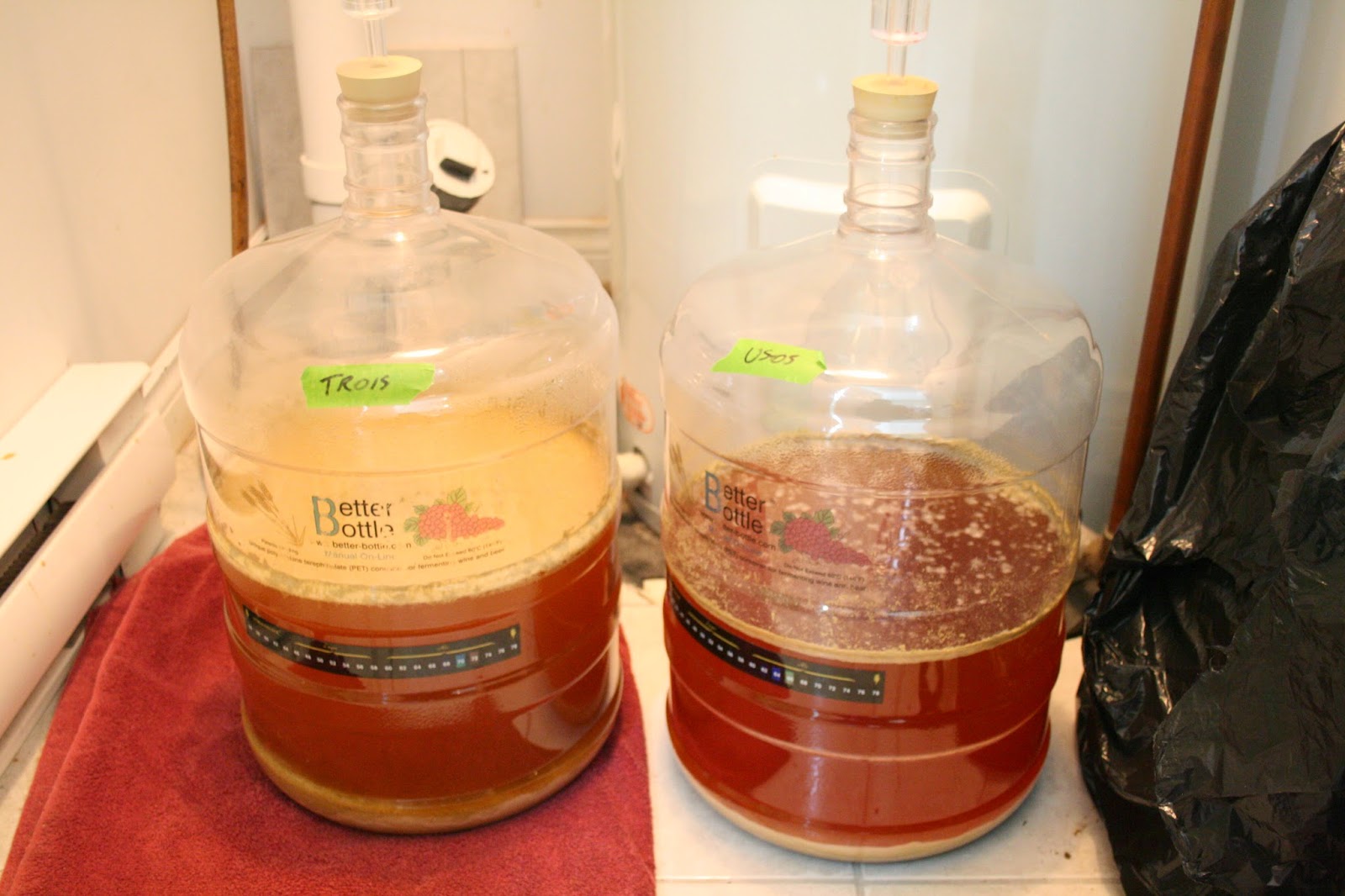
After the temp was in the low 60s, I simply gave a slight stir to the wort (to ensure there was an equal amount of trub going in each fermentor) and poured half into one Better Bottle, and half into another. Both were aerated with 60 seconds of pure O2 each, and the yeasts were pitched. The White Labs website says the ideal fermentation temps for Trois are between 70-85 F; now, I'm not sure if this should be updated or not. I know others have used Trois and definitely weren't fermenting in the high 70s or beyond. But, to be sure, I set the BB with Trois in my water heater room, a small space with a baseboard heater controlled by a digital thermostat, and set it to 68-70 F. The US-05 fermentor, however, was set in my laundry sink, where the ambient temp was probably around 64 F.

Fermentation started relatively quickly for both beers; obviously, the Trois beer had more active fermentation at the beginning, as the temp kept steady in the high 60s and quickly reached 70-72 F, while the US-05 beer stayed in the low 60s for the first couple of days, before fermentation really took off. Trois finished faster, as expected, with US-05 a couple of days behind. After 10 days or so (no pellicle developed in this time; mind you, it probably takes longer than a week and a half, if it develops at all?), I took a FG reading - both finished at 1.013 (as you can see from the picture below, the US-05 beer dropped much clearer). I then dry-hopped directly in primary, twice, for 5 days at a time. Ideally, I would have moved both beers to "dry-hop kegs", as is my current routine for hoppy beers, but I only have one dry-hop keg, and I wanted to keep the procedure as consistent as possible between beers. At the time, I was also unsure if I was kegging the beers or bottling them, so dry-hopping in primary was my safest bet.

One week after pitching
I ended up kegging both, as I had two free taps in my keezer. The tasting notes for both beers are below; really, they came out pretty similar. That being said, I think most people could definitely tell the difference between the two, and I've had several friends try the beer, all of whom had no problem telling the beers apart. The general consensus is that the Trois-fermented beer is slightly better, with a bit more tangy, juicy fruitiness to it, but the US-05 version is pretty great, too. Personally, I find the US-05 beer has a bit more of a "bite" to it in the finish; not sure why - like I said, both beers finished at 1.013 - but there it is. Just my opinion.

Whether you have access to Trois or not, this is still a great recipe... one of the perfect hoppy summer beers, in my opinion. Big on hop aroma and flavor, low on alcohol. But if you DO have Trois, I find it gives the beer a slightly small push towards greatness, even from where it was before.

Now, White Labs, how about packaging more than 2-3 billion cells of Trois in a vial?

Recipe Targets: (6 gallons, 73% efficiency) OG 1.048, FG ~1.012, IBU ~35, SRM 5.3, ABV ~4.7%

Grains:
2.6 kg (54.1%) Wheat malt
1.7 kg (35.3%) Canadian 2-row
330 g (6.9%) CaraVienne
80 g (1.7%) Acid malt
100 g (2.1%) Rice hulls

Hops:
Hop extract - 2 mL @ 60 min (or 11 g of a 10% AA hop variety)

Citra - 56 g (12.4% AA) @ 0 min (with a 10 min hop steep)
Amarillo - 28 g (7.9% AA) @ 0 min (with a 10 min hop steep)
Citra - 56 g @ 0 min (when start chilling)
Amarillo - 28 g @ 0 min (when start chilling)

Citra - 56 g dry-hop for 5 days (in primary)
Amarillo - 14 g dry-hop for 5 days (in primary)
                                                                          *Both dry-hop additions halved for each fermentor
Citra - 56 g dry-hop for 5 more days (in primary)
Amarillo - 14 g dry-hop for 5 more days (in primary)

Misc: 1/2 tab Irish Moss at 5 min

Yeast: US-05 Safale (1/2 pack, rehydrated) for half the wort, WLP644 Brett Trois (with a 900 mL starter, stepped up with another 1.5 L)

Water: Fredericton city water, carbon-filtered; 5 g Gypsum and 5 g calcium chloride added to mash

- Brewed on March 22nd, 2015, by myself. 50-minute mash with 14 L of strike water, mashed in at target of 155 F. Mashed-out for 10 minutes with 5.5 L of boiling water. Sparged with ~4.5 gallons of 168 F water for final volume of ~7.25 gallons.

- SG on target, 1.040. 90-minute boil. Flameout hops had a 10-minute steep before turning on the chiller. Final volume a bit high at ~6.25 gallons; OG 1.048. Chilled to low-60s F, stirred gently to evenly distribute trub, then poured into two Better Bottles. Aerated each with 60 seconds of pure O2, and pitched decanted yeast starter in one fermentor, and the rehydrated US-05 in the other, at 64 F for each. The Trois fermentor was set in the water heater room (ambient temp ~68 F), US-05 fermentor in laundry room (ambient ~64 F).

- Fermentation for the Trois batch took off quickly, with visible activity complete after only 3 days (temp reached as high as 70 F). US-05 started slower and continued longer, eventually reaching a high of 70 F as well, albeit over several days. FG for both beers was 1.013.

- 2/4/15 - Added first dry-hop addition to primary for both beers.

- 7/4/15 - Second dry-hop addition, also into both primaries.

- 12/4/15 - Racked both beers to kegs, purged with CO2 before and after, set in keezer to chill down overnight. Started carbing the next day.


Appearance: Both poured with a medium-sized, white head that sticks around for a while before fading to 1/4-finger. Bodies are both golden-coloured with pretty good clarity. Seem identical to me.

Aroma: The aroma between the two is quite similar. I find the dankness/cat pee characters of the Citra comes through more in the US-05, while the Trois is slightly more fruity/juicy smelling. Bit of supporting sweetness in both beers, but obviously the hops dominate.

Taste: Trois - Starts off with a touch of sweetness and tartness, and then a really nice tropical fruit character takes over, with some supporting pineapple working with it. Very juicy. Finishes with a moderate-light bitterness, nice balance between dry and sweet.

US-05 - Ditto with the malt character, but the hop flavors are more dank; definitely still fruity from all that Citra, but not quite as tropical as the Trois. Like the Trois, finishes moderate-lightly bitter, but it has a bit more "bite" to it; slightly drier.

Mouthfeel: Both are medium-bodied with moderate carbonation.

Overall: Interesting experiment; at first I was more a fan of the US-05 half, as I didn't think the Trois was overly dominant at the beginning. But after a few weeks, I think I prefer the Trois; I really like the extra juiciness the yeast adds to the beer. That being said, I don't detect any Brett characteristics (funky, barnyard) in the beer at all.

Friday, 10 April 2015

"Baby Zoe" - a Session version of Maine Beer Co. Zoe


It was almost two years ago that I brewed my first Maine Beer Co. clone; it was Zoe, a hoppy Amber ale that was the second beer that the brewery released. I had contacted co-owner/brewer Dan Kleban for help formulating a Zoe recipe; he sent along some useful suggestions, and the resulting beer was excellent. When tasted side-by-side with the commercial beer, I found that the homebrew version actually came out hoppier. I think it's possible that Zoe has become a less-hoppy beer over the years compared to when it was first released, but I could easily be wrong; it could simply be that my tastes have changed.

Either way, I really enjoyed the homebrew version and had always planned on brewing it again. Recently, I decided to revisit it, mainly because I've brewed several really hoppy Amber ales since then that I've loved (such as a Modern Times Blazing World clone, and Meek Celebration, a hoppy Amber I brewed for Christmas a few months ago), and I wanted to see if the Zoe clone could hold its own. But then I had another idea: I've been brewing more and more lower-ABV, hoppy beers lately, and had been planning on doing a "Session Red IPA" of sorts. I love Red IPAs, but they're usually 6-8% ABV (or higher), and the idea of a sessionable one really appealed to me. So... why not brew Zoe to a lower ABV?

This is exactly the same recipe - grist-wise and hopping-wise - as before, except it's all been scaled down to a 4-gallon batch, and to an OG of 1.048. The grist is made up of equal parts 2-row and Maris Otter, with several specialty malts added to give the beer its dark amber color and supporting malt backbone (lots of caramel in this one, and even a bit of chocolate, too). I did raise the mash temp this time; it was 150 F before (at Dan's recommendation), but with the lower OG, I wanted to make sure that the beer had enough body. My experience with low-ABV hoppy beers has led me to always use a mash temp of at least 153 F, which is the target I aimed for with this beer. I also kept the water adjustment the same as last time, with a bit of Gypsum, table salt, and Epsom salt added to adjust to the "San Diego - Hoppy" water profile from The Mad Fermentationist. Not a profile I usually aim to replicate anymore, but it obviously worked well for this beer before, so I decided to use it again.

The hopping schedule I used for Zoe is made up of equal amounts of Centennial, Columbus (CTZ), and Simcoe. Apparently, Simcoe is used as the bittering hop, but this time around I subbed in CTZ, simply because I can't see it making a difference. There's lots of other hop additions for flavor and aroma: two near the end of the boil, one at flameout for a hop steep, and another when I started chilling the wort. A single dry-hop (in primary) for a week or so, and then rack to a keg or bottle. Pretty straight-forward.

The brew day went well; my only real complaint was a slightly low OG due to a little extra volume. Brewing this time of year can be a pain, even with a garage to keep the wind out and the temps from getting TOO low (but come on, it's winter, and the door still has to be open a bit, so it's still damned cold). The one plus is that the ground water temps are so low, it takes barely any time to chill the wort to pitching temp. But yeah, I know, for those of you in California, this sounds like a bit of a stretch... and it is! Jerks.

As before, I fermented the wort with US-05. These low-OG beers usually ferment out pretty quickly, and after 2-3 days of activity in the airlock, things settled down. I dry-hopped the beer directly in primary about a week and a half later (I would normally have racked the beer to my dry-hop keg, but didn't have the time, oddly), then racked to a keg and carbed it up.

I wasn't really sure what to expect from this beer, but I guess I was hoping to have a beer that smelled and tasted as good as the original clone, in spite of the lower ABV. And you know what? That's about how it turned out. For the first few pours, I felt like the beer was good, but not as hoppy as the last time (despite using the same hop varieties, and the same amounts); it actually tasted more like the real Zoe than the last one did! But after a couple of days (probably as the carbonation improved), the beer really opened up. It's the perfect balance of malty (slightly sweet, some caramel and toffee, and just a touch of chocolate) and hoppy (citrusy, fruity, slightly dank). All that and 4.3% ABV? I'll take it.

With these results, there's nothing I would change with the recipe. I suppose I could bump the mash temp up a bit, to 155-156 F, next time, just to see if a bit more body would make the beer even better. If you're a big fan of Zoe, brew the first recipe. If you're a big fan of Zoe but want less alcohol, brew this one. I'm definitely going to continue this experiment, and re-brew the other Red IPAs I mentioned above, but in the sub-5% ABV zone. Cheers!

Recipe Targets: (4 gallons, 80% efficiency) OG 1.048, FG ~1.012, IBU ~50, SRM 11.5, ABV ~4.7%

Grains:
1.25 kg (41.7%) Canadian 2-row
1.25 kg (41.7%) Maris Otter
150 g (5%) Munich
150 g (5%) Victory
75 g (2.5%) Crystal 40 L
75 g (2.5%) Crystal 80 L
45 g (1.5%) Chocolate malt

Hops:
CTZ - 5 g (11.3% AA) @ 60 min
Centennial - 10 g (8% AA) @ 10 min
CTZ -10 g @ 10 min
Simcoe - 10 (11.8% AA) g @ 10 min
Simcoe, Centennial, CTZ - 10 g each @ 5 min
Simcoe, Centennial, CTZ - 14 g each @ flameout, 10-minute hop steep
Simcoe, Centennial, CTZ - 14 g each when started chiller
Simcoe, Centennial, CTZ - 19 g each dry-hop for 5-7 days

Misc: 1/2 tab Irish Moss at 5 min

Yeast: US-05 Safale, ~3/4 package, rehydrated

Water: Fredericton city water, carbon-filtered; 4 g Gypsum, 3 g table salt, 2 g epsom salt added to the mash

- Brewed on March 6th, 2015, by myself. 50-minute mash with 9 L of strike water, mashed in at 153 F. Mashed-out for 10 minutes with 4 L of boiling water. Sparged with ~3.75 gallons of 168 F water for final volume of ~5.4 gallons.

- SG low at 1.036 (target 1.037). 60-minute boil. Flameout hops had a 10-minute steep before turning on the chiller. Final volume a bit high at ~4.25 gallons; OG a little low at 1.046. Chilled to low-60s F, then poured into Better Bottle. Aerated with 60 seconds of pure O2, pitched rehydrated yeast at 64 F.

- Good fermentation after about 24 hours from pitching; took 2-3 days before it started slowing down significantly in the airlock. Temp reached as high as 68 F.

- 15/3/15 - FG 1.013. Added dry-hops directly into primary. Kegged about 7 days later and started carbing.


Appearance: Pours with a moderate-sized, off-white head that eventually fades to a thin film on the beer. Body is a dark amber/light red color, with excellent clarity.

Aroma: Equal balance between fruity hops and caramel malt... sweet, but not too much. A tiny bit of chocolate making its way through, as well as a little hop dankness.

Taste: Sweet caramel and toffee flavors at first, melded with just a hint of chocolate. The fruitiness of the hops comes through very quickly, and finishes with a moderate bitterness. More on the side of dry than sweet.

Mouthfeel: Medium-light bodied, moderate carbonation. 

Overall: Very enjoyable; nice having a "sessionable-Zoe". Nothing wrong with the previous clone at ~7%, but I'll take something that tastes about as good with less alcohol, any time!

Wednesday, 19 November 2014

Tasting : Saizacca (Oxbow Grizacca clone)

I'm writing this post while the pain is still fresh in my heart.

Let me say that I really loved how this beer, my clone attempt of Grizacca from Oxbow in Maine, came out. That's correct, I'm using the word "love" in the past tense, even though the beer has only been kegged and carbonated for a few weeks at the most. When I started drinking it, I was quite impressed with what Azacca brought to the beer. Sure, I threw in a bit of Simcoe, too, but I could tell this was something I hadn't had before. I wish I was better at describing different fruity characteristics... but I'm not. It just had a very over-ripe fruit aroma to it (but not in a bad way), that followed in the flavor; a friend insisted it reminded him strongly of clementines. Combined with the Saison yeast fruity/spicy flavors and aromas, it was a really interesting combination.

I even took a trip to Portland last weekend, and went to Oxbow's new "Blending and Bottling tasting room". Very cool spot; something like 6-7 of their beers on tap, lots of swag for sale, a couple of bottles, growlers, etc. Very large warehouse-like area that had the tasting room on one side (picnic benches and a bar, basically), and a whole lot of barrels on the other. There was also some brewing equipment over there as well...? Not sure what they have planned for the future. We were able to try several new Oxbow beers (to me) on tap, and I of course had Grizacca again. I thought it tasted quite similar to my clone, but theirs was definitely smoother and more-refined, I'd say. I had bottled some of my clone before the trip to drop off for owner/brewer Tim Adams, at his request. I'll be interested to see what he has to say about it. (UPDATE ALREADY: He said he and some other employees really enjoyed it...)


SO. When I got home, I checked on my keezer and hooked up the beer line for my Brown IPA that I had brewed and started carbonating. I tested it out, and that was that. The next afternoon, I decided to go down and pour myself a Saizacca. The towel on the floor, beneath the taps (a temporary drip-tray, I guess) was sopping wet. It was not like this the night before. When I opened the keezer, there was a good inch of beer on the bottom. Crap. Crap. CRAP. I don't know how I knew, but I pulled the Saizacca tap, and only CO2 came out (with a bit of beer left in the line).

Some slight cursing may have followed.

You know what's REALLY frustrating about all this? It's not just that there was still more than half the batch left (I had only poured/sampled it seven times myself), it's not only that I really liked this beer (more than the other 2-3 beers on tap at the time), it's that I still have no idea exactly what happened. I tested the keg for leaks, it's fine. I filled it with hot water and ran it through the same line, the same tap, the same QD, everything shortly after... and there was no leak. And I hadn't opened that tap before the leak began, either. One homebrewer suggested that when I hooked up the beer QD to the Brown IPA, maybe something jostled against the Saizacca beer QD, and it started a slow leak? I dunno, maybe; that's as good an explanation as any, other than there's an evil beer fairy who hates me.

Therefore, please excuse the lack of a photo of the beer in this post (the first time I've done that). Instead, I'm including a couple of not-fantastic-quality pics from our visit to the Oxbow tasting room in Portland. Luckily, I DO have my tasting notes on the beer. And also-luckily, I picked up a pound of 2014 Azacca hops on the trip, that I had ordered a few weeks ago. Maybe this is a sign?

Oh, and don't ever let anyone tell you that kegging is always better than bottling.


Appearance: Pours with a medium-sized, white fluffy head that shows some good retention. The body is a pale yellow color, and quite hazy.

Aroma: Huge ripe (over-ripe?) fruit aroma... really nice. Very up-front. A few more sniffs shows a bit of Belgian phenolic character coming through; very familiar to me after using this yeast many times.

Taste: Again with the ripe fruit. There's a lot going on here, I'm just not eloquent enough to say exactly what it all is; but there's lots of citrus and tropical fruit. Kind of reminds me of Nelson Sauvin, but it becomes clear after many sips that it's set apart from Nelson. Finishes with a moderate bitterness; perhaps a bit too much, and definitely more than the commercial beer has.

Mouthfeel: Medium-light bodied, with moderate carbonation.

Overall: It was a very nice beer. If I brewed it again, I'd cut back on the IBUs for sure. Definitely gives me a very good idea of what Azacca brings to the table; I'd like to use it in a beer with a more-neutral yeast, maybe an APA or IPA. I think it would pair nicely with other hops, as well.

Tuesday, 21 October 2014

Brewing an Oxbow Grizacca clone (No. 5 in the Maine Beer Clone series)


It occurred to me a while ago that I hadn't brewed any Maine beer clones lately; my last one was the delicious APA, MO, from Maine Beer Company, back in early January. So, naturally that got the idea in my head to brew another... and I'm telling you, there's a lot of good options. It never ceases to amaze me how many awesome breweries that Maine has. Some obvious beers that would be great to "clone" came to me: Maine Beer Co. Lunch, lots of beers from Allagash, and one of the most highly-sought-after beers in the state, The Substance, a fantastic American IPA from one of Portland's newest breweries, Bissell Brothers.

BUT. I was in Portland for one of my beer trips in June, and I had a lot of fantastic beers there, as always. Maybe my favorite was one from the farmhouse brewery, Oxbow, in Newcastle. The beers coming out of this little brewery are pretty awesome; I attempted a clone of one of their Freestyle series beers, No. 5 (a "Black Wheat Saison"), almost two years ago (my recipe here, along with more info on Oxbow). That was actually my first beer in the Maine Beer Clone series, and I had a lot of help from Oxbow co-founder and head brewer Tim Adams.


Oops, I'm digressing. Anyway, this awesome beer I had from Oxbow was Grizacca. I didn't know anything about the beer at the time, other than it was a ~5% ABV Saison-type beer. It was really delicious, and smelled fantastic. Light and easy-drinking, it was a very pale-colored beer, pretty cloudy. Strong on both Saison yeast character, and hops. Very "ripe" and fruity, I swore to myself that it must be heavily-hopped with Nelson Sauvin. Obviously, I was paying absolutely no attention to the actual NAME of the beer. Now that I know more, I can elaborate. Grizacca is a Grisette, heavily-hopped with Azacca.


First, some info on what a Grisette is/was. Thought to originate in the Hainaut province of Belgium in the late 1800s, Grisette was brewed for miners with the intention of being a dry, refreshing, and sessionable beer, similar to Saisons being brewed for farmers. Indeed, Grisette is very similar to the Saison style... at least, how Saison originally was: a low-alcohol, light-bodied golden ale. With a grist usually made up of a healthy portion of wheat, the beer was only lightly-hopped. According to "Farmhouse Ales: Culture and Craftsmanship in the Belgian Tradition", by Phil Markowski, only a single brewery in Belgium markets the name grisette: Brasserie Friart, better known now as Brasserie St. Feuillien

So, Oxbow took a mostly-diminished beer style (although, to be honest, it seems to me that a lot of today's low-alcohol Saisons could be considered Grisettes as well), and made it their own... by hopping the hell out if it with one of the newest, hottest hop varieties out there right now - Azacca. An American variety, I believe the 2013 crop was the first time Azacca was released commercially under that name (previously, it was known as ADHA 483; not quite as catchy). Like a lot of hops, it has many descriptors, including tropical fruit, citrus, pineapple, grapefruit, orchard fruit, and pine, among others. Already, there have been a lot of experiments with single-hopped beers with Azacca (especially among homebrewers; check out those by Derek at Bear-Flavored and Chris at Lewy Brewing).


Due to the generous information I was given for my last Oxbow clone, I decided to try emailing Tim Adams again to see if he'd be willing to help out a bit with a clone for Grizacca. Luckily for me, he was once again quite forthcoming. Here's his email response...


Use some good pils. 1/2 the grist should be a blend of malted wheat and and spelt.  Again, use the good stuff! Shoot for 4.5-5% abv. Blast your whirlpool with Azacca but save some for dry hop!  You might wanna dry hop twice, and you might wanna thow in one more hop varietal ;) Saison yeast of your choice, just make sure it does a good job!  We shoot for about 1.002 final gravity. You want that shit dry!

He was even nice enough to apologize later for being "cryptic" about the second hop variety; totally unnecessary, but still great of him! I felt this was plenty of information to go on, and could at the very least set me on the right track. 

I started by, of course, putting the recipe's grist together. Spelt is an ancient type of wheat that is high in protein (~17%) that is starting to see more use in brewing. I knew right away that I wouldn't be able to find any spelt from my LHBS. However, a friend here in Fredericton is the owner/brewer of a fairly-new Belgian-style brewery (Grimross Brewing), and he normally uses spelt in one of his flagship beers. Unfortunately, it had been hard to come by lately, so he was fresh out. Tim had actually told me that if finding spelt was an issue, to substitute in flaked wheat, which is what I ended up having to do. Otherwise, the rest of the grist was easy... I added a bit of Acid malt for pH reasons, and some rice hulls to help prevent a stuck sparge. I aimed for an OG of about 1.042 to get to ~4.7% ABV... I thought getting down to 1.002 for a final gravity may be pushing it a bit on my system at this time of year (summer would have been another story), so I figured 1.005-1.006 would be more realistic.


Coming up with a hopping schedule was, for the most part, pretty easy. I added a bit of Azacca at the beginning of the boil to provide a few IBUs (feel free to use any bittering hop; I used Azacca simply because I didn't feel the need to open a vacuum-sealed bag of another variety for just a few grams), and then added a whole whack of it near the end of the boil, at 5 minutes, flameout for a hop stand/steep, and even more when the wort temp dropped below 180 F (an approach I've been using a lot lately for hoppy beers). The question was... what should I add for the other hop variety, which I assumed would be in the dry-hop additions?

I really wish I had one of those amazing senses of smell, or a fantastic palate like some do... but I don't. I'm not going to pretend I can pick out a certain hop variety in a multi-hopped beer, especially when it's in the background compared to a highly-flavorful hop like Azacca. First, I considered Nelson Sauvin based on my initial thoughts on Grizacca, but somehow I can't see Oxbow using that in a beer with Azacca. I was going to go with Centennial, but at the last minute I changed my mind... and I don't know why. But I did, and threw in some Simcoe for both dry-hop additions. Even if it's not what Oxbow uses, I figure it'll still be tasty!

For my yeast, I went with the always-dependable (for me, anyway) Wyeast 3711 French Saison. I've used this strain several times in the past (such as in my very tasty Prairie Artisan Ales 'Merican clone); I really like what it brings to a beer, and how well it attenuates without a lot of fuss (I'm looking at you, 3724). It's also a great yeast to use this time of year; it's not exactly hot out anymore, and Wyeast lists the fermentation range from 65-77 F, which is perfectly doable any time of year, really, indoors.

And that's about it. As usual, here's hoping for a tasty beer, if not a clone of the real thing! It's all about the adventure, right? Well, the end product has to play SOME part in all this.

Recipe targets: (4 gallons, 75% efficiency) OG 1.041, FG ~1.005, IBU ~40, SRM 3, ABV ~4.6%

Grains:
1.3 kg (49.1%) Pilsner
650 g (24.5%) Wheat malt
650 g (24.5%) Flaked Wheat
50 g (1.9%) Acid malt
125 g Rice hulls


Hops:
Azacca - 5 g (14% AA) @ 60 min
Azacca - 30 g @ 5 min

Azacca - 30 g @ 0 min (with a 15-minute steep)

Azacca - 60 g after started chilling, when wort temp below 180 F

Azacca - 40 g dry-hop for 4 days (in primary)
Simcoe - 20 g dry-hop for 4 days (in primary)

Azacca - 40 g dry-hop for 4 more days (keg-hop)
Simcoe - 20 g dry-hop for 4 more days (keg-hop)

Misc.: 1/2 tab Irish Moss @ 5 min

Yeast: Wyeast 3711 French Saison (production date Aug 19th)

Water: Fredericton city water, carbon-filtered; 2 g Gypsum and 2 g calcium chloride added to the mash


- Brewed on September 28th, 2014, by myself. 50-minute mash with 8 L of strike water, mashed in at target of 148 F. Mashed-out for 10 minutes with 5 L of boiling water. Sparged with ~4.25 gallons of 168 F water for final volume of ~5.75 gallons.

- SG a bit low at 1.028 (target 1.029). 90-minute boil. Flameout hops had a 10-minute steep before turning on the chiller; wort temp was almost immediately below 180 F, where I added the second amount of flameout hops. Final volume ~4 gallons. Chilled down to 64 F, then poured into Better Bottle. OG slightly high at 1.042. Aerated with 60 seconds of pure O2, pitched yeast.

- Good activity over the first several days, temp getting up to 74 F. Visible fermentation ended quickly.

- 10/10/14 - FG 1.005. Added 1st dry hops directly into primary.

- 14/10/14 - Racked beer to CO2-purged keg; added 2nd dry hops in a weighted-down mesh bag; left at room temp.

- 18/10/14 - Removed dry-hops, set keg in keezer to bring temp down before starting to carb.

- Tasting notes here... the beer came out great, I'm really happy with it. However...