Showing posts with label Saison. Show all posts

Friday, 13 November 2015

Brewing a Hoppy Saison (based on my Prairie 'Merica clone)

After brewing my Maine Beer Co. Peeper clone in late June, my stretch of frantic brewing (for me... 6 batches in 6 weeks!) was over. Enter the summer months... temperatures are a lot higher, making it more difficult to control fermentation adequately (my fermentation chamber became my keezer over a year ago), and I'm often away on weekends off. During the months of July and August, I only brewed one time... and I wanted to make it count; I really had to think hard about what exactly to brew.

It actually turned out to be an easy decision; weeks before, I had ordered one of my favorite Saison yeast strains from my LHBS; because they don't regularly keep it in stock, it can easily take 4 weeks or longer, so I ordered back in early June. Wyeast 3711 French Saison has always given me good results - I like the combination of fruity and pepper flavors that it gives, and I like that it isn't finicky... it's never once crapped out on me and left me wondering if the beer was ever going to finish. With this yeast, I was armed to do a re-brew of one of my all-time favorite homebrews of mine: the Prairie Artisan Ales 'Merica clone, originally brewed almost two years ago.

That beer - a SMaSH Saison brewed with Pilsner malt and hopped heavily with Nelson Sauvin, and dosed with Brettanomyces at bottling - was a real winner. Juicy and tropical, dry, and a touch of funk from the Brett (I actually split the batch, dosing half with Brett and leaving the other half without), it was definitely one of my homebrew highlights of 2013, and likely in the top 10 of all-time. I put the recipe together based on some info I found online (mostly through the brewery's website); after I posted the recipe, they tweeted back to me a couple of recommended minor adjustments to the hop schedule. Since then, I've been wanting to rebrew it, which is what I finally planned to do for my solo summer brew day.

I was initially going to do the exact same recipe, but with everything scaled down to a lower-ABV beer. My 'Merica clone had an OG target of 1.056; the non-Brett portion finished at 1.006, for an ABV of 6.7%. This time, I aimed for 1.048. No particular reason, I just didn't really need a higher-ABV beer. Otherwise, I planned on following Prairie's recommendations... but I changed my mind very close to brew day, and made several alterations:

1) I decided to back off the Nelson a little bit, and add two more varieties, Citra and Centennial. Not that I have anything against Nelson; quite the contrary! However, it IS an extremely expensive and hard to obtain hop, and I really wanted to play with a combination of the three. These three varieties were used in my Societe Brewing The Pupil clone I brewed last year, and worked great together. I wanted to see what this combination would be like with a Saison yeast. Note from the recipe below that Nelson is still the most-used hop.

2) I went with a hopping schedule more similar to my first beer then Prairie's recommendations. Not because I think mine would work better, but because I know my original one worked well on my system the first time. The minor changes include a very small hop addition at 60 minutes (I used Nelson because the package was open; at only 7 grams, I figured it wasn't a big deal to use it), and I took out the 5-minute addition.

3) I added a dry-hop addition; the first (Nelson and Centennial) would be in primary, and the second (Nelson and Citra) a keg-hop before transferring to the serving keg. Not that the first beer didn't have tons of hop flavour and aroma; I just wanted to really try to maximize the hop presence, and see if a keg-hop addition would boost it even more.

So, this beer ended up being more "inspired by" my original clone than a simple rebrew. The mash temp was kept the same as before (151 F). When I went to weigh out the grains (and mill them) the night before brewing, I realized I was almost completely out of Acid malt. Now, I didn't use any Acid malt when I brewed the 'Merica clone, but I use it for almost all my beers now to adjust mash pH. I had planned on using close to 2.5% of the grist as Acid malt, but I only had a mere 22 g on hand... that's about 0.5%. Even with the bump up of salt additions to the mash this time around, my mash pH was still calculated to be higher than I would like (I usually try to target 5.4 or so). But at this point, there was no changing it, so I just had to accept it.

Otherwise, the day went well. My OG came in a bit high (1.051), but I was ok with that. I pitched the yeast at about 64 F and decided to just let it go on its own; being a Saison yeast (Wyeast 3711 French Saison, my typical go-to Saison yeast), I wasn't worried about it getting over 70 F. A couple days after pitching, it got up to 76 F, and started dropping slowly the next day as active fermentation petered out. After close to two weeks, the first round of dry-hops were added to primary, then the beer was racked to the designated dry-hop keg, where the second addition was thrown in. Transferred to the serving keg after another 4-5 days, and carbed.

I have to say that, despite being a very tasty beer, I prefer the original 'Merica clone. This beer DOES have plenty of tropical fruit and citrus in both the aroma and taste, and the Nelson is quite apparent (being so dominant as usual), but it was just SO in your face when used completely on its own... in a wonderful, wonderful way. I also find this beer to have a slight carbonic bite in the finish; the bitterness isn't too high, but there's just something that was a tad bit off.

In the end, though, still a really good beer, I think. We had no problem polishing this keg off a few weeks ago (I really have to start posting more), and I think lovers of hoppy Saisons would be impressed with the hop presence in this beer. If you can get your hands on some Nelson and Citra, give it a try!

Recipe Targets: (5.5 gallons, 75% efficiency) OG 1.048, FG ~1.004, IBU ~45, SRM 3.5, ABV ~6%

Grains:
4.25 kg (99.5%) Pilsner
22 g (0.5%) Acid malt

Hops:
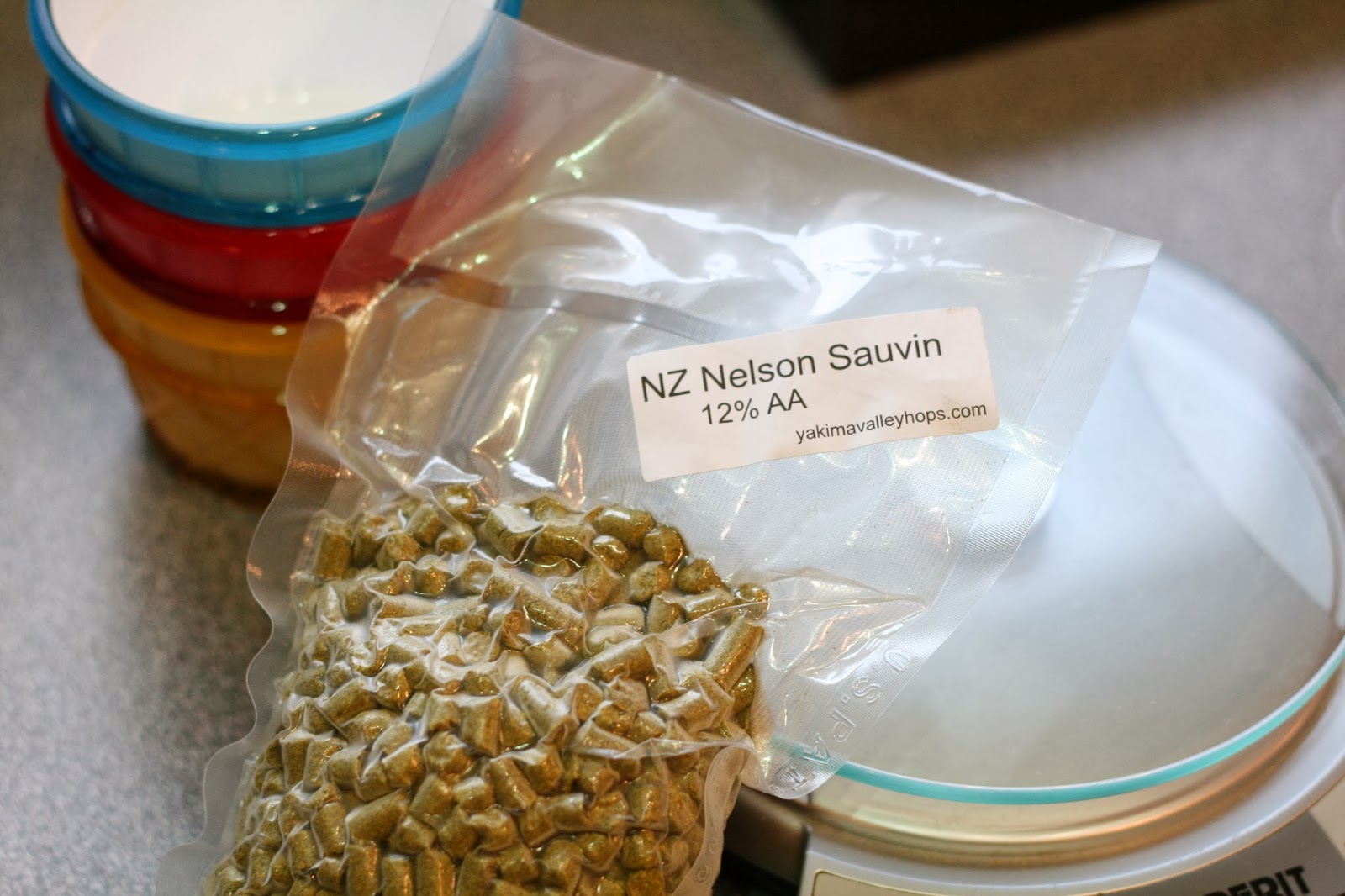
Nelson Sauvin - 7 g (11.6% AA) @ 60 min
Nelson Sauvin - 28 g @ 10 min

Citra - 28 g @ 0 min (with a 15 min hop steep)
Nelson Sauvin - 42 g @ 0 min (with a 15 min hop steep)

Centennial - 40 g dry-hop for 5 days (in primary)
Nelson Sauvin - 42 g dry-hop for 5 days (in primary)

Citra - 28 g dry-hop for 5 more days (keg)
Nelson Sauvin - 42 g dry-hop for 5 more days (keg)

Misc: 1/2 tab Irish Moss at 5 min

Yeast: Wyeast 3711 French Saison (with a starter)

Water: Fredericton city water, carbon-filtered; 3 g Gypsum and 5 g calcium chloride added to mash

- Brewed on July 29th, 2015, by myself. 50-minute mash with 13 L of strike water, mashed in at target of 151 F. Mashed-out for 10 minutes with 6.5 L of boiling water. Sparged with ~4.5 gallons of 168 F water for final volume of ~7.25 gallons.

- SG 1.038 (target 1.036). 90-minute boil. Final volume ~5.75 gallons; OG high at 1.051. Chilled to low-60s F, then poured into Better Bottle. Aerated with 60 seconds of pure O2, pitched yeast starter at 64 F.

- Great fermentation over the first few days, temp hovering around 70 F for the first day, eventually rising to as high as 76 F by the second day. Began to slow after day 3, temp dropping only slightly ever day. FG finally reached as low as 1.003.

- Added first round of dry hops to primary on August 11th; five days later, racked to CO2-purged dry-hop keg and added second dry hops. Cold-crashed five days later and transferred to serving keg and began carbing with CO2.
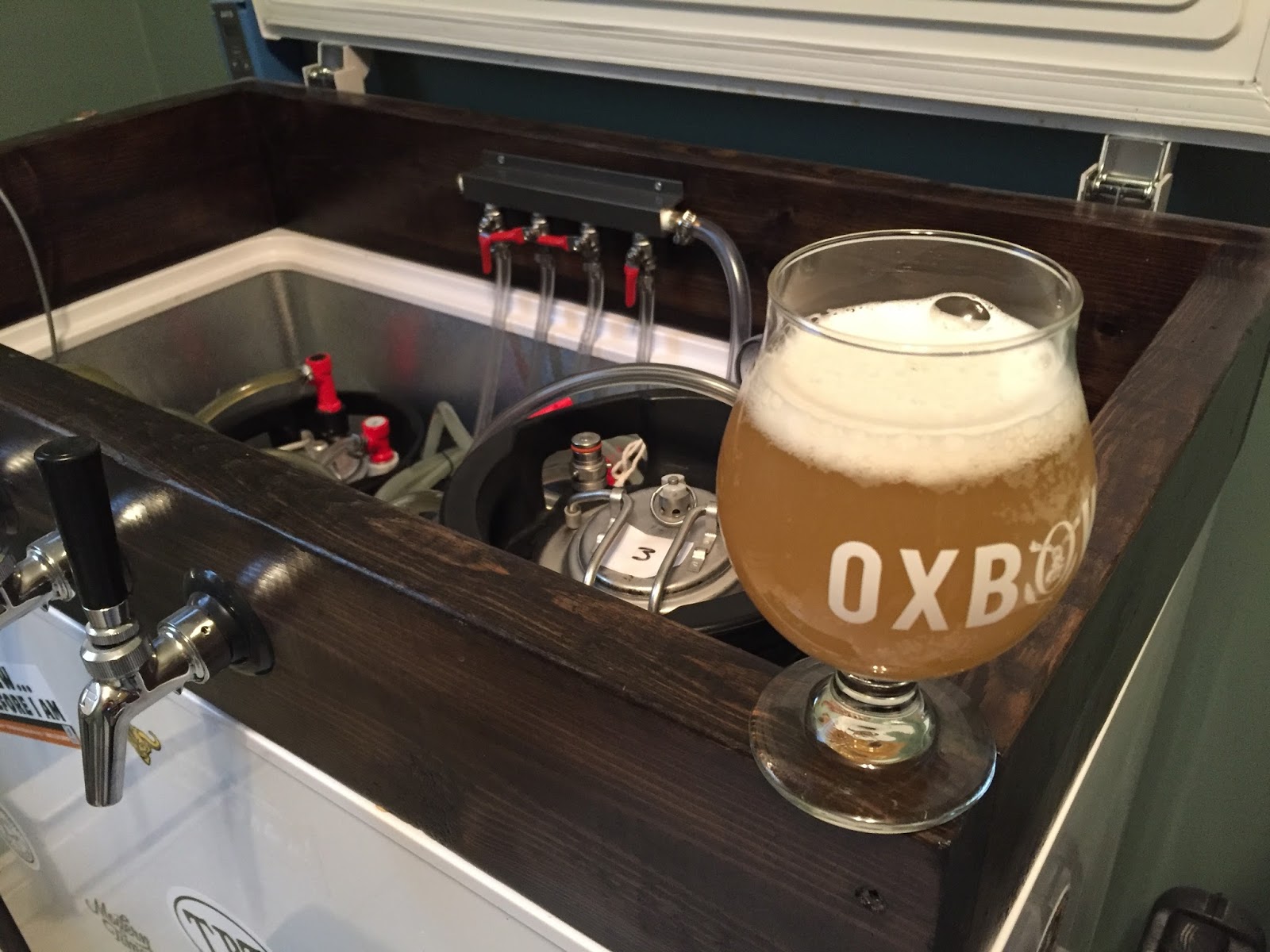

Appearance: Pours with a moderate-sized head that quickly fades to 1/2-finger... too fast for the style. Body is a light yellow color, and quite hazy/murky (I assume from all the dry-hopping). Not the prettiest beer.

Aroma: Nice smack of tropical hop goodness, with a fair amount of citrus in there, too. There is definitely a background of Belgian phenolic spiciness from the yeast, but various fruit wins out by far.

Taste: Ditto; very tropical and citrusy. Nelson sticks out more than anything else with its characteristic gooseberry flavour, but this beer has more citrus than the first iteration, with a little spicy phenolics backing it all up. Moderate bitterness in the finish; bit of a carbonic bite. Quite dry.

Mouthfeel: Medium-light bodied, with carbonation that borders somewhere between medium and medium-low... could definitely be higher for the style.

Overall: Very enjoyable, but in the end I'd have to say I prefer my straight 'Merica clone, i.e. all Nelson Sauvin.

Wednesday, 19 November 2014

Tasting : Saizacca (Oxbow Grizacca clone)

I'm writing this post while the pain is still fresh in my heart.

Let me say that I really loved how this beer, my clone attempt of Grizacca from Oxbow in Maine, came out. That's correct, I'm using the word "love" in the past tense, even though the beer has only been kegged and carbonated for a few weeks at the most. When I started drinking it, I was quite impressed with what Azacca brought to the beer. Sure, I threw in a bit of Simcoe, too, but I could tell this was something I hadn't had before. I wish I was better at describing different fruity characteristics... but I'm not. It just had a very over-ripe fruit aroma to it (but not in a bad way), that followed in the flavor; a friend insisted it reminded him strongly of clementines. Combined with the Saison yeast fruity/spicy flavors and aromas, it was a really interesting combination.

I even took a trip to Portland last weekend, and went to Oxbow's new "Blending and Bottling tasting room". Very cool spot; something like 6-7 of their beers on tap, lots of swag for sale, a couple of bottles, growlers, etc. Very large warehouse-like area that had the tasting room on one side (picnic benches and a bar, basically), and a whole lot of barrels on the other. There was also some brewing equipment over there as well...? Not sure what they have planned for the future. We were able to try several new Oxbow beers (to me) on tap, and I of course had Grizacca again. I thought it tasted quite similar to my clone, but theirs was definitely smoother and more-refined, I'd say. I had bottled some of my clone before the trip to drop off for owner/brewer Tim Adams, at his request. I'll be interested to see what he has to say about it. (UPDATE ALREADY: He said he and some other employees really enjoyed it...)


SO. When I got home, I checked on my keezer and hooked up the beer line for my Brown IPA that I had brewed and started carbonating. I tested it out, and that was that. The next afternoon, I decided to go down and pour myself a Saizacca. The towel on the floor, beneath the taps (a temporary drip-tray, I guess) was sopping wet. It was not like this the night before. When I opened the keezer, there was a good inch of beer on the bottom. Crap. Crap. CRAP. I don't know how I knew, but I pulled the Saizacca tap, and only CO2 came out (with a bit of beer left in the line).

Some slight cursing may have followed.

You know what's REALLY frustrating about all this? It's not just that there was still more than half the batch left (I had only poured/sampled it seven times myself), it's not only that I really liked this beer (more than the other 2-3 beers on tap at the time), it's that I still have no idea exactly what happened. I tested the keg for leaks, it's fine. I filled it with hot water and ran it through the same line, the same tap, the same QD, everything shortly after... and there was no leak. And I hadn't opened that tap before the leak began, either. One homebrewer suggested that when I hooked up the beer QD to the Brown IPA, maybe something jostled against the Saizacca beer QD, and it started a slow leak? I dunno, maybe; that's as good an explanation as any, other than there's an evil beer fairy who hates me.

Therefore, please excuse the lack of a photo of the beer in this post (the first time I've done that). Instead, I'm including a couple of not-fantastic-quality pics from our visit to the Oxbow tasting room in Portland. Luckily, I DO have my tasting notes on the beer. And also-luckily, I picked up a pound of 2014 Azacca hops on the trip, that I had ordered a few weeks ago. Maybe this is a sign?

Oh, and don't ever let anyone tell you that kegging is always better than bottling.


Appearance: Pours with a medium-sized, white fluffy head that shows some good retention. The body is a pale yellow color, and quite hazy.

Aroma: Huge ripe (over-ripe?) fruit aroma... really nice. Very up-front. A few more sniffs shows a bit of Belgian phenolic character coming through; very familiar to me after using this yeast many times.

Taste: Again with the ripe fruit. There's a lot going on here, I'm just not eloquent enough to say exactly what it all is; but there's lots of citrus and tropical fruit. Kind of reminds me of Nelson Sauvin, but it becomes clear after many sips that it's set apart from Nelson. Finishes with a moderate bitterness; perhaps a bit too much, and definitely more than the commercial beer has.

Mouthfeel: Medium-light bodied, with moderate carbonation.

Overall: It was a very nice beer. If I brewed it again, I'd cut back on the IBUs for sure. Definitely gives me a very good idea of what Azacca brings to the table; I'd like to use it in a beer with a more-neutral yeast, maybe an APA or IPA. I think it would pair nicely with other hops, as well.

Tuesday, 21 October 2014

Brewing an Oxbow Grizacca clone (No. 5 in the Maine Beer Clone series)


It occurred to me a while ago that I hadn't brewed any Maine beer clones lately; my last one was the delicious APA, MO, from Maine Beer Company, back in early January. So, naturally that got the idea in my head to brew another... and I'm telling you, there's a lot of good options. It never ceases to amaze me how many awesome breweries that Maine has. Some obvious beers that would be great to "clone" came to me: Maine Beer Co. Lunch, lots of beers from Allagash, and one of the most highly-sought-after beers in the state, The Substance, a fantastic American IPA from one of Portland's newest breweries, Bissell Brothers.

BUT. I was in Portland for one of my beer trips in June, and I had a lot of fantastic beers there, as always. Maybe my favorite was one from the farmhouse brewery, Oxbow, in Newcastle. The beers coming out of this little brewery are pretty awesome; I attempted a clone of one of their Freestyle series beers, No. 5 (a "Black Wheat Saison"), almost two years ago (my recipe here, along with more info on Oxbow). That was actually my first beer in the Maine Beer Clone series, and I had a lot of help from Oxbow co-founder and head brewer Tim Adams.


Oops, I'm digressing. Anyway, this awesome beer I had from Oxbow was Grizacca. I didn't know anything about the beer at the time, other than it was a ~5% ABV Saison-type beer. It was really delicious, and smelled fantastic. Light and easy-drinking, it was a very pale-colored beer, pretty cloudy. Strong on both Saison yeast character, and hops. Very "ripe" and fruity, I swore to myself that it must be heavily-hopped with Nelson Sauvin. Obviously, I was paying absolutely no attention to the actual NAME of the beer. Now that I know more, I can elaborate. Grizacca is a Grisette, heavily-hopped with Azacca.


First, some info on what a Grisette is/was. Thought to originate in the Hainaut province of Belgium in the late 1800s, Grisette was brewed for miners with the intention of being a dry, refreshing, and sessionable beer, similar to Saisons being brewed for farmers. Indeed, Grisette is very similar to the Saison style... at least, how Saison originally was: a low-alcohol, light-bodied golden ale. With a grist usually made up of a healthy portion of wheat, the beer was only lightly-hopped. According to "Farmhouse Ales: Culture and Craftsmanship in the Belgian Tradition", by Phil Markowski, only a single brewery in Belgium markets the name grisette: Brasserie Friart, better known now as Brasserie St. Feuillien

So, Oxbow took a mostly-diminished beer style (although, to be honest, it seems to me that a lot of today's low-alcohol Saisons could be considered Grisettes as well), and made it their own... by hopping the hell out if it with one of the newest, hottest hop varieties out there right now - Azacca. An American variety, I believe the 2013 crop was the first time Azacca was released commercially under that name (previously, it was known as ADHA 483; not quite as catchy). Like a lot of hops, it has many descriptors, including tropical fruit, citrus, pineapple, grapefruit, orchard fruit, and pine, among others. Already, there have been a lot of experiments with single-hopped beers with Azacca (especially among homebrewers; check out those by Derek at Bear-Flavored and Chris at Lewy Brewing).


Due to the generous information I was given for my last Oxbow clone, I decided to try emailing Tim Adams again to see if he'd be willing to help out a bit with a clone for Grizacca. Luckily for me, he was once again quite forthcoming. Here's his email response...


Use some good pils. 1/2 the grist should be a blend of malted wheat and and spelt.  Again, use the good stuff! Shoot for 4.5-5% abv. Blast your whirlpool with Azacca but save some for dry hop!  You might wanna dry hop twice, and you might wanna thow in one more hop varietal ;) Saison yeast of your choice, just make sure it does a good job!  We shoot for about 1.002 final gravity. You want that shit dry!

He was even nice enough to apologize later for being "cryptic" about the second hop variety; totally unnecessary, but still great of him! I felt this was plenty of information to go on, and could at the very least set me on the right track. 

I started by, of course, putting the recipe's grist together. Spelt is an ancient type of wheat that is high in protein (~17%) that is starting to see more use in brewing. I knew right away that I wouldn't be able to find any spelt from my LHBS. However, a friend here in Fredericton is the owner/brewer of a fairly-new Belgian-style brewery (Grimross Brewing), and he normally uses spelt in one of his flagship beers. Unfortunately, it had been hard to come by lately, so he was fresh out. Tim had actually told me that if finding spelt was an issue, to substitute in flaked wheat, which is what I ended up having to do. Otherwise, the rest of the grist was easy... I added a bit of Acid malt for pH reasons, and some rice hulls to help prevent a stuck sparge. I aimed for an OG of about 1.042 to get to ~4.7% ABV... I thought getting down to 1.002 for a final gravity may be pushing it a bit on my system at this time of year (summer would have been another story), so I figured 1.005-1.006 would be more realistic.


Coming up with a hopping schedule was, for the most part, pretty easy. I added a bit of Azacca at the beginning of the boil to provide a few IBUs (feel free to use any bittering hop; I used Azacca simply because I didn't feel the need to open a vacuum-sealed bag of another variety for just a few grams), and then added a whole whack of it near the end of the boil, at 5 minutes, flameout for a hop stand/steep, and even more when the wort temp dropped below 180 F (an approach I've been using a lot lately for hoppy beers). The question was... what should I add for the other hop variety, which I assumed would be in the dry-hop additions?

I really wish I had one of those amazing senses of smell, or a fantastic palate like some do... but I don't. I'm not going to pretend I can pick out a certain hop variety in a multi-hopped beer, especially when it's in the background compared to a highly-flavorful hop like Azacca. First, I considered Nelson Sauvin based on my initial thoughts on Grizacca, but somehow I can't see Oxbow using that in a beer with Azacca. I was going to go with Centennial, but at the last minute I changed my mind... and I don't know why. But I did, and threw in some Simcoe for both dry-hop additions. Even if it's not what Oxbow uses, I figure it'll still be tasty!

For my yeast, I went with the always-dependable (for me, anyway) Wyeast 3711 French Saison. I've used this strain several times in the past (such as in my very tasty Prairie Artisan Ales 'Merican clone); I really like what it brings to a beer, and how well it attenuates without a lot of fuss (I'm looking at you, 3724). It's also a great yeast to use this time of year; it's not exactly hot out anymore, and Wyeast lists the fermentation range from 65-77 F, which is perfectly doable any time of year, really, indoors.

And that's about it. As usual, here's hoping for a tasty beer, if not a clone of the real thing! It's all about the adventure, right? Well, the end product has to play SOME part in all this.

Recipe targets: (4 gallons, 75% efficiency) OG 1.041, FG ~1.005, IBU ~40, SRM 3, ABV ~4.6%

Grains:
1.3 kg (49.1%) Pilsner
650 g (24.5%) Wheat malt
650 g (24.5%) Flaked Wheat
50 g (1.9%) Acid malt
125 g Rice hulls


Hops:
Azacca - 5 g (14% AA) @ 60 min
Azacca - 30 g @ 5 min

Azacca - 30 g @ 0 min (with a 15-minute steep)

Azacca - 60 g after started chilling, when wort temp below 180 F

Azacca - 40 g dry-hop for 4 days (in primary)
Simcoe - 20 g dry-hop for 4 days (in primary)

Azacca - 40 g dry-hop for 4 more days (keg-hop)
Simcoe - 20 g dry-hop for 4 more days (keg-hop)

Misc.: 1/2 tab Irish Moss @ 5 min

Yeast: Wyeast 3711 French Saison (production date Aug 19th)

Water: Fredericton city water, carbon-filtered; 2 g Gypsum and 2 g calcium chloride added to the mash


- Brewed on September 28th, 2014, by myself. 50-minute mash with 8 L of strike water, mashed in at target of 148 F. Mashed-out for 10 minutes with 5 L of boiling water. Sparged with ~4.25 gallons of 168 F water for final volume of ~5.75 gallons.

- SG a bit low at 1.028 (target 1.029). 90-minute boil. Flameout hops had a 10-minute steep before turning on the chiller; wort temp was almost immediately below 180 F, where I added the second amount of flameout hops. Final volume ~4 gallons. Chilled down to 64 F, then poured into Better Bottle. OG slightly high at 1.042. Aerated with 60 seconds of pure O2, pitched yeast.

- Good activity over the first several days, temp getting up to 74 F. Visible fermentation ended quickly.

- 10/10/14 - FG 1.005. Added 1st dry hops directly into primary.

- 14/10/14 - Racked beer to CO2-purged keg; added 2nd dry hops in a weighted-down mesh bag; left at room temp.

- 18/10/14 - Removed dry-hops, set keg in keezer to bring temp down before starting to carb.

- Tasting notes here... the beer came out great, I'm really happy with it. However...

Wednesday, 18 December 2013

Tasting : Raspberry Zombie Printemps


Now, I'm not really sure WHY it took me so long to post the tasting notes for this beer. I mean, look at the picture - I took the damn thing in the summer, for crying out loud!

This was my first time brewing a Saison. A "Super Saison" with a high-ABV I brewed it in August of 2012, and bottled half of it a few weeks later (tasting notes for that portion here). The other half I tried to get a bit creative, aging it on raspberries for over four months. I also pitched the bottle dregs from a delicious Fantome Saison, just to see if I could coax a bit of funkiness into it.

Well, as you can see from the picture, the raspberries definitely came through in the color. I'm pleased to say they came through in the aroma and flavor as well, without making the beer too syrupy or cough medicine-like. I really don't think the Fantome dregs added anything, though, but this doesn't surprised me - the beer's FG was already at 1.004 at that point, and it only dropped a couple points more to 1.002. There just wasn't a lot of sugars left for the dregs to work on, even with the raspberries present.

Still, the beer is pretty tasty, and is shockingly drinkable at 8.9% ABV. It definitely encourages me to work with fruit in a Saison again in the future; and maybe add some Fantome yeast before fermentation has completely finished.

Appearance: Pours with a moderate-sized, white head that begins to fade very quickly, before settling in at 1/2 cm or so. The body is hazy and bright red; very pretty-looking.

Aroma: The raspberries definitely come through, here... the first few bottles smelled a little too-much like some raspberry-flavored cold syrup, but luckily after a bit of time it mellowed out a bit, so it's now not sickening at all. There's a hint of spiciness from the yeast as well. No hop aroma.

Flavor: Again, raspberries. Quite refreshing, even with the high ABV. A bit of alcohol warmth on the way down, but it's not hot at all, and is pretty easy-drinking. Moderate-low bitterness in the extremely dry finish.

Mouthfeel: Medium-light bodied, with high carbonation. Spritzy.

Overall: This beer wouldn't be for everyone; I guess you could call it a fruit Saison if you had to call it something. I like it; again, no need really to pitch the Fantome dregs, but I tried. Next time, pitch the dregs before the fermentable sugars are mostly gone.

Friday, 11 October 2013

Brewing a Prairie Artisan Ales 'Merica clone

In September, my wife and I were lucky enough to make another trip to San Diego, one of the beer meccas of the U.S. Despite being accompanied by our 16-month-old daughter, we did pretty well in the beer department, I thought; I personally had 36 new beers during the week we were there. Along with trips to the San Diego Zoo and several beaches, we also visited Modern Times, Stone Brewing World Bistro & Gardens (Liberty Station location), Pizza Port Ocean Beach, and a few choice beer bars, such as Toronado.

As expected, many of the beers I had were fantastic... lots of very hoppy IPAs and DIPAs were consumed! However, one of my favorite beers of the trip was a hoppy Saison brewed by a fairly new brewery called Prairie Artisan Ales... out of Tulsa, Oklahoma. Yep. Oklahoma. They brew many different types of Saisons; the one I had was called 'Merica. It was fabulously grassy and fruity, with a good amount of funk in both the aroma and flavor. When I arrived home, the Wyeast 3711 French Saison yeast I had ordered from my LHBS arrived; I had originally planned on brewing a Modern Times Lomaland clone, or some other Saison, but I decided to attempt to put together a 'Merica clone recipe.

Searching the internet for other attempts at 'Merica clones turned up nothing. There IS some helpful info on Prairie's website, however:

"‘Merica is a single malt, single hop saison. It’s brewed with floot malted pilsner and 3lbs per bbl Nelson Sauvin hops. The beer is conditioned with 2 brett strains and wine yeast."

While I've never brewed with Nelson Sauvin hops before, I just happened to have 8 oz of it from an order I made with Yakima Valley Hops a few months ago... 3 lbs/bbl equates to about 8 oz for a 5 gallon batch. Perfect! It was meant to be (Disclaimer: If you put your mind to it, you can convince yourself of anything in homebrewing). Nelson Sauvin is a New Zealand variety hop that has been quickly growing in popularity over the past few years. It is well-known for a strong fruity flavor and aroma: gooseberries, passionfruit and grapefruit, or a Sauvignon Blanc (white wine) character.

I thought I'd try sending a direct message to Prairie's Facebook account, asking for a bit more help with the recipe, but unfortunately they didn't respond. I mainly wanted to get a rough idea of the hop schedule, and find out whether the beer was dry-hopped or not (I assumed it was, from the strong aroma). I dug around a little more, and found the IBUs (35) listed on the Shelton Bros. (beer importers) site; they also note that the beer is "heavily dry-hopped". After a little more searching on Prairie's website, I found that their Standard Saison (their "everyday" beer) is dry-hopped with 1 lb/bbl of Motueka, another New Zealand hop variety. I figured this was a good number to shoot for in the dry-hopping of my 'Merica clone, which amounts to about 2.5 oz for 5 gallons.

The grist of the recipe was easy, obviously - 100% pilsner malt - with 3 grams of Gypsum thrown in the mash, just to increase the calcium levels of my water a little. As for the hop-schedule, however, I was on my own. When you're hopping a beer to about 35 IBUs with 8 oz in a 5 gallon batch, and the hop variety has an alpha acid % of 11... well, it seems to me that you pretty much have to avoid any early hop additions, or the IBUs on the beer are going to end up being too high. I fooled around with the additions on Beersmith, and decided to go with three at increasing amounts: 1 oz at 10 minutes, 2 oz at 5 minutes, and 2.5 oz at flameout, with a 15-minute hop steep. That should get me roughly around 35 IBUs... and hopefully one hell of a lot of hop flavor and aroma. And a lot of hop sludge leftover.

Now, while I've brewed with Brettanomyces in the past, I've never strictly bottle-conditioned with it. Because Brett is capable of fermenting carbohydrates with as many as nine molecules of glucose (compared to brewer's yeast max of three molecules long), it can slowly chew away at leftover sugars in the beer for months, and even years, producing more CO2, increasing the risk of gushing and bottle bombs.

Don't get me wrong, lots of breweries bottle condition with Brett, and it certainly doesn't always result in exploding bottles. Orval is probably the most well-known Brett-bottle-conditioned beer out there; I've opened bottles that were over three years old, and there hasn't been any gushing at all... just fantastic, mouth-watering funkiness! For the homebrewer, the two main issues when adding Brett at bottling are how MUCH Brett do you add, and how much bottling sugar, if any?

There's some good articles out there about approaches to take (check out this one from The Mad Fermentationist), but I'm going to keep it simple for myself, and take the safe route. I decided on splitting the batch in two from the very beginning: 
  • Half will have the bottle dregs from several Brett beers pitched in over time. I'll try to start pitching the dregs before the 3711 is completely done fermenting, because in my experience with it, it can ferment LOW, which wouldn't leave much in the way of sugars behind for the Brett to work on. Not a very accurate approach, but hopefully it'll be ok. When the gravity seems to have plateaued, I'll dry-hop for a week or so and then bottle it as-is.
  • The other half will be fermented with JUST the 3711, dry-hopped for a week, and bottled without Brett. I figure this is a good way to a) have a Saison to drink a little earlier, and b) compare the qualities that the Brett hopefully adds to the other half.
I'm not really sure what the added wine yeast at bottling provides to the beer, but I'll probably add a little dry wine yeast that I have on hand, at least to the Brett-half, just for the heck of it. Some of Prairie's beers are starting to show up in Maine, I believe, so hopefully I'll find a bottle of 'Merica when I'm there later in the month to compare to my results.

UPDATE: After I tweeted the link to this post, Prairie responded back about the hop schedule. They say they use a 60-minute bittering addition (so, it would have to be very small), and 1 lb/bbl whirlpool, 2 lb/bbl dry-hop. This translates to 2.5 oz Nelson at flameout for a 5-gallon batch, and 5 oz for dry-hopping. So, I was right for the whirlpool, but added hops at 5 & 10 minutes that should have gone into the dry-hop, for the most part. 

Recipe targets: (5.5 gallons, 75% efficiency) OG 1.056, FG ~1.007, IBU ~35, SRM 4, ABV ~6.5%

Grains:
5 kg (100%) Bohemian Pilsner

Hops:
Nelson Sauvin - 28 g (11% AA) @ 10 min
Nelson Sauvin - 56 g @ 5 min
Nelson Sauvin - 70 g @ flameout (steeped for 15 minutes)
Nelson Sauvin - 78 g dry-hop for 7 days (divided in two, 39 g for each half-batch)

Misc.: 1/2 tab Irish moss @ 5 min

Yeast: Wyeast 3711 French Saison (with a 1.5 L starter)

Water: Fredericton city water, carbon-filtered; 3 g Gypsum in the mash

- Brewed on October 7th, 2013, by myself. 60-minute mash with 16.5 L of strike water, mashed in a little under target temp of 151 F. Sparged with 5.5 gallons of 168 F water for final volume of ~7.5 gallons in the kettle.

- SG at 1.044, slightly over target of 1.042. 90-minute boil. Final volume a bit over 5.5 gallons. Flameout hops steeped for 15 minutes, then turned on immersion chiller. Chilled down to 64 F, then poured ~10 L into 3-gallon Better Bottle, and the rest into a 6-gallon BB (lots of trub got into this half). OG on target of 1.056. Aerated with 60 seconds of pure O2 for each half, and placed in laundry room, ambient temp about 72 F.

- 8/10/13 - 14/10/13 - Over this week, visible fermentation was never fast and furious, bubbling about 3-4 times per 10 seconds in the airlock, temp 70 F.  Gravity got down to 1.009, so I attached a heat belt to the non-Brett portion and turned it on, bringing the temp up to the high 70s. Pitched the bottle dregs of two bottles of Orval into Brett portion.

- 25/10/13 - Added dry hops to non-Brett portion directly into primary.

- 29/10/13 - Bottled non-Brett portion with 85 g table sugar, aiming for 3 vol CO2 for 10 L and a max temp of 78 reached.

- 4/11/13 - Over the next few weeks, pitched bottle dregs of three more bottles of Orval and one bottle of Allagash Confluence. Racked Brett portion into secondary on Nov. 12th.

- 28/11/13 - Added dry-hops to Brett portion into secondary fermentor.

- 4/12/13 - Bottled Brett portion with 67 g table sugar (and ~1/8 pack Lalvin EC-1118 rehydrated yeast... a white wine yeast, unfortunately realized I didn't have any red wine yeast), aiming for 3 vol CO2 for 2.13 gallons with a max temp of 78 F reached.

- 24/12/13 - Tasting notes... damn, what a delicious beer! Huge Nelson presence, lots of fruit (berries, specifically)... amazing! Close to the real thing, but more hoppy and lacking a bit of hard-to-place funkish character.

Monday, 15 April 2013

Tasting : Zombie Freestyle (Oxbow Freestyle #5 clone)

Bottle label
I've said it before, but it's really nice getting advice from a brewer on how to clone a beer of theirs that I've tried. The problem, of course, is when I finally get to try my clone, and I can't remember much in the way of specifics about the actual commercial beer. It's made even more difficult when said beer is pretty much a one-off, limited-release product.

And that's the problem I have with this beer, a "Black Wheat Saison" (brewing notes here). Chances of me ever getting to try a real Oxbow Freestyle #5 again are probably extremely low. The notes that Tim Adams (co-owner/brewmaster) gave me were very helpful, and I think I did the best I could in terms of substituting a couple of the ingredients. So, regardless of clone-closeness, how did the beer actually turn out?

Overall, I like it. It's different, that's for sure. In the end, I didn't quite hit the FG I was aiming for, but Wyeast 3724 is notoriously picky, and I chose to brew this beer during the coldest time of the year. Brilliant. I DID have a heating belt on the Better Bottle, raised the ambient temp, and even ran a damn space heater for days, for crying out loud (which I'm sure didn't help my power bill). Doing all this, I was able to keep the temp of the beer probably in the mid-80s, but I was away for a period of that and had to unplug everything, so the temp dropped to the low 70s, and then I turned all the heat back on, and it went up, etc. Not the most ideal conditions, but the yeast slowly did their work and I got to a reasonably low number. In fact, if you look at the apparent attenuation, with 77% I was within the range that Wyeast mentions is realistic for this yeast.

In the end, I'm happy with how this beer came out, regardless of whether I'm close to Freestyle #5 or not. A recipe I'd recommend to anyone looking for an easy-drinking, smooth, ~5% Saison... that's black. Thanks again to Tim Adams of Oxbow for all the help! Anyone visiting Maine, seek out Oxbow beers... you won't be sorry!

Appearance: Poured with a medium-sized, tan, creamy head. Retention isn’t as good as I’d expect for the style... fades to a thin film. Body is black and opaque.

Aroma: A mesh of wheat tartness and spicy... at first, I was unsure if it could be described as phenolic. Upon further sampling, I think it's due to the yeast, and the large hop addition at the end of the boil.

Taste: There definitely is a strong spicy character to this beer, that again strikes me as yeast-related. The finish is moderately bitter, maybe even medium-light, with some - again - spicy hop flavor. Slightly tart and crisp, likely from the high amount of wheat malt.

Mouthfeel: Medium-light bodied, with moderate carbonation.

Overall: If I couldn’t see it, I definitely wouldn’t guess it’s as dark as it is. The Aromatic malt, large hop flameout addition, and Dupont yeast are probably adding more to the aroma and flavor than anything else. Fairly enjoyable; smooth and easy-drinking.

Thursday, 3 January 2013

Brewing an Oxbow Freestyle #5 clone (No.1 in the Maine Beer Clone series)

If I had to pick just one reason to be jealous of the state of Maine, it would be over its number of quality breweries. Sure, they're one of the highest brewery-per-capita states in the U.S., but really, a lot of these breweries make some extremely tasty and original beers. Allagash is, of course, probably the first Maine craft brewery that comes to mind, but if you even look at some of the newer ones that have opened up in just the past few years (e.g. Maine Beer Company, Baxter Brewing, and Rising Tide), you can tell that Mainers definitely have more than their share of great breweries.

Oxbow Brewing
Another fantastic new brewery in Maine is Oxbow Brewing. Located in Newcastle, they're considered a Farmhouse brewery, and while their output is, of course, low compared to a lot of larger breweries, the beers they're making are delicious, and already extremely popular. While Oxbow just opened in 2011, they already have quite a repertoire of beers that they've made available to the public, most of which are in their Freestyle series. Several of the beers in this series are Stouts and IPAs, but the majority of them are different types of Saisons. I've been lucky enough to try a few of the Freestyle beers, my favorite of which is their #5, a "Black Wheat Saison". Dark, spicy, and creamy, it's a delicious beer that, at 5% ABV, won't knock you on your butt like a lot of the higher-alcohol Saisons that you see now.

Back in the summer, I contacted Oxbow and asked them if they would be able to help me with a clone recipe of the Freestyle #5. It took a bit of time, but I eventually got a reply from Tim Adams, co-founder and head brewer at Oxbow, with some quite-detailed notes on brewing their beer:

"It was basically 50% wheat (red & white), 50% french/belgian pale malt. Some aromatic for character and Briess Midnight wheat for color. hold at 148 for 40 min, recirc for 20 mins. Hopped with Saaz and Styrian Goldings to somewhere in the 20 ibu range. 90 minute boil. bittered at 75, some at 10, more at 5, loads in the whirlpool. Pick your favorite saison yeast strain or blend. Ferment in the mid 80s. Cheers! Tim"

This was more information than I was expecting, and much thanks to Tim for the help. When putting the recipe together, I had to make some substitutions due to what was available to me. For the grist, I went with White Wheat malt only (I've never seen Red Wheat at my LHBS), and then a 50/50 mixture of Maris Otter and Pilsner in place of the French/Belgian pale malt. Hopefully it'll get me close. I actually WAS able to order some Midnight Wheat on a group buy... it took a few months to get, hence the reason that I'm just brewing this beer now. This wheat malt is extremely dark (~550 SRM), and, like Carafa Special, doesn't give a lot of bitter, harsh roastiness, due to the lack of a husk. When figuring out how much to add, I eventually decided on a little over 10% of the grist, enough to get the color of the beer to about 36 SRM on BeerSmith... I remember the #5 as being very dark, so I based it on that.

Unfortunately for the hop schedule, I didn't have any Styrian Goldings on hand or even available to order. I subbed in some UK Fuggles based on various online recommendations, as they seem to have relatively-comparable flavor and aroma characteristics to Styrian Goldings. A good proportion of the hops were added at flameout for a 10-minute whirlpool, to try to bump up the aroma of the beer. In fact, looking at the recipe now (after I've brewed the beer), I think I may have overdone it a bit with the 10- and 5-minute additions... we'll see.

For my last Saison, I used the Wyeast 3711 French Saison, which I liked. However, I decided to change for this beer and try the Wyeast 3724 Belgian Saison, a very popular yeast, despite it's notoriety for being slightly difficult. Apparently, the yeast has been known to seemingly "stick" in the mid 1.030s during fermentation; however, supposedly patience and warm temperatures will eventually aid the yeast in finishing with very good attenuation. This is going to be a bit difficult for me to accomplish this time of year, with temperatures already as low as -15 Celsius or even lower, so I purchased a Brew Belt to try to help bring the temperature up to at least the high-70s F.

I'm hoping that on my next trip to Portland (or even better, maybe a first trip to Newcastle?), I'll be able to track down the Freestyle #5 again. May not be too likely outside of the brewery tasting room, since they continue to release new Freestyle beers, but I'd love to be able to actually compare the real thing to my effort! I'd also really like for this to be the first in a series of Maine brewery clones; I may try putting out some feelers to some other brewers, to see if they're as generous with recipe info as Tim has been!

Recipe targets: (5.5 gallons, 75% efficiency) OG 1.045, FG 1.007, IBU 22, SRM 36.5, ABV 5%

Grains:
1.64 kg (41.4%) White Wheat malt
817 g (20.7%) Maris Otter
817 g (20.7%) Pilsner malt
454 g (11.5%) Midnight Wheat
227 g (5.7%) Aromatic malt

Hops:
Saaz - 21 g (2.4% AA) @ 75 min
Fuggles - 9 g (5% AA) @ 75 min
Saaz - 28 g @ 10 min
Fuggles - 28 g @ 10 min
Saaz - 28 g @ 5 min
Fuggles - 28 g @ 5 min
Saaz - 49 g @ 0 min
Fuggles - 49 g @ 0 min

Misc.:
1/2 tsp yeast nutrient @ 15 min
1/2 tab Irish moss @ 5 min

Yeast: Wyeast 3724 Belgian Saison (PD Dec. 14/2012, with a 1 L starter)

Water: Fredericton city water, carbon-filtered

- Brewed December 31st, 2012, by myself. 50-minute mash with 12.5 L of strike water, mashed in at 148 F. Mashed out for 10 minutes with 7 L of boiling water, resulting temp 163 F. Sparged with ~4.5 gallons of 168 F water for final volume of ~7.3 gallons in the kettle.

- SG 1.034 (target). 90-minute boil. 10-minute whirlpool at flame-out. Chilled to 62 F in about 20 minutes with immersion chiller. Poured into Better Bottle. OG a bit high at 1.048. Pitched yeast starter at 65 F, aerated by shaking for several minutes before and after pitching. Placed BB in room with ambient temp set to 70 F, with a small space-heater on as well.

1/1/13 - In AM, the airlock is bubbling almost every second, but the temp is only at 72 F. I attached the Brew Belt and bumped up the space heater temp as well. By the evening, the temp on the fermometer was past its max (78 F), and the ambient temp was 82 F, so I assume fermentation temp is around the low to mid-80s.

2/1/13 - Temp still above 78 F, but airlock activity has already slowed to every 2 seconds.

6/1/13 - Gravity at 1.015. Trying to keep the temperature up...

14/1/13 - Gravity still only down to 1.013. Leaving the space heater and Brew Belt on.

9/2/13 - Turned off the space heater a couple of weeks ago, temp stayed consistently around 76-78 F. Even after 6 weeks, FG only at 1.011. That actually proves to be an apparent attenuation of 77%, which is in the range listed on the Wyeast website. Bottled with 157 g table sugar, aiming for 3 vol CO2 for 4.75 gallons with max temp of 85 F (?) reached.

15/4/13 - Tasting notes here. Spicy and easy-drinking.

Tuesday, 16 October 2012

Tasting : Zombie Printemps

While the separate 8 L or so of Saison that was racked to secondary still sits on 600 g of raspberries (along with some yeast dregs from a bottle of Fantome Saison), the plain portion has been bottled for about 5 weeks now. I've only had several bottles, but I think I like how the beer has turned out. Despite aiming for 3.5 volumes of CO2, I'd definitely go higher next time, as the carbonation didn't come out quite as high as I would have liked (Saisons are generally very carbonated, as in "bottle the beer in Duvel-type bottles" high).

From some individual descriptions of the Wyeast 3711 French Saison blend, I was expecting more fruitiness to come through in both the aroma and flavors of the beer; however, while it IS present, I feel that the spiciness/phenolics win here. The beer DID attenuate very well, however (FG 1.004), and the characteristic dry-finish was achieved nicely.

Next on the Saison brew-list is a clone of the very tasty Oxbow Freestyle #5, based on some very helpful notes from the head brewer/co-founder of Oxbow Brewing, Tim Adams. Hopefully that will be something I'll be able to tackle in the next month or two.

Appearance: Poured with a moderate-large, white fluffy head. Fades slowly, to 1/2-finger or so. Body is a golden color, and slightly hazy.

Aroma: Fruity and peppery, with some definite alcohol coming through. Some of the spiciness in the aroma could be coming from the Saaz hops. The alcohol fades to a background presence.

Taste: Fruity and spicy, again with the pepper being prominent. A bit of spicy hop flavor. Some phenolics in there; I don't think it's from wild yeast or chlorine-treated water. Very dry finish, with moderate bitterness.

Mouthfeel: Moderate-high carbonation, medium-light bodied. Some alcohol warmth, but nothing harsh.

Overall: Not bad at all. Don’t know how much I hit/missed the mark here. I’d like the beer to be more on the fruity side... seems to me it’s leaning towards spicy. Still, it mostly looks the part, has some pleasant character in the aroma and flavors, and finishes dry and pretty well-carbonated.

Sunday, 19 August 2012

Brewing a Saison

All beer styles can be interpreted fairly loosely to some extent, especially by the homebrewer. But not all styles are created equal - while there's a lot of approaches you can take to brewing a Flanders Red, for example, you're more restricted to what you can do with an Oktoberfest (if you want to be authentic, anyway).

There may be no beer style that is more "loose" than Saison, a style that originated in southern Belgium many years ago. Originally thought to be brewed in winter to have on hand in the summer as a refreshing drink for farmhands, Saison has certainly come a long way since. As many families began brewing their own Saison, recipes began evolving at a rapid rate, and "terroir" (the effects the local environment has on the beer) contributed even more to the ever-changing end-products. Now, there are very many interpretations of this wonderful beer style; colors range from light-gold to black, ABVs from 3% table beers to 10% "Super Saisons", and simple 100%-pilsner grists to 8-different malt, heavily-spiced beers.

One thing Saisons generally have in common, however, is high attenuation. It is not-unheard of for final gravities to reach as low as 1.000-1.002, with apparent-attenuation rates as high as 95% being reported by some homebrewers. This is due to the yeast strains used in fermentation, low-temp saccharification rests, and the fact that many Saison strains can handle abnormally-high fermentation temperatures, including up to the mid-90s F. Saisons are also one of the most highly-hopped Belgian beers, especially in terms of flavor and aroma. More brewers are even now dry-hopping their Saisons, which isn't a method usually seen for other Belgian styles.

Anyway, I won't delve too deep into the history and evolution of Saison. An excellent reference for this is "Farmhouse Ales", by Phil Markowski. If you're new to this style of beer, I also recommend seeking out some of the finer commercial versions, especially the ultimate classic, Saison Dupont. While definitely a more "simple" Saison, at least in terms of the recipe (the grist is 100% Belgian pilsner malt), this is an awesome beer packed with flavor, thanks to the highly-expressive yeast used by the Dupont brewery. Also keep in mind that this yeast strain is available to homebrewers as the Wyeast 3724 Belgian Saison. And if you'd like to try a Saison that brings more of terroir into play, seek out any beer made by Fantome, a small brewery in Soy, Belgium that brews extremely innovative, ever-changing, funky Saisons... oh, and they're awesome.

So, for this, my 50th homebrew, there were a lot of Saison recipes to choose from. I finally went with this Printemps (spring season) recipe taken from an article in the May/June 2008 edition of Zymurgy. It's definitely different than your typical beginner's Saison, in that it has a high percentage of malted wheat (~45%), to go with an equal amount of pilsner malt. A bit of Aromatic malt and Carapils make up the remaining grist, along with a pound of table sugar to help make a very dry beer. With a target OG of 1.073 (and a potentially very low FG), this would definitely be considered a "Super" Saison, with an ABV that may reach as high as 8-10%.

As for the hopping, there's a bittering, flavor, and aroma addition for a total of almost 34 IBUs. I changed the bittering hops to East Kent Goldings, since Styrian Goldings were not available. I also didn't have any Tettnanger hops on hand for the flavor addition, so I substituted Saaz, which I'm sure will be fine. Since Saisons are typically more bitter than other Belgian beers, as I mentioned, I added a small amount of gypsum in the mash to increase the sulfate in the water, to slightly (hopefully) accentuate the hop bite of the beer.

While tempted to use the Wyeast 3724 mentioned above, I decided to go with a Saison yeast that produced more citrus flavors, compared to spicy... in this case, Wyeast 3711 French Saison. Also, the temperature range for this yeast isn't quite as high as the 3724 (homebrewers often have to use a heat belt to bring temps up high enough to get the yeast to finish fermenting), so I figured that would be a plus now that my house is cooler thanks to the wonderful world of air conditioners.

My tentative plans for this beer is to bottle half of the 5.5 gallons in a few weeks, and rack the other half to secondary, where I'll pitch the bottle dregs of a Fantome Saison. Not sure how much this will add in terms of funkiness, if anything, but I think it's worth a try. I may also dry-hop with a bit of Sorachi Ace, or even add some raspberries to secondary, and let the beer develop for several months before bottling.

Recipe targets: (5.5 gallons, 75% efficiency): OG 1.073, FG 1.005-1.008?, IBU 34, SRM 6, ABV ~8-9%

Grains & Other:
2.61kg Bohemian Pilsner
2.61 kg Wheat malt
227 g Aromatic malt
227 g Carapils
113g Rice hulls
454 g table sugar (added when fermentation starts to slow)

Hops:
EKG - 49 g (4.5% AA) @ 60 min
Saaz - 28 g (5.5% AA) @ 20 min
Saaz - 28 g @ 0 min

Misc.:
1/2 tsp yeast nutrient @ 15 min
1/2 tab Irish moss @ 5 min

Yeast: Wyeast 3711 French Saison (PD July 7th, with a 2.25 L starter)

Water: Fredericton city water, carbon-filtered; mash water treated with 4 g of gypsum

- Brewed August 6th, 2012, by myself. 50-minute saccharification rest with 16 L of water (I think I accidentally added ~2 L too much here), for a mash temp of 152 F, a little above my target of 151 F. Mashed-out with 9.65 L water at ~203 F, resulting temp 167 F. Let rest for another 10 minutes, then vorlaufed 3-4 L and drained into kettle. Sparged with 16 L of 168 F water, stirred well, and left for 5 minutes before vorlaufing and draining into kettle again, for a total volume of 7.5 gallons.

- SG 1.045 (target 1.048 before sugar addition). 90-minute boil. Began chilling at flameout, and added last Saaz addition a few minutes afterwards. Had down to 68-70 F after 40 minutes. Poured into BB and set in ice water to drop temp a few more degrees. OG 1.062 before sugar (so, 1.070 including) - a bit low, but not surprising considering the extra volume before and after the boil (say ~1/4 gallon). When temp dropped to 66 F, pitched yeast slurry, aerating by shaking well for several minutes before and after. Placed BB in sink, no ice water, to let ferment to as high as it will go.

- 7/8/12 - In AM, bubbling q 2 seconds or so, temp 70 F. By PM, bubbling at least 2 times per second, temp high at 76 F.

- 8/8/12 - In PM, bubbling q second, temp 77 F. Added sugar (boiled and cooled in 1-2 cups of water) to fermenter. A few hours later, bubbling 2 x per second again, and the temp exceeded the 78 F on the fermometer.

- 14/8/12 - Took a gravity reading... already down to 1.006. The sample I tasted was quite citrusy, with some spiciness as well, and a bit of warmth from the alcohol (already ~8.4% ABV).

- 28/8/12 - FG 1.004... ABV going to come in at about 8.6%.

- 5/9/12 - Bottled ~2.5 gallons, using 98 g table sugar for a target of 3.5 vol CO2 with a max temp of 80 F reached. Added ~1/4 package of Champagne yeast, rehydrated. Racked the other 8 L into secondary, onto 600 g of frozen, and then thawed raspberries.

- 6/9/12 - Pitched in the bottle dregs of a Fantome Saison into the raspberry-half. Not sure how much sugars are really left for the Fantome yeast to have an effect, but what the heck.

- 16/10/12 - Tasting of the plain portion.

- 18/1/13 - Bottled the raspberry portion. FG 1.002. Used 70 g table sugar, aiming for 3 vol CO2 for 2.1 gallons with a max temp of 80 F reached.

- 18/12/13 - Long overdue, but here are the tasting notes... was waiting to see if some funk would develop, but it didn't. However, the result is still a pretty tasty raspberry Saison.