Showing posts with label Simcoe. Show all posts

Thursday, 15 September 2016

Brewing a New England Pale Ale with Funktown Pale Ale yeast

By now, I think we're all quite familiar with the whole New England (Northeast?) IPA subject, a beer which many in the Northeast USA love, and those in the Western states despise. I actually don't think it's as cut-and-dry as all that, but if you were to read (and I'm sure most of you have) the constant arguments online over this, you'd be easily fooled. It seems to boil down to a beer that is super-hoppy (with an emphasis more on hop flavour and aroma than bitterness), hazy, and with a creamy mouthfeel (but still finishing fairly dry). It seems to be the haze that bothers non-believers the most; I fall on the side that doesn't care about the haze. If the beer is delicious, I'm ok with it; and as I've said before, when I now see a pale, super-hazy beer, I get excited! It's like Pavlov's dogs, but with tasty beer instead of dog treats or whatever he used (maybe he DID use beer, secretly).

There's plenty of commercial and home brewed NEIPAs and NEPAs out there now; even New Brunswick is coming through with some. TrailWay Brewing, here in Fredericton, releases many beers that are big on hop aromatics and flavours, hazy to the point of downright murky, and often sub-5% ABV. It's great! Personally, I've brewed a lot of beers in this area as well, even if I haven't really labelled them "New England" (or Northeast), specifically.

One thing I haven't been doing in my recipes that many others do is add oats (flaked or malted). It's not that I'm against it, it's just that I've had pretty good success in achieving the goals I've aimed for by fermenting with London Ale III, limiting use of fining agents to a bit of Whirfloc near the end of the boil, and adjusting my water chemistry to have roughly equal amounts of chloride and sulfate (in the 100-120 ppm range). When putting together a new Pale Ale recipe early in the summer, I decided to try incorporating oats into the recipe, and immediately remembered that I had always wanted to try brewing the Tired Hands HopHands clone on Ed Coffey's site. Obviously this is a very popular recipe, as there's around 90 comments on that post alone (no wonder he's gone semi-pro now!), and I've seen it pop up on other homebrew sites since.

Ed's recipe is made up of roughly 82% Superior Pale Ale malt, and 18% Flaked Oats; the beer is hopped with equal amounts of Amarillo, Centennial and Simcoe, with the emphasis being on a large dry-hop addition of all three. Fermented with London Ale III, he compares it to a "fruit juice cocktail", which sounds pretty damned good to me. However, I decided not to brew this exact beer this time around, although I imagine I will come to doing that, eventually. No, this time I wanted to "borrow" from this recipe, and take it in a slightly different direction.


How? Mainly by fermenting with The Yeast Bay's Funktown Pale Ale, which they describe as a "blend of our Vermont Ale strain and a unique wild strain of Saccharomyces that is well-suited for primary fermentation". The blend is a collaboration with White Labs, so let me just put out there what you're immediately thinking on that description - this is Conan blended with what used to be called Brett Trois (until White Labs confirmed that it's actually not Brett, and reclassified it as a wild Saccharomyces). A friend of a friend had some Funktown Pale Ale slurry left over, and I was lucky enough to get some, so I grew it up over a couple of steps to have enough for a Pale Ale. I hadn't set out to use it with Ed's HopHands clone grist and hopping schedule, but that seems as good a place as any to use it! I've never actually brewed with Conan, either by purchasing it, or growing it up from a can of Heady Topper, but I've heard plenty of good/frustrating things about it. I feel like I've read (from other homebrewers) that after several generations, it can be finicky to finish fermentation, but maybe I'm wrong.

As mentioned, while I kept the hop schedule, I changed two of the three varieties. The Simcoe remained, but I dropped the Amarillo and Centennial, mainly because I'm planning on brewing a Maine Beer Co. Lunch clone very soon, which uses these three varieties as well. So, I gave it some thought and mostly-randomly settled on subbing in Chinook and Hallertau Blanc, two varieties I've used before and always enjoy. With these three, I was expecting to get pine, grapefruit, pineapple, and citrus, which sounds like a decent mix to me. Roughly equal amounts of all three, the dry-hop amounts were a bit skewed due to inventory levels, but the overall amount used for that addition is still fairly large, at a total of 5 oz.

It was a relatively normal brew day; my OG came in on target, no major issues that I noticed. I pitched what I calculated to be about 200 billion cells. Who knows how accurate that is; I estimated to have a very small amount of cells to begin with, 3 billion, and like I mentioned built that up over a couple of starters on my stir plate. Fermentation started by that evening, however, so things were looking good. Unfortunately, when I checked the gravity a week and a half later, it wasn't at the 1.008 that BeerSmith had estimated (based on the apparent attenuation of the Funktown yeast)... it was 1.016! I'm not really sure what happened here - the temp didn't drop, and it appears that I pitched plenty of cells, so I'm going to assume it has something to do with the finicky nature of Conan? I'll never know. When I tried a taste, however, I didn't find it overly sweet, so I wasn't extremely worried. I dry-hopped the beer, and then kegged it six days later and force-carbed.

I'm pretty happy with how it came out in the end. The hops seem to work well together, although I don't really get much pine in either the aroma or flavour; mainly a fruit-blend, if that makes any sense. I can't really pick out any one or two specific types of fruit, but I've never really had a nose/palate for that, anyway. Definitely a creamy, smooth mouthfeel, the beer could still benefit from a bit of a drier finish. It's not sweet, exactly, but another 3-4 points lower in the gravity would improve it.

As for the real question, what does the yeast add to this beer... I'm not sure I can really answer. Since this isn't a recipe I've brewed before, or a yeast I've used before, all I can say is that it's a tasty, wonderfully hoppy brew. But how much does the yeast strain have to do with this? In hindsight, I should have split the batch and fermented half with US-05 or something, but it was the beginning of summer and I had limited fermenting space at this time. So, while I'd recommend the recipe as a whole, I'm not sure how different it would be with a more readily-available yeast strain. I'm interested to hear of others' experience(s) with Funktown Pale Ale, however!

Recipe Targets: (5.5 gallons, 75% efficiency) OG 1.052, FG ~1.008, IBU ~38, SRM 4.1, ABV ~5.7%

Grains:
1.95 kg (41.7%) Canadian 2-row
1.95 kg (41.7%) Maris Otter
600 g (12.8%) Flaked Oats
175 g (3.7%) Acid malt

Hops:
Polaris - 5 g (20% AA) @ 60 min
Chinook - 14 g (11.8% AA) @ 5 min
Hallertau Blanc - 14 g (8% AA) @ 5 min
Simcoe - 14 g (11% AA) @ 5 min

Chinook, Hallertau Blanc, Simcoe - 21 g each @ 0 min (with a 20 min hop steep)

Chinook - 35 g dry-hop for 5 days (in primary)
Hallertau Blanc - 51 g dry-hop for 5 days (in primary)
Simcoe - 54 g dry-hop for 5 days (in primary)

Misc: 1/2 tab Irish Moss at 5 min

Yeast: Funktown Pale Ale (with a starter, ~200 billion cells)

Water: Fredericton city water, carbon-filtered; 5 g Gypsum and 8 g calcium chloride added to mash

- Brewed on June 27th, 2016, by myself. 50-minute mash with 13 L of strike water; mash temp on target of 150 F. Mashed-out for 10 minutes with 7 L of boiling water to 168 F. Sparged with ~3.75 gallons of 168 F water for final volume of ~6.75 gallons.

- Pre-boil gravity at 1.043 (target 1.042). 60-minute boil. Final volume ~5.5 gallons; OG on target at 1.052. Chilled to 64 F, then poured into Better Bottle. Aerated with 60 seconds of pure O2, pitched yeast at 64 F.

- Airlock showing activity by that evening, temp up to 68 F. By the next morning, regular bubbling going on, temp at 72 F. Fermentation seemed pretty much done by the next couple of days; temp never got higher than 72.

6/7/16 - Added dry hops into primary; FG higher than planned, at 1.016.

13/7/16 - Racked beer to keg; LOTS of hop sludge left in the carboy that did not settle well, so I left more beer behind than I would have liked. Set in keezer for ~12 hours to bring temp down, then force carbed.


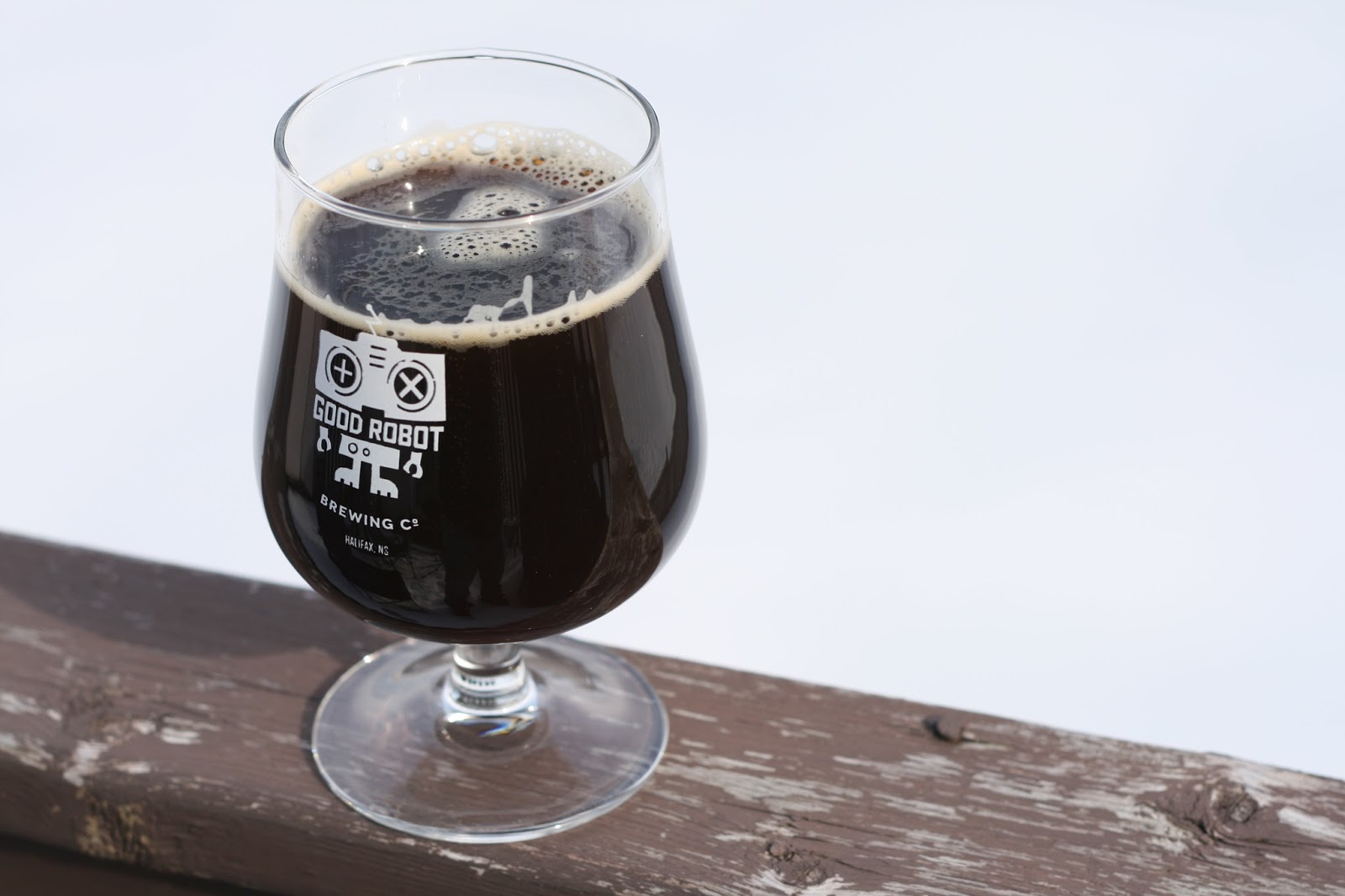
Appearance: Pours a very light-golden colour (lighter than it appears in this crappy picture), with a medium-sized, white head that settles at about 1/2 finger. Quite hazy, as expected.

Aroma: All hops, with the emphasis on fruity (pineapple) and citrus; not really getting much grapefruit or pine, surprisingly.

Taste: A little more malt character in the flavour, but it's definitely still in the background compared to the hops. I wouldn't say a particular fruit flavour jumps out at me; I find it a pleasant mix of tropical fruit. Medium to medium-low bitterness in the finish.

Mouthfeel: Medium-bodied, very smooth and creamy. Moderate carbonation.

Overall: I enjoyed this beer, and found that it continued to improve over weeks in the keg, surprisingly. One could argue that the hops were a bit muddled at first, but I found the fruit character came through more once it settled down a little. A fine beer that I wouldn't necessarily rush back to brew exactly the same, but I'd definitely experiment with this yeast some more.

Wednesday, 30 March 2016

Brown IPA with CTZ, Galaxy, & Simcoe, fermented with London Ale III

About a year and a half ago, I brewed my first Brown IPA. This was right around the time that the draft of the 2015 BJCP Guidelines had come out, where it was being suggested that Brown IPA become a new category, or more accurately I guess, a sub-category of "Specialty IPA". I won't bore you with the details on how a Brown IPA differs from an American Brown Ale... you can check out the BJCP Guidelines or click on the link for my first brew. In my original beer, I went with a five-malt grist, hopped fairly aggressively with Citra, CTZ and Nugget. I liked it: with a toffee/caramel sweetness, it had a prominent nose of earthy, spicy hops (Nugget made up the majority of the additions), and finished fairly dry with a moderate-high bitterness.

But this is kind of a tough style to brew, simply because I don't think I've had many Brown IPAs. And really, I don't know if I want to. That sounds bad, but there's something about this style that I just can't get excited about. God knows I love hoppy beers, and I'll happily brew and drink any variety of American IPAs, Session IPAs, APAs, etc. I really enjoy a well-crafted Red IPA or Black IPA... so why is it that I can't get excited about a Brown IPA? Is it because I haven't had many, or because it's one of those styles that seems like it was created as an afterthought? Maybe the whole 114 categories of IPA and counting is starting to wear a bit thin? I don't know, and maybe even suggesting such things is blasphemous. But I know how to really test this out... brew another one!

Sure, why the hell not? I was looking to mix things up anyway, so I decided to revisit this recipe. Here's where I made a mistake: because I made the decision to go this route a bit too-close to brew day, I simply used the same grist as with the first beer (but with a little Acid malt added for the mash pH). I should have re-read my post, because that grist gave a beer that was too dark. The style SRM range is 11-19, and the grist I selected brings it in to 23.That's slightly below Black IPA territory, but that's really not a big deal... I'm certainly not using a lot of dark, roasted malts in this beer. It's mostly 2-row, a couple of caramel-type malts, and some Victory and Chocolate malt as well. I also added some Gypsum and calcium chloride as usual, and aimed for a mash temp of 151 F, trying to keep the body medium-light, with a mostly-dry finish.

I wanted to approach the hops differently for this beer. While the first Brown IPA did have some CTZ and Citra - so, you're getting some fruit character - Nugget, as mentioned, made up the majority. I initially went that route because I thought the combination would work well in this style, and it did. But this time around I wanted to go more in the direction of an APA or American IPA; read: fruity, citrusy. I chose three varieties: CTZ again, because I feel it really does work well in this style of beer, and Galaxy and Simcoe, to hopefully really boost the tropical fruit, and maybe add some pine as well. I followed my general schedule: a bit of Polaris at 60 to ~17 IBUs, then an ounce each of CTZ and Simcoe at 10, followed by some Galaxy and Simcoe for a hop steep, CTZ and Simcoe after starting the chiller, and an ounce each of all three in the dry hop (plus a little more Galaxy to use up the rest of that package).

As I've done many times over the last few months, I fermented this beer with London Ale III. The first beer was fermented with US-05, but I've been using LAIII a lot lately, with good results, and honestly, I really wanted to brew a Brown IPA and ferment it with this strain, if only to see how many people would get angry when I posted a pic of the resultant beer, all cloudy and brown. If some people get upset about a beer that looks like orange juice, imagine their reaction if it literally looks like shit!

Ok, I'm kidding. And actually, while I'm on the side of those who get excited when they see an IPA that looks like pulpy juice, there IS something different about seeing a darker beer with the same haze/cloudiness. Juice is one thing. Mud is another. But it wouldn't bother me to the point of not drinking it, that's for sure, especially if it was delicious!

Where was I? Oh, the beer. So, yeah, that's the recipe. When I brewed it I was under my target gravity by 4 points (my efficiency has definitely been lower lately; maybe an issue with my grain mill?), but as usual, I wasn't too bothered. The FG was also higher than expected, at 1.017, so overall the beer did come in at quite a lower ABV than expected. I dry-hopped the beer in primary for 5 days, then kegged it.

While, again, I don't feel like I have a lot of beers to compare this to, I'm pretty happy with how it came out, and I think I like it a little better than my first Brown IPA. Sure, the grist is the same, but I think the hops selected here do work better - there's a nice piney and slightly dank overtone to it, but it's a little more fruity than the first beer. I definitely don't think the Galaxy comes through like it would in a paler beer, but it works. Still too dark, naturally (actually, being such a dark brown prevents it from looking muddy!), but the high breadiness and very light chocolate comes through in the aroma and flavor as I was hoping. The bitterness comes across as in the medium range, with a fairly dry finish. Overall, though, the beer is quite smooth and creamy.

In the end, though, I don't think I'm a big fan of Brown IPAs. While I've definitely embraced Black, Red, White, and Belgian takes on the IPA style, Brown is definitely at the bottom of the list for me. Could be because I haven't had a really great example of one, could be because it's just not for me. I'll continue to try commercial (and other homebrew) versions as they're available to me, but I won't be rushing out to brew one again any time soon.

And no, it's not because it's a cloudy, brown beer!

Recipe Targets: (5.5 gallons, 75% efficiency) OG 1.066, FG ~1.013, IBU ~58, SRM 23, ABV ~6.9%

Grains:
5.1 kg (82.7%) Canadian 2-row
325 g (5.3%) Caramunich II (45 SRM)
265 g (4.3%) Chocolate malt
235 g (3.8%) Victory malt
165 g (2.7%) Crystal 60 L
75 g (1.2%) Acid malt

Hops:
Polaris - 7 g (19.8% AA) @ 60 min

CTZ - 28 g (13.4% AA) @ 10 min
Simcoe - 28 g (12% AA) @ 10 min

Galaxy - 28 g @ 0 min (with a 15 min hop steep)
Simcoe - 28 g @ 0 min (with a 15 min hop steep)

CTZ - 28 g @ 0 min (when begin chilling)
Simcoe - 28 g @ 0 min (when begin chilling)

CTZ - 28 g dry-hop for 5 days (in primary)
Galaxy - 37 g dry-hop for 5 days (in primary)
Simcoe - 28 g dry-hop for 5 days (in primary)

Misc: 1/2 tab Irish Moss at 5 min

Yeast: Wyeast 1318 London Ale III (with a starter, ~250 billion cells)

Water: Fredericton city water, carbon-filtered; 7 g Gypsum and 7 g calcium chloride added to mash

- Brewed on January 26th, 2016, by myself. 50-minute mash with 15 L of strike water; mash temp a bit low at 150 F. Mashed-out for 10 minutes with 7.75 L of boiling water to 165 F. Sparged with ~3.5 gallons of 168 F water for final volume of ~6.75 gallons.

- Pre-boil gravity low at 1.050 (target 1.054). 60-minute boil. Final volume ~5.75 gallons; OG low at 1.062. Chilled to 62 F, then poured into Better Bottle. Aerated with 75 seconds of pure O2, pitched yeast slurry at 64 F.

- Fermentation was off and pacing by the next morning, going strong over the first few days with the temps staying comfortably in the 67-68 F range. The krausen, as usual for LAIII, was thick and milkshake-like for many days after fermentation signs stopped in the airlock.

- 18/2/16 - Added dry hops into primary, FG 1.017.

- 22/2/16 - Racked into CO2-purged keg, set in keezer to bring temp down and began force carbing the next day.


Appearance - Poured with a medium-sized head that fades after a few minutes to a thin film on top of the beer. Body is a very dark brown colour, and seems virtually opaque when held to the light.

Aroma - Quite balanced, with the toffee-like, chocolatey malt character melding well with the piney, dank, slightly fruity overtones from the hops. Otherwise clean, no flaws.

Taste - Very nice flavour blending here: light chocolate, dark bread, toffee, with similar hop character noted in the aroma. Finishes slightly dry, but balanced well with the sweetness, medium bitterness. Smooth.

Mouthfeel - Medium-bodied, medium carbonation, creamy.

Overall - I enjoy this beer, even if it's far from my favorite IPA style. If I brewed it again, I'd try to drop the color by at least several SRM points, and maybe dial the bitterness back by 5-10 IBUs. I wouldn't mind also switching up the hops again, maybe even dropping the CTZ in favor of another fruity variety, such as Azacca or something similar.

Wednesday, 24 December 2014

Brewing a Red IPA, à la Sierra Nevada Celebration

DISCLAIMER: This is not a clone recipe of, or an attempt at cloning, Sierra Nevada Celebration Ale.

Not that I have anything against Celebration... on the contrary, I've always really enjoyed it. Hard to believe that a beer like this - they call it an American-style IPA, but look at it... it's a Red IPA, or hoppy American Amber, right? - has been around for over 30 years. There would have been a lot of years at the beginning there where you'd be hard-pressed to find another beer like this from anyone. For the two of you reading this post who haven't tried this beer, it's a seasonal release that comes out in the late fall, in time for Christmas. No, it's not spiced or mulled or anything like that, so I guess you can't call it a "Christmas beer", but what does that really even mean? It's just a tasty amber-colored, hoppy beer that is brewed with Cascade, Centennial, and Chinook hops.


All this being said, I decided this year to brew a "Christmas beer"; not a beer that is dark, strong, and heavily spiced, but simply a beer that I could give away for the holidays. I considered a lot of styles, most of them hoppy (of course), and, inspired by the type of beer Sierra Nevada Celebration is, I decided to go with a hoppy Amber Ale, aka West Coast Amber, aka India Red Ale, aka - and according to the new BJCP guidelines, the "definitive name" - Red IPA.

But I wanted this beer to be more than Celebration... that is, I wanted it to be hoppier. Every year there are some people who inevitably complain that Celebration isn't as hoppy as it was last year. I have no idea if this is true; I suspect that it's more likely that people have changed. I know for a fact that beers I found hoppy a few years ago would no longer taste as hoppy to me now; when you've had some great hoppy beers, you can get spoiled quickly (otherwise known as the lupulin threshold shift). Now that I HAVE had a lot of hoppy beers, I can confirm that Celebration isn't a supremely-hoppy beer... it's got a great malt character, and the hops ARE there, but I want more in my Red IPAs. I want beers along the lines of the last couple of hoppy Ambers I've brewed, namely the Modern Times Blazing World clone and Maine Beer Co. Zoe clone.

So that's exactly what I aimed for with this beer. I enjoyed the Blazing World clone so much that I went with the exact same malt bill; it makes a deep-red colored beer, with a really great malty sweetness that works fantastically at supporting a very hoppy beer. Lots of Maris Otter, almost 15% Munich malt, and then a little bit of Roasted Barley and Carafa II... in my opinion, it all works perfectly for this style of beer.

I had a LOT of ideas about which hops to use in this beer. I've brewed a lot of hoppy beers in 2014, and I still had quite a few varieties from the 2013 harvest. Three varieties, max, were what I wanted to use in this beer. But... which ones? After a lot of thought, I decided that I absolutely wanted to use Amarillo and Simcoe, mainly because I'm a big fan of Alpine Duet, an IPA that uses equal amounts of both; I've tried to clone that beer twice (here and here), and these hops really do work well together. But I had never used them together in an Amber, so I thought this was a great chance to try them in a darker beer.

Picking out the third hop was harder. I wanted to go with something great, one of the popular, new/newish varieties that I've brewed with, and therefore had a bit of experience with. I strongly considered both Nelson and Mosaic, but as much as I loved both, I had used them in the Blazing World clone. Galaxy crossed my mind as well, but in the end I settled on Azacca. I loved what it brought to my Oxbow Grizacca clone, and after the debacle with that beer (a leak of some sort drained most of the keg in the keezer, shortly after I had started drinking it), I wanted to try it again, and soon. The aromas of ripe stone fruit, the touch of pine... I figured it would work really well with Amarillo and Simcoe.

So, the hopping schedule below is what I came up with. I didn't base it on anything other than feel; if I had written the recipe down, and then erased my memory and wrote it again an hour later, the proportions would probably be different. An addition of Amarillo at 15 minutes, then heavy flameout additions (one for a hop steep, the other after turning on the wort chiller), and one dry-hop addition in primary... it all came to roughly 45% Amarillo, and 27.5% each Simcoe and Azacca. I really liked how the hopping in this recipe looked; it somehow worked in a way on paper that just HAD to translate to the final product. Or, so I hoped. Fermented with US-05, typical for my hoppy beers, the goal was a really hoppy (emphasis on tropical fruit and pine) ale, balanced with the malty sweetness of an Amber ale, finishing on the dry/bitter side.

I would normally keg a beer like this, but since my plans were to give the majority of the batch away, it just made sense to bottle it and distribute it ASAP, so that everyone would be able to drink the beer as fresh as possible. I timed the brew day to be in mid-November; that would give it a couple of weeks in primary, followed by the dry-hop (also in primary), and then a good two week period to carbonate, more than enough if the bottles were kept at room temperature.

And in a complete twist in my blogging routine, I'm posting the tasting notes at the same time as the recipe. I don't think I've ever managed to do that for a beer that I brewed recently! I'm quite behind in my posts lately, and I really wanted to have this one out before Christmas... looks like I'm just making it. BARELY. I can say that the beer came out really great, just what I was aiming for in terms of hop presence (huge), flavors/aromas (tropical, piney, citrusy), and malt presence (balanced almost perfectly). If I could change anything, I'd back off on the bitterness, but only slightly. Maybe knock it down to 60-65 IBUs? I've had several friends check-in to this beer on Untappd - Meek Celebration (2014) - and they've all loved it, for the most part.

If you're looking for a new hoppy Amber, Red IPA, whatever, to brew, I suggest you give this recipe a try... if you can get your hands on the hops, of course. Here's hoping everyone has a great Christmas, filled with good cheer, friends and family, and - of course - fantastic beer!

Recipe Targets: (5.5 gallons, 72% efficiency) OG 1.068, FG ~1.012, IBU ~75, SRM 14, ABV ~7.2%

Grains:
5.2 kg (83.3%) Maris Otter
930 g (14.9%) Munich malt
70 g (1.1%) Roasted Barley
45 g (0.7%) Carafa II

Hops:
Hop extract - 5 mL @ 60 min (or 28 g of 10% AA hop variety)

Amarillo - 40 g (8.1% AA) @ 15 min

Amarillo - 20 g @ 0 min (with a 15 minute hop steep)
Azacca - 40 g @ 0 min (with a 15 minute hop steep)
Simcoe - 20 g @ 0 min (with a 15 minute hop steep)

Amarillo - 20 g @ 0 min (when wort temp below 180 F)
Simcoe - 40 g @ 0 min (when wort temp below 180 F)

Amarillo - 54 g dry-hop for 5-7 days
Azacca - 40 g dry-hop for 5-7 days
Simcoe - 20 g dry-hop for 5-7 days

Misc: 1/2 tab Irish Moss at 5 min

Yeast: US-05 Safale, 1 package, rehydrated

Water: Fredericton city water, carbon-filtered

- Brewed on November 18th, 2014, by myself. 50-minute mash with 16 L of strike water, mashed in at target of 150 F. Mashed-out for 10 minutes with 8.75 L of boiling water. Sparged with ~3 gallons of 168 F water for final volume of ~6.75 gallons.

- SG a high at 1.057 (target 1.055). 60-minute boil. First flameout hops had a 15-minute steep before turning on the chiller, then added the second flameout hops. Final volume a little over 5.5 gallons; OG on target at 1.068. Chilled to 65 F, then poured/filtered into Better Bottle. Aerated with 90 seconds of pure O2, pitched rehydrated yeast.

- Good fermentation activity over the next four days, started slowing down quickly after that. Temp got as high as 70 F.

- 28/11/14 - FG a bit high at 1.016. Added dry-hops directly into primary.

- 3/12/14 - Bottled with 104 g table sugar, aiming for 2.5 vol CO2. 


Appearance: Pours with a moderate-sized, slightly off-white head that is thick and pretty creamy, with really good retention... fades to 1/2-finger or so. Body is a deep, dark ruby-red color, with excellent clarity.

Aroma: Absolutely huge hop aroma. Lots of tropical fruit, citrus, pine... there's a lot going on. The malty sweetness is there behind the hops, and it provides a nice backing to the aroma. No alcohol, no flaws that I can detect.

Flavor: Some of that bready, maltiness that is a little sweet, but the hops win out again. Great, sticky tropical and citrusy flavors in here. The beer is nicely balanced, with the finish leaning towards the dry side. Moderate-high bitterness.

Mouthfeel: Medium-light bodied, medium (almost medium-high) carbonation.

Overall: I really like this beer; it's up there with the Blazing World clone for my favorite hoppy Ambers that I've brewed. I'd dial back the IBUs a little, but otherwise I'd keep the recipe as-is.