Showing posts with label Galaxy. Show all posts

Wednesday, 30 March 2016

Brown IPA with CTZ, Galaxy, & Simcoe, fermented with London Ale III

About a year and a half ago, I brewed my first Brown IPA. This was right around the time that the draft of the 2015 BJCP Guidelines had come out, where it was being suggested that Brown IPA become a new category, or more accurately I guess, a sub-category of "Specialty IPA". I won't bore you with the details on how a Brown IPA differs from an American Brown Ale... you can check out the BJCP Guidelines or click on the link for my first brew. In my original beer, I went with a five-malt grist, hopped fairly aggressively with Citra, CTZ and Nugget. I liked it: with a toffee/caramel sweetness, it had a prominent nose of earthy, spicy hops (Nugget made up the majority of the additions), and finished fairly dry with a moderate-high bitterness.

But this is kind of a tough style to brew, simply because I don't think I've had many Brown IPAs. And really, I don't know if I want to. That sounds bad, but there's something about this style that I just can't get excited about. God knows I love hoppy beers, and I'll happily brew and drink any variety of American IPAs, Session IPAs, APAs, etc. I really enjoy a well-crafted Red IPA or Black IPA... so why is it that I can't get excited about a Brown IPA? Is it because I haven't had many, or because it's one of those styles that seems like it was created as an afterthought? Maybe the whole 114 categories of IPA and counting is starting to wear a bit thin? I don't know, and maybe even suggesting such things is blasphemous. But I know how to really test this out... brew another one!

Sure, why the hell not? I was looking to mix things up anyway, so I decided to revisit this recipe. Here's where I made a mistake: because I made the decision to go this route a bit too-close to brew day, I simply used the same grist as with the first beer (but with a little Acid malt added for the mash pH). I should have re-read my post, because that grist gave a beer that was too dark. The style SRM range is 11-19, and the grist I selected brings it in to 23.That's slightly below Black IPA territory, but that's really not a big deal... I'm certainly not using a lot of dark, roasted malts in this beer. It's mostly 2-row, a couple of caramel-type malts, and some Victory and Chocolate malt as well. I also added some Gypsum and calcium chloride as usual, and aimed for a mash temp of 151 F, trying to keep the body medium-light, with a mostly-dry finish.

I wanted to approach the hops differently for this beer. While the first Brown IPA did have some CTZ and Citra - so, you're getting some fruit character - Nugget, as mentioned, made up the majority. I initially went that route because I thought the combination would work well in this style, and it did. But this time around I wanted to go more in the direction of an APA or American IPA; read: fruity, citrusy. I chose three varieties: CTZ again, because I feel it really does work well in this style of beer, and Galaxy and Simcoe, to hopefully really boost the tropical fruit, and maybe add some pine as well. I followed my general schedule: a bit of Polaris at 60 to ~17 IBUs, then an ounce each of CTZ and Simcoe at 10, followed by some Galaxy and Simcoe for a hop steep, CTZ and Simcoe after starting the chiller, and an ounce each of all three in the dry hop (plus a little more Galaxy to use up the rest of that package).

As I've done many times over the last few months, I fermented this beer with London Ale III. The first beer was fermented with US-05, but I've been using LAIII a lot lately, with good results, and honestly, I really wanted to brew a Brown IPA and ferment it with this strain, if only to see how many people would get angry when I posted a pic of the resultant beer, all cloudy and brown. If some people get upset about a beer that looks like orange juice, imagine their reaction if it literally looks like shit!

Ok, I'm kidding. And actually, while I'm on the side of those who get excited when they see an IPA that looks like pulpy juice, there IS something different about seeing a darker beer with the same haze/cloudiness. Juice is one thing. Mud is another. But it wouldn't bother me to the point of not drinking it, that's for sure, especially if it was delicious!

Where was I? Oh, the beer. So, yeah, that's the recipe. When I brewed it I was under my target gravity by 4 points (my efficiency has definitely been lower lately; maybe an issue with my grain mill?), but as usual, I wasn't too bothered. The FG was also higher than expected, at 1.017, so overall the beer did come in at quite a lower ABV than expected. I dry-hopped the beer in primary for 5 days, then kegged it.

While, again, I don't feel like I have a lot of beers to compare this to, I'm pretty happy with how it came out, and I think I like it a little better than my first Brown IPA. Sure, the grist is the same, but I think the hops selected here do work better - there's a nice piney and slightly dank overtone to it, but it's a little more fruity than the first beer. I definitely don't think the Galaxy comes through like it would in a paler beer, but it works. Still too dark, naturally (actually, being such a dark brown prevents it from looking muddy!), but the high breadiness and very light chocolate comes through in the aroma and flavor as I was hoping. The bitterness comes across as in the medium range, with a fairly dry finish. Overall, though, the beer is quite smooth and creamy.

In the end, though, I don't think I'm a big fan of Brown IPAs. While I've definitely embraced Black, Red, White, and Belgian takes on the IPA style, Brown is definitely at the bottom of the list for me. Could be because I haven't had a really great example of one, could be because it's just not for me. I'll continue to try commercial (and other homebrew) versions as they're available to me, but I won't be rushing out to brew one again any time soon.

And no, it's not because it's a cloudy, brown beer!

Recipe Targets: (5.5 gallons, 75% efficiency) OG 1.066, FG ~1.013, IBU ~58, SRM 23, ABV ~6.9%

Grains:
5.1 kg (82.7%) Canadian 2-row
325 g (5.3%) Caramunich II (45 SRM)
265 g (4.3%) Chocolate malt
235 g (3.8%) Victory malt
165 g (2.7%) Crystal 60 L
75 g (1.2%) Acid malt

Hops:
Polaris - 7 g (19.8% AA) @ 60 min

CTZ - 28 g (13.4% AA) @ 10 min
Simcoe - 28 g (12% AA) @ 10 min

Galaxy - 28 g @ 0 min (with a 15 min hop steep)
Simcoe - 28 g @ 0 min (with a 15 min hop steep)

CTZ - 28 g @ 0 min (when begin chilling)
Simcoe - 28 g @ 0 min (when begin chilling)

CTZ - 28 g dry-hop for 5 days (in primary)
Galaxy - 37 g dry-hop for 5 days (in primary)
Simcoe - 28 g dry-hop for 5 days (in primary)

Misc: 1/2 tab Irish Moss at 5 min

Yeast: Wyeast 1318 London Ale III (with a starter, ~250 billion cells)

Water: Fredericton city water, carbon-filtered; 7 g Gypsum and 7 g calcium chloride added to mash

- Brewed on January 26th, 2016, by myself. 50-minute mash with 15 L of strike water; mash temp a bit low at 150 F. Mashed-out for 10 minutes with 7.75 L of boiling water to 165 F. Sparged with ~3.5 gallons of 168 F water for final volume of ~6.75 gallons.

- Pre-boil gravity low at 1.050 (target 1.054). 60-minute boil. Final volume ~5.75 gallons; OG low at 1.062. Chilled to 62 F, then poured into Better Bottle. Aerated with 75 seconds of pure O2, pitched yeast slurry at 64 F.

- Fermentation was off and pacing by the next morning, going strong over the first few days with the temps staying comfortably in the 67-68 F range. The krausen, as usual for LAIII, was thick and milkshake-like for many days after fermentation signs stopped in the airlock.

- 18/2/16 - Added dry hops into primary, FG 1.017.

- 22/2/16 - Racked into CO2-purged keg, set in keezer to bring temp down and began force carbing the next day.
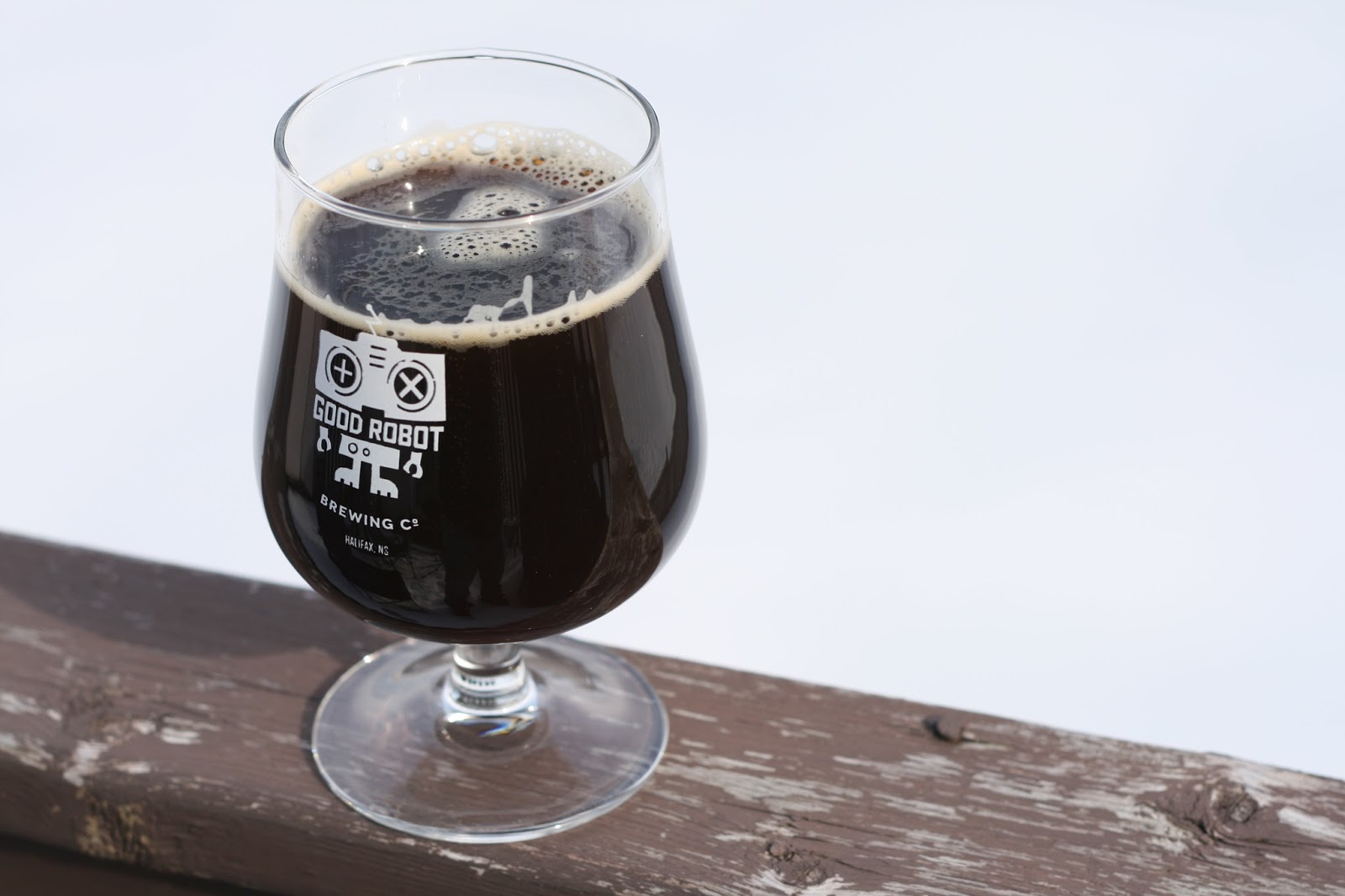

Appearance - Poured with a medium-sized head that fades after a few minutes to a thin film on top of the beer. Body is a very dark brown colour, and seems virtually opaque when held to the light.

Aroma - Quite balanced, with the toffee-like, chocolatey malt character melding well with the piney, dank, slightly fruity overtones from the hops. Otherwise clean, no flaws.

Taste - Very nice flavour blending here: light chocolate, dark bread, toffee, with similar hop character noted in the aroma. Finishes slightly dry, but balanced well with the sweetness, medium bitterness. Smooth.

Mouthfeel - Medium-bodied, medium carbonation, creamy.

Overall - I enjoy this beer, even if it's far from my favorite IPA style. If I brewed it again, I'd try to drop the color by at least several SRM points, and maybe dial the bitterness back by 5-10 IBUs. I wouldn't mind also switching up the hops again, maybe even dropping the CTZ in favor of another fruity variety, such as Azacca or something similar.

Wednesday, 2 March 2016

American Pale Ale with Azacca and Galaxy, fermented with London Ale III

In 2014, I brewed the widely-available clone recipe of Russian River's Row 2, Hill 56, a Simcoe single-hopped American Pale Ale. I had been looking to brew something for my older brother's wedding, and I had heard good things about this beer. Simcoe is a great hop, and despite being used in relatively-small amounts in this recipe (only 4 oz for a batch; compared to a lot of hoppy recipes nowadays - my own included - that's really not that much!), the beer had a great aroma and flavour, and was enjoyed by non-beer-drinkers and beer geeks alike.

Since then, I've always meant to brew that recipe again, except change up the hop(s) used. I know other homebrewers have used that recipe to feature other varieties, continuing the trend of single-hopped beers. But for me, I more just wanted to stick with the grist and go from there. I don't know why the grist seems to work so well, but it does. The combination of Pilsner malt and Maris Otter (instead of just using 2-row, which is pretty common in APAs) works really well at providing enough of a slightly-bready malt character to the beer, topped off with a little bit of light Crystal (~20 L) and Carapils. As usual for my system, Acid malt is also added to bring the mash pH down to the 5.4 region; I've been doing this consistently now, and I've been quite happy with the effect it's having (I fully acknowledge that a blind-tasting has not been done to confirm this!).

So, with the grist already decided, I had a hell of a bunch of hops to pick from. I've made several hop orders since late fall, and along with quite a bit left from last year's crop, there were all sorts of options. I wanted this beer to be REALLY juicy; ever since I was lucky enough to have tried Scaled Up, a DIPA from Trillium Brewing, a month or so ago (have you tried this beer? It's amazing!), I've been craving hops even more than usual. Damn these delicious beers for spoiling me! Luckily, many of the hop varieties I have in my freezer should be more than satisfactory, so, what to pick?

Ultimately, I settled on two varieties, to keep things relatively simple. And I picked two that are becoming two of my favourites as I use them more and more - Azacca and Galaxy. I really don't think you can go wrong with either one, and as I was giving it some thought, I realized that I hadn't actually used them together before. Travesty! But what better beer to showcase how these two blend than a fairly simple APA? And how could these not work together, right? They've definitely got to be two of the more-tropical, fruity, citrusy varieties out there, in a world with one heck of a lot of fruity hop types.

I didn't follow the hopping schedule for R2H56; I went with what I almost always use now for hoppy recipes that I develop on my own: a small bittering charge at 60 minutes (to only 10-15 IBUs; in fact, I'm starting to drop this altogether in some beers), an ounce at 10 minutes, then large WP and post-chilling additions, along with a dry-hop of 3 oz total. I've had good results with this method, and don't usually stray too far. The ratio is skewed slightly towards Galaxy (5.5 oz vs. 3.5 oz of Azacca), but only because I had more Galaxy on hand.

For fermentation, I went once again with London Ale III. I've brewed several different variations on the IPA style with this strain now, and you can count me as yet another believer... it is truly great with hoppy beers. It doesn't attenuate as highly as US-05, usually finishing for me to 1.013-1.014, giving the beer a nice, creamy mouthfeel without tasting under-attenuated. I find the beers I brew with this strain come out very hazy/cloudy in true Hill Farmstead/Trillium fashion, but that's ok with me! I know not everyone is thrilled by a hazy beer, but many of the best hoppy beers I've had have been cloudy, so I kind of expect that, now.

The brew day for this beer was uneventful, everything going smoothly. Fermentation was going strong by the next day - normal for my experience with London Ale III - and after 10 days or so I dry-hopped the beer in primary for about a week, then transferred to a keg and started carbing. I was really looking forward to this beer.

And what a tasty beer this is! I have to say, if Azacca and Galaxy were easier to get, this would be my new house APA. I've made very few beers juicier than this - big blast of tropical fruit and citrus, with maybe just a touch of pine in there. Lately, as the keg is getting down, the beer looks and tastes a lot like OJ, and of course I mean that in a good way. Creamy, smooth body, but it still finishes quite dry with a moderate bitterness. It's definitely been one of the best-received of my homebrews; it's rating on Untappd is the highest of any I've brewed, tied with my Equinox Session IPA.

Ok, so it's no big deal that I've confirmed what we all would have guessed: Azacca and Galaxy work great together, especially when fermented with London Ale III. But hey, I'm still glad I took the time to try it!

Recipe Targets: (5.5 gallons, 75% efficiency) OG 1.056, FG ~1.013, IBU ~45, SRM 5.2, ABV ~5.6%

Grains:
2.9 kg (57.7%) Bohemian Pilsner
1.65 kg (32.8%) Maris Otter
200 g (4%) CaraRed (20 L)
150 g (3%) CaraPils
125 g (2.5%) Acid malt

Hops:
Polaris - 5 g (19.8% AA) @ 60 min

Galaxy - 28 g (12% AA) @ 10 min

Galaxy - 56 g @ 0 min (with a 15 min hop steep)
Azacca - 28 g @ 0 min (with a 15 min hop steep)

Galaxy - 28 g @ 0 min (when begin chilling)
Azacca - 28 g @ 0 min (when begin chilling)

Galaxy - 42 g dry-hop for 5 days (in primary)
Azacca - 42 g dry-hop for 5 days (in primary)

Misc: 1/2 tab Irish Moss at 5 min

Yeast: Wyeast 1318 London Ale III (with a starter, ~200 billion cells)

Water: Fredericton city water, carbon-filtered; 7 g Gypsum and 7 g calcium chloride added to mash

- Brewed on January 13th, 2016, by myself. 50-minute mash with 15 L of strike water; mash temp on target of 151 F. Mashed-out for 10 minutes with 7.5 L of boiling water to 166 F. Sparged with ~3.25 gallons of 168 F water for final volume of ~6.75 gallons.

- Pre-boil gravity 1.044. 60-minute boil. Final volume ~5.75 gallons; OG 1.055. Chilled to 62 F, then poured into Better Bottle. Aerated with 60 seconds of pure O2, pitched yeast slurry at 64 F.

- Active fermentation by the next day, continued for 2-3 before settling down. Dry-hopped in primary on January 25th; FG 1.013. Kegged on February 1st.


Appearance: Pours with a moderate-sized, white creamy head (not normally as large as in that picture) that fades to about 1/2-finger and sticks around. Body is a light-orange colour, and very hazy/cloudy.

Aroma: Big punch of orange juice, along with a tropical fruit character that I unfortunately can't pick apart to actually name which fruit(s). Very little malt character.

Taste: A little more malt presence here - lightly bready, maybe a touch of wheat character? - but still mostly juicy, fruity hops. Bitterness in the finish comes across as medium-light, to me.

Mouthfeel: Medium-light bodied, very creamy, moderate carbonation. Smooth.

Overall: A great beer, made great by great hops. Will brew again, and don't think I'd change anything... at least not to a large degree.

Thursday, 26 November 2015

Brewing a 100% Brett IPA (with Galaxy and Southern Cross)

In late July, I posted about my first 100%-Brett IPA, a light-coloured beer with plenty of late-hopping: all Amarillo after knockout, and a big dry-hop of Hallertau Blanc. Fermented with The Yeast Bay's Amalgamation, a "Brett Super Blend" featuring six different Brettanomyces strains, the beer came out really tasty. It had just what I was looking for in a Brett IPA, with lots of tropical, fruity hop aroma and flavour, with just the right balance of Brett funk. Mouthfeel was creamy and very smooth, with - for me - the perfect amount of bitterness (let's say medium-low).

In that post, I threatened to brew the same recipe again and change the hop varieties, and that's exactly what I did in late September. I felt absolutely no need to change the grist for this beer; as mentioned above, the body was perfect. Despite my initial worries that the Brett strains would not produce the glycerol needed to boost mouthfeel, the combination of a good proportion of wheat malt (21%) and higher mash temp (153 F) seemed to do the job nicely. When I initially made the starter for the Amalgamation blend, I built it up enough to have twice as many cells as I needed. Yes, it had been three months since then, and I needed to make another starter, but the slurry looked and smelled healthy enough to me. So, I got the Brett into some more wort and onto my stir plate, aiming for ~300 billion cells (200 for this batch, and another 100 to have on hand for another time). The starter seemed quite active; there was a large krausen that actually overflowed from the flask a little, before settling down as activity slowed.

For this batch, I wanted to stick to two hop varieties again. While I had considered doing a single-hop brew, I had so many I wanted to experiment with Brett that I knew I'd have to pick at least two. Like last time, I was mostly looking at hops that would offer a lot of tropical fruit and/or citrus character, to complement the fruity/pineapple aspects that you often see in 100% Brett IPAs. I finally settled on two Southern Hemisphere varieties: Galaxy and Southern Cross. I've brewed with both before, but never together. Australia's Galaxy is found in plenty of commercial beers, and is well-known for adding plenty of tropical fruit. I had used Southern Cross (New Zealand) in my Alpine Nelson clone, and really liked how it worked with Nelson Sauvin: it's citrusy characteristics paired perfectly with the gooseberry of the Nelson.

Otherwise, I kept everything about this beer exactly the same - grist, mash temps, Gypsum and calcium chloride additions, etc. This time around, my mash efficiency was a little low (compared to a little high the first time), which I can't really explain. Aside from that, the brew day went smoothly. I had cold-crashed the Brett starter several days prior, decanted the large amount of beer off, and then "woke up" the yeast with another 500 mL of wort on the stir plate for a couple of days, before pitching the starter at 66 F into the chilled wort. I then aerated with pure O2 for 75 seconds. This is exactly the same procedure I followed for my first Brett IPA; by the next morning for that beer, fermentation was coming along nicely.

Not this time. When I checked on the carboy the first morning after brew day, there was zero visible activity. The airlock wasn't bubbling, there was no krausen; you could see the trub/yeast cake sitting on the bottom of the Better Bottle. I was confused. The temperature was still 66 F, and there wouldn't have been any drops in temp overnight. When I checked on it again that evening after work, there was no change. By the next morning, I was starting to panic when there was STILL no activity. I knew I had pitched enough yeast and aerated well, but I pitched a little more slurry (approx 40 billion cells) just in case, as a last-ditch effort. My plan was if it wasn't doing anything by that evening (which would be a little over 48 hours since the original pitch), I'd have to add some US-05 and see what happened.

Luckily, when I got home from work, there was finally bubbling in the airlock. Fermentation grew strong and continued nicely, bringing the beer to a final gravity of 1.008 (quite a bit lower than I had achieved with the first Brett IPA). But why did it take 48 hours to get going? Yes, the slurry I had saved from the original starter was about 3 months old, but I took that into consideration when calculating the booster starter size, and should have had plenty of cells pitched into the wort. Not to mention the fact that the starter was extremely active, as noted. Whatever the reason, I was slightly nervous as to how the end result was going to taste.

After about 2 weeks, I dry-hopped the beer in primary for 5 days, and then kegged it. The first time around, I had bottled the beer so I could get a good idea of how it developed over time with the Brett. It still tasted great after four months (when I consumed the last bottle that I had saved), but the hop character, as expected, had faded considerably. And it was when the beer was really hoppy that I enjoyed it the most, so I was looking to keg it for this batch, to keep the hoppy goodness around as long as possible.

This turned out to be a very interesting beer. Despite the fact that the only real change to the recipe was the hops used, it tastes a lot different than the first batch, to me. The first time I poured a sample, before carbonation was really where I wanted it to be, I got a huge blast of pineapple and tropical fruit... and I mean HUGE! I immediately loved it. But since then, I haven't been as crazy about it. Not to say I don't like it, but for the next several pours, I wasn't sure where this beer was headed. I hate to say it, but I swear with the second or third pour I was tasting and smelling... urinal. I wasn't sure if it was how these particular hops were working with the Brett strains, or if it was that the Brett had really taken a turn for the worse somewhere down the line, but I was starting to get worried again.

However, now the beer is tasting fine. I must say I prefer the Amarillo/Hallertau Blanc beer, but the Galaxy/Southern Cross combo really settled into its own after a little time. That pineapple and tropical fruit presence is still there in spades, but the funk backs it up quite well. I find the "funk" different than in the first beer, and I wish I could explain exactly how... but I can't. It's just different. Not unpleasant, but not the same.

I really need more people to try this beer, but only a few others have as of right now. Those that HAVE tried it seem to really enjoy it, but I'd like some more input. I've been drinking it for about a month and haven't noticed it changing too much, yet; the kegging has definitely helped in that regard. My real concern now is, is the small amount of yeast slurry I've saved for the next batch trustworthy? I'm planning on brewing another 100% Brett beer soon, so I guess it won't be long before I find out...

Recipe Targets: (5.5 gallons, 75% efficiency) OG 1.057, FG ~1.010, IBU ~52, SRM 4.1, ABV ~6.5%

Grains:
3.7 kg (71.2%) Canadian 2-row
1.1 kg (21.2%) Wheat malt
200 g (3.8%) Cara-Pils
200 g (3.8%) Acid malt

Hops:
Hop extract - 5 mL @ 60 min (or 28 g of a 10% AA hop variety)

Galaxy - 35 g (12% AA) @ 0 min (with a 20 min hop steep)
Southern Cross - 35 g (13.5% AA) @ 0 min (with a 20 min hop steep)

Galaxy - 35 g @ 0 min (when start chilling)
Southern Cross - 35 g @ 0 min (when start chilling)

Galaxy - 63 g dry-hop for 5-7 days (in primary)
Southern Cross - 63 g dry-hop for 5-7 days (in primary)

Misc: 1/2 tab Irish Moss at 5 min

Yeast: Yeast Bay Brett Amalgamation (slurry, ~200 billion cells)

Water: Fredericton city water, carbon-filtered; 3 g Gypsum and 3 g calcium chloride added to mash

- Brewed on Sept 22nd, 2015, by myself. 50-minute mash with 15 L of strike water, mashed in at 153 F. Mashed-out for 10 minutes with 6.75 L of boiling water. Sparged with ~3.5 gallons of 168 F water for final volume of ~6.75 gallons.

- SG 1.045 (low, target 1.047). 60-minute boil. Final volume a bit high at 5.75 gallons; OG 1.055. Chilled to low-60s F, then poured into Better Bottle. Aerated with 75 seconds of pure O2, pitched yeast slurry at 66 F.

- After about 48 hours, activity finally became apparent - bubbling in airlock, krausen forming. Continued quite vigorously for 2 days, then began to slow down. Temp got up to 72 F.

- 7/10/15 - FG 1.008. Dry-hopped in primary. Kegged 5 days later and set in keezer to bring temp down before starting to carb the next day.


Appearance: Pours with a small-moderate sized white head, which fades fairly quickly to a thin film on the beer. Body is a light-golden color (that picture isn't the best representation), and very hazy, almost cloudy, even after a month or so of being kegged.

Aroma: Definitely an interesting aroma - while it's quite obvious this is a hoppy beer, with it's strong pineapple, citrusy smell, there's a very strong funkiness that comes through easily as well as the hops. It's not really barnyard; I can't quite put my finger on it.

Taste: A little more well-rounded than the aroma, I'd say the hops win - slightly - here. Lots of powerful fruit flavours coming through, but yes, still a good amount of funk. Medium to medium-low bitterness in the finish, quite dry and a bit tart. More white-wine like than the last Brett IPA.

Mouthfeel: Medium-light bodied, moderate carbonation. Quite smooth and creamy.

Overall: Very tasty. I'm happy with the mouthfeel and finish of the beer; definitely a bit drier than the last one. I don't think the differences in this beer are completely due to the different hops used, but either way Galaxy and Southern Cross are working really well together, here. Let the experimenting continue!

Wednesday, 18 March 2015

Brewing an American IPA with London Ale III yeast and high chloride water

Not exactly the catchiest of titles, is it?

With my recent stretch of Belgian-inspired beers, it's time for another American IPA! Looking back at every American IPA I've brewed, it hit me that I've used either US-05 or Wyeast 1056 American Ale for fermentation every time. I have absolutely nothing against using a neutral American yeast for any hop-forward beer, but I thought it was time to try something different. Seeing that other homebrewers have had success with fermenting their IPAs "outside the box" - that is, with English yeast - I wanted to try the same. There's also quite a few other excellent commercial breweries that have an English yeast as their house strain: Hill Farmstead, Stone, and Firestone Walker, to name just a few.

Ok, let's work backwards and start with the yeast, then. There's a lot of English strains out there; I've used a few, some in English beers, and some in American hoppy beers (but not IPAs). Wyeast 1968 London ESB Ale is often used in homebrew recipes, including several clones; I can't quite put my finger on why I'm not a huge fan of this yeast, but I'm just not. Any beer I've brewed with it, American or English, has had a certain flavor that I'm not big on. I fully admit this could be due to something else in the recipe, or some mess-up on my part, but I've consistently been disappointed with it in my homebrew history. I've had better luck with Wyeast 1098 British Ale, especially in American beers. Definitely a more neutral strain in the English yeast family, 1098 is often thought to be as close to the Stone house yeast that you can buy commercially; I've heard some sources say 1968 is closer, but I'd definitely go with 1098 if you ever brew a Stone clone.

More homebrewers have been using Wyeast 1318 London Ale III in their hoppy beers lately. Thought to be the Boddington's strain (check out the Wyeast chart from mrmalty.com), I think what's led more and more people to this yeast is the rumor that it's also the same strain that Hill Farmstead uses; and if there's a shortlist somewhere with the top breweries that homebrewers want to emulate, Hill Farmstead is definitely on there. It's been a few years since I've had a HF beer; while I can't remember if Edward was the perfect hoppy beer, I definitely recall this it was extremely delicious. What I remember most, along with the beautiful hoppiness of the beer, is that it was somehow still very creamy and smooth. I don't know if this is due to the yeast strain they use, their water source/treatment, or a combination of both. I imagine it's both, along with proper transfer technique and whatnot (i.e. keep oxygen out of the picture as much as possible). When I read Derek's post (of bearflavored.com) about his experience with 1318, his description of the results having a "saturated, soft mouthfeel" immediately brought to mind my experience with Edward. So, time to finally give this yeast a try.

On to water chemistry. I won't try to get into the intricacies of this subject, here. Many others have written much more than I ever could, and much more eloquently than I could ever hope to do myself. In a nutshell, Shaun Hill has been saying for a few years now that chloride may be more important in water profiles for hoppy beers than most people realize. Certainly, the general consensus for years now has been to bump up your calcium and sulfate in your IPA's water, with no mention at all of chloride. More sulfate usually results in a drier, crisper beer, which is normally synonymous with IPAs; more chloride than sulfate is thought to give a "maltier" beer. But maybe in IPAs, "maltier" really means "smoother", as long as the beer is hopped appropriately (that is, lots of flavor and aroma additions)? I've been adding both calcium chloride and gypsum (calcium sulfate) to my hoppy beers lately; more to help decrease the mash pH than as a flavoring addition, but I was happy to try a different approach. So, with this IPA, I added a large amount of calcium chloride and a bit of gypsum, targeting a chloride level of close to 200, and sulfate at around 70 (based on levels Derek has aimed for).

Something else I've changed in my hoppy beers lately is the way I've dry-hopped and transferred them... sort of. Months ago, I read an excellent write-up (again, from Derek... homebrewer extraordinaire!) on a great method to dry-hop IPAs with no oxygen pickup or clogged kegs (now, that guy knows how to title a blog post!). Check out his post; basically, it involves the use of a "dry-hop keg" featuring two separate stainless steel filters (a small, narrow one that goes over the bottom ~4 inches of the dip tube, and another larger one, also encompassing the entire dip tube), and then transferring the beer afterwards to the "serving keg" by the use of two liquid QDs and some tubing. Pretty simple process once you purchase the equipment needed, and it makes sense that it should definitely minimize oxygen contact with your beer. I've followed this approach the past several batches; since I ferment in a Better Bottle, I still have to use an auto-siphon to transfer the beer to the dry-hop keg, but I'm working on other methods to further decrease oxygen exposure.

Before I continue with the recipe for this IPA, I'll mention briefly that I brewed an American Pale Ale recently that followed all three methods: high-chloride water, London Ale III yeast, and closed transfer when dry-hopping. I didn't post about it because it's a clone recipe (of sorts) that I vowed never to share, but I can say that I was very happy with the results. I had brewed the same beer last year with no water adjustments and with a different English yeast; this more-recent attempt came out much better - the hops popped more, and the bitterness was much smoother in the finish than before.

For the grist, I actually replicated the one used in my Russian River Row 2, Hill 56 clone (an all-Simcoe American Pale Ale). I really enjoyed that beer, and found that the combination of Pilsner malt and Maris Otter gave a nice, bready malt complexity while still allowing the hops to shine through. The only change I made was subbing CaraRed malt (~20 L) for Crystal 15 L, based on what I had on hand. I increased the amounts of each malt to give an OG of 1.062, but otherwise kept the percentages about the same as before.

I decided on three different hop varieties for this IPA; all hops that I've brewed with before, but never specifically used together. Two of them are of the newer, more-popular, and more-expensive varieties: Galaxy (an Australian variety), and Nelson Sauvin (from New Zealand). Nelson remains one of my favorite hops; I love how fruity it is, and at the same time... kind of dank. I've only brewed with Galaxy once, in an all-Galaxy DIPA; that beer kind of disappointed me, but I suspect it wasn't because of the hop variety. It's supposed to be an intensely tropical and fruity hop, and I know from drinking other Galaxy-hopped beers that it lives up to its hype. Stone Enjoy By is hopped with many varieties, but the heavy dry-hop is supposed to be with both Galaxy and Nelson; the few times I've had that beer, I've loved it, so I'm hoping both of these together in this IPA will work well. I also threw in a bit of Columbus at each addition, because... well... I like Columbus, too, and find that it can be a great supporting hop in lots of combinations.

Other than a small bittering addition at the beginning of the boil, with hop extract, I took the route of adding all hops from flame-out on: a 25-minute hop steep, and two dry-hop additions (one in primary, and one in the keg, as described above). I haven't completely given up on 5 or 10-min additions, but I HAVE been experimenting with the approach I've taken here, and can understand why some homebrewers (and professionals) prefer this method. I estimate the IBUs to come in around 70; a 25-min steep with three high-AA varieties comes in at a much higher number in Beersmith, but I suspect that whatever formula is in there is overcompensating?

Overall, the brew day went well... except, I had calculated for a 60-minute boil, and didn't realize until weeks later that I should have boiled for 90 minutes (well, I always do, anyway, when the grist contains pilsner malt). OG was a touch low, likely due to my volume being a bit higher than target, but fermentation took off well and was finished in several days. After 10 days total of dry-hopping, I carbed the beer and was drinking it near the end of February.

I have to admit, that while this beer is quite tasty, I'm slightly disappointed. I think I got my hopes up too much due to: a) the hop varieties I used, and the large amounts, and b) based on how much I enjoyed the APA I had brewed with the same yeast and water adjustment. To be fair, I find this beer has a good bitterness for the style, and remains quite smooth and easy-drinking; the higher chloride seems to provide a different mouthfeel - very creamy - than I'm used to with my IPAs. The Nelson Sauvin, however, appears to be overshadowed; there's nothing wrong with the hop aroma or flavor at all - it's very fruity, citrusy, and a bit dank - but the white wine/gooseberry/whatever-it-is-exactly that Nelson always contributes just isn't there. Not sure if this is because Galaxy is the more dominant hop of the two (not to mention the CTZ in there as well), or because the Galaxy hops I had were the freshest of the three in the recipe. Maybe it's both.

Whatever it is, the beer still came out very nice (other than the appearance... I have no idea why it's so dark and murky!), and I'll continue to make similar water adjustments in most of my hoppy beers. And I'll definitely be using the London Ale III yeast again; I think it's one of the best yeasts I've used in beers that showcase hops. If anyone else has any experience with this English yeast in IPAs, feel free to comment.

Recipe Targets: (4 gallons, 75% efficiency) OG 1.062, FG ~1.013, IBU ~70, SRM 6, ABV ~6.4%

Grains:
2.05 kg (59.1%) Pilsner
1.3 kg (32%) Maris Otter
160 g (3.9%) CaraRed
120 g (3%) Carapils
80 g (2%) Acid malt

Hops:
Hop extract - 2 mL @ 60 min (or 11 g of 10% AA hop variety)

Galaxy - 56 g @ 0 min (with a 25 minute hop steep)
Nelson Sauvin - 56 g @ 0 min (with a 25 minute hop steep)
CTZ - 28 g @ 0 min (with a 25 minute hop steep)

Nelson Sauvin - 42 g dry-hop for 5 days (in primary)
Galaxy - 14 g dry-hop for 5 days (in primary)
CTZ - 14 g dry-hop for 5 days (in primary)

Nelson Sauvin - 28 g dry-hop for 5 days (in keg)
Galaxy - 28 g dry-hop for 5 days (in keg)
CTZ - 14 g dry-hop for 5 days (in keg)

Misc: 1/2 tab Irish Moss at 5 min

Yeast: Wyeast 1318 London Ale III (~3/4 cup slurry)

Water: Fredericton city water, carbon-filtered; 3 g Gypsum and 10 g calcium chloride added to mash

- Brewed on January 28th, 2015, by myself. 50-minute mash with 11 L of strike water, mashed in at target of 149. Sparged with ~4.25 gallons of 168 F water for final volume of ~5.25 gallons.

- SG low at 1.042 (target 1.044). 60-minute boil (NOTE: recipe should have been calculated for 90-minutes, my typical approach with pilsner malt in the grist). Flameout hops had a 25-minute steep before turning on the chiller. Final volume a bit high at 4.25 gallons; OG a little low at 1.060. Chilled to low-60s F, then poured into Better Bottle. Aerated with 75 seconds of pure O2, pitched yeast slurry at 64 F.

- Fermentation took off strongly by the next morning, with the airlock activity pretty much finished within three days. Temp reached as high as 72 F.

- 5/2/15 - FG reading of 1.011. Added 1st dry hops to primary.

- 10/2/15 - Racked beer to CO2-purged keg, added second dry-hops, purged again and set at room temp. Left for another 5 days, then set in keezer overnight to bring temp down and crash out hops.

- 16/2/15 - Transferred beer to serving keg via closed system. Set in keezer to and hooked up CO2.


Appearance: Pours with a moderate-sized, off-white head that has pretty good retention. Body is a murky, orangey-brown color, and very hazy. Not a pretty beer.

Aroma: Hop-forward - very fruity (kind of a mix of citrus and tropical) with a bit of dank mixed in. Not a lot of malt character there.

Taste: Again, lots of hops, with a mixture of tropical and citrus notes. The malt comes through more here in the flavor, with a pleasant supporting background without honing in on hop territory. Finished with a firm, moderate-high bitterness, but it’s all quite dry, smooth, and goes down easy.

Mouthfeel: Medium-bodied, with moderate carbonation.

Overall: Pretty good beer; I think the Galaxy is the dominant hop here, but being that it’s the freshest of the three, I’m not surprised. I don’t know why the beer is so dark and murky though...? Solid recipe, solid beer, but doesn’t quite impress me as much as I thought it would.

Monday, 10 November 2014

Tasting : Galaxy DIPA

When I originally posted about this beer, a DIPA brewed entirely with Galaxy hops, I mentioned that Galaxy was "well known for making an almost-overwhelmingly fruity beer". By "well known", I was referring to tasting notes from other homebrewers who had experimented with the hop, not to mention the many descriptions noting just that from hop suppliers online. I hadn't brewed with Galaxy before, so I was really looking forward to an immensely-hoppy, fruity beer.

Unfortunately, I'm a little disappointed in how this beer came out. I don't find that I'm slapped in the face with fruity hoppy goodness. Maybe my hopes were too high, but like I said, I've read so much about how great the Galaxy hop is, and I know I've had some great commercial beers featuring Galaxy. I'm a bit confused how this happened. The hops I had were from the 2013 (the most recently-available at the time) harvest - no, not new, but not that old, and they had been vacuum-sealed and stored in the freezer the whole time. I used a 1/2-lb for a 4 gallon batch (that's the equivalent of ~3/4 lb for a 6-gallon batch of homebrew, the usual batch size, roughly), and all of those hops were added from flameout on (the single bittering addition at the beginning of the boil was hop extract).

So, what gives? Oxidation? I don't really think so - I used the same dry-hop method I've relied on for awhile, now (two additions: one in primary, and one in a weighted-down mesh bag in the keg), and the CO2 environment of the keg would cut down on oxygen issues, not to mention that the beer doesn't have that oxidized-hop aroma/flavor. I'm starting to think that it's just me - am I expecting too much with my beers lately? My wife and friends - fellow beer geeks, naturally - who have tried the beer seem to really like it. One friend in particular seemed to really enjoy it, and he's a BJCP-certified judge, so I trust his opinion and honest criticism.

Did I therefore just waste your time in a confused mini-rant about this beer? Sorry about that. If I could send out samples to everyone who wanted them, I would. It's really not a bad beer; I should have stressed from the beginning that the hops ARE there... I just wanted more from them. I'll admit that after typing this all up, I tried another pint of the beer, and liked it more... maybe I just needed to vent? In the meantime, I've ordered more Galaxy; I'm not scared to try it again. Maybe I'll even pair it with Nelson Sauvin in a beer (similar to the dry-hop of Stone Enjoy By), and/or try it in a Red IPA or something different.


Appearance: Poured with a moderate-sized, white, fluffy and sticky head that had very good retention, leaving thick lacing on the glass as the beer lowers. Body is a light golden color, with decent clarity and a bit of haziness.

Aroma: Fruity and citrusy, but not immensely so, as I was expecting. There’s a malt sweetness balancing it out; if anything, I would like to see more hops, and a bit less malt. Just a touch of alcohol in there as well.

Taste: As in the aroma - a good hop presence that’s mostly citrus, with a background of bready malt character. A firm (medium-high) bitterness in the finish, and a bit of warmth from the alcohol level.

Mouthfeel: Medium bodied, with moderate carbonation.

Overall: I'm just not crazy about this beer; I like it, but was expecting more from the Galaxy. It's still really decent, though, and mostly quite easy-drinking for a higher-ABV beer.

Monday, 6 October 2014

Brewing a Galaxy One-Hop Imperial IPA

Judging from the title of this post, it may appear that I'm overdoing it with concentrating on one-hop beers lately (two of my more recent brews were an El Dorado Session IPA, and a Lawson's Finest Liquids Double Sunshine clone, a DIPA brewed with all Citra hops). I swear it's a coincidence; this isn't the sole direction my homebrewing "career" is taking. I think two things helped me make the decision on what to brew next: 1) the Double Sunshine clone had kicked, so I was ready for another DIPA, and 2) I've been sitting on a 1/2 lb of Galaxy hops for months, and have never brewed with this hop, so I was anxious to try them out before they got too old.

First, a few words on the Galaxy hop variety. A high alpha-acid, Australian variety, it's another one of those hard-to-get hops that have become really popular over the past few years. Used for its very strong hop flavor and aroma (citrus and passionfruit are two of the main descriptors you'll see), it appears to make an almost-overwhelmingly fruity beer. I like fruity hops; hell, who doesn't? But there's a lot of fruity hop varieties out there, so I'm curious to see how Galaxy compares to a lot of others that I've brewed with in the past.

A beer where Galaxy hops are front and center certainly isn't something new, especially in the world of commercial beer. If you do a quick search online, you'll find many APAs, IPAs, DIPAs and more that are brewed solely with Galaxy. Always reassuring, especially considering that Galaxy hasn't been around that long. I wouldn't say that any of these beers in particular pushed me towards brewing my own, but I HAVE always had Hill Farmstead's Double Galaxy on my wish list (mind you, I have a lot of beers from HF on that list). What I'm brewing is in no way a clone attempt of Double Galaxy - I didn't contact Shaun Hill for any info and I've never tried the beer. My Galaxy DIPA is being brewed for research and enjoyment purposes only!

When putting together the recipe, I didn't really do any particular research. I know what I like in a DIPA - I don't want much in the way of specialty malts (I'm looking at you, Crystal), and I want the beer to finish dry. I'm looking for some firm bitterness in the finish, but I mostly want the beer to be about hop flavor and aroma. This isn't anything new, as I think a lot of hoppy-beer drinkers look for their DIPAs to be this way.


So, on to the grist. As you can see, I kept it very simple, with the high majority being 2-row, a touch of Carapils and Crystal 40 L, and some table sugar to help dry the beer out a bit more. And as I've been doing with most of my pale beers lately, a very small amount of Acid malt to bring the mash pH down. The sugar is added directly into primary (boiled with water and cooled) once fermentation slows; it's certainly fine to add it in the boil, I just prefer to do it the other way to take a bit of strain off the yeast. If you follow my approach, make sure you adjust your OG target accordingly when taking a reading after the boil.

For the hop schedule, I went with something very similar to that used in my Modern Times Fortunate Islands clone; that is, no actual hops added until flameout, but then you add a LOT after that point. A bit of hop extract for bittering at the beginning of the boil, and then lots of Galaxy at flameout for a hop stand/steep, some more when the chiller is turned on and the wort temp drops below 180 F, and then lots more Galaxy again in two separate dry-hop additions. I've had success with this approach before, so as long as these hops are fairly fresh (they should be; they're the 2013 harvest, but have been sealed, nitrogen-flushed, and stored properly the whole time) I'm expecting good things with this beer... minus the always-possible infection, stuck fermentation, etc.

Fermented as usual with US-05, I'm hoping to be drinking this beer by mid-October at the absolute latest. I'm continuing my approach to brewing smaller batches for hoppy beers; it's working out well, to prevent them from aging too much, without making me feel like I have to plow through high-ABV beers on a daily basis. Now that I'll likely be back to brewing every couple of weeks, it also helps keep the turnaround on the taps at a more-reasonable pace.

Recipe targets: (4 gallons, 72% efficiency) OG 1.077, FG ~1.012, IBU ~80, SRM 6, ABV ~9%

Grains & Sugars:
4.5 kg (86%) Canadian 2-row
188 g (4.8%) Carapils
100 g (1.9%) Crystal 40 L
80 g (1.5%) Acid malt
300 g (5.8%) Table sugar (added in primary when fermentation slows)


Hops:
Hop extract - 6.25 mL (equivalent to 35 g of 10% AA hop) @ 60 min

Galaxy - 50 g (14.1% AA) @ 0 min (with a 25-minute steep)

Galaxy - 50 g after started chilling, when wort temp below 180 F

Galaxy - 63 g dry-hop for 5 days (in primary)
Galaxy - 63 g dry-hop for 5 more days (keg-hop)

Misc.: 1/2 tab Irish Moss @ 5 min

Yeast: US-05 Safale, rehydrated

Water: Fredericton city water, carbon-filtered; 3 g of Gypsum and 3 g CaCl added to the mash


- Brewed on September 10th, 2014, by myself. 50-minute mash with 13 L of strike water, mashed in at target of 148 F. Mashed-out for 10 minutes with 7.5 L of boiling water. Sparged with ~2 gallons of 168 F water for final volume of ~5.75 gallons.

- SG a bit low at 1.052 (target 1.053). 60-minute boil. Flameout hops had a 25-minute steep before turning on the chiller; wort temp was almost immediately below 180 F, where I added the second amount of flameout hops. Final volume ~4.25 gallons, a bit high. Chilled down to 64 F, then poured into Better Bottle. OG high at 1.073 (when including future sugar addition). Aerated with 90 seconds of pure O2, pitched rehydrated yeast. Placed BB in laundry sink with some cold water to try to keep temp down. 

- Fast fermentation over the next couple of days, temp getting as high as 74 F, higher than I'd like. Luckily I pitched low, so hopefully the alcohols don't get too hot. By the third day, fermentation was already showing signs of slowing down, so I added the sugar in two additions over 24 hours, 150 g each that had been boiled and cooled in about 1/2 cup of water.

- 19/9/14 - FG 1.012. Added 1st dry hop addition directly into primary.

- 24/9/14 - Beer racked to CO2-purged keg, second dry hops added in a weighted-down mesh bag. 

- 30/9/14 - Dry hops removed, keg put in keezer to drop temp down.    

- 10/11/14 - I'm admittedly a little disappointed, but it still came out pretty good... I was just expecting more fruit in the aroma and flavor.