Showing posts with label DIPA. Show all posts

Thursday, 26 January 2017

Northeast Double IPA (with five hop varieties)

Because five hop varieties is better than four, right?!?

No, of course it isn't, and anyone who reads this blog even semi-regularly probably knows that I don't usually use more than 2-3 hop varieties in any beer, with a few exceptions (namely clone recipes that I put together, where I know that the beer in question contains more than a couple of different hops).

The day after brewing my Experimental Sour entry for the 4th Annual Big Spruce Home Brew Competition - a Gose dry-hopped with Chinook and grapefruit zest - I brewed my entry for the Imperial IPA category. I don't normally do back-to-back brew days, but in this case I didn't have a lot of choice. It's difficult brewing these styles of beers for competitions - you really have to time it well, so that your beer is definitely ready in time to have it entered, but also, you don't want it ready TOO early, when you're talking about a style that is better fresh.

I should say right off that if you're brewing a DIPA for a BJCP-certified competition, brewing it in the style of a Northeast version - pale-coloured, cloudy, low bitterness - probably isn't the best idea, if you're really trying to win. Why enter if you're not trying to really win? Great question, you've got me in a box here. In this case, I guess I just really wanted to brew what I like to drink; with several bottles going to the competition, that's a lot of beer leftover. And I'm just no longer a fan of sweet-tasting, Crystal-laden, extremely-bitter DIPAs. So, I thought I'd brew a beer that I knew I'd like (on paper, anyway), enter it, and see what the judges thought.

The grist you see below is basically an amalgamation of several hoppy recipes I've brewed and enjoyed: 2-row and Pilsner malt, with almost equal amounts of Flaked Oats, Carapils and Wheat malt, plus my usual ~2% of Acid malt for mash pH adjustment purposes. Mashed low at 149 F to keep the beer dry, it is, as you can see, purposefully devoid of any real Crystal malts, resulting in a calculated SRM of just 4.5. The BJCP lists the range for DIPA as 6-14, which is pretty wide. Whenever I pour a new-to-me DIPA and see it on the higher end of that range, I cringe, as I'm usually expecting a Crystal-y, low-hop aroma to follow (which isn't always the case, of course, but...). I also added a good portion of table sugar to help dry out the beer further, which I boiled in a bit of water, cooled, and added to the carboy when primary fermentation showed signs of slowing.

As I mentioned above, I don't normally use more than 2-3 hop varieties in a beer, but I had come up with a combination that I was looking to try. I've been enjoying Chinook lately (which I used in the mentioned Gose and a 100%-Chinook Session IPA), and have always been a fan of Columbus (CTZ), so I decided to throw an ounce of each in at 10 minutes. At flameout, more Chinook for a hop steep, along with one of my favourites, Galaxy. After that steep, and when my immersion chiller began its job, I added two other favourites, Nelson Sauvin and Simcoe. I knew from my own experience and many commercial beers that these hops work together well, so I finally went with a single, fairly-large dry-hop addition of the big three, Galaxy, Nelson and Simcoe. With a small Polaris addition at the beginning of the boil, the total calculated IBUs comes in around 65, at the low end of the BJCP range of 60-120.

It probably comes as no surprise that I fermented this beer with London Ale III, which seems to be the go-to yeast now for many northeast hoppy style beers; I'm no exception, as I think it's a great strain for hoppy beers. Once again, I knew that the resulting cloudiness could easily be a negative factor for the judges, if they were judging strictly by-the-book. However, I also know that a lot of BJCP judges probably enjoy a DIPA that is cloudy and pale... and I've never had any problems with a beer coming out cloudy with LAIII - it's pretty much a guarantee when I ferment with it. Throw in an addition of Flaked Oats, and it's probably going to be even cloudier.

This one was brewed in mid-October, the day after the Gose, and kegged on November 8th (Election Day). I definitely didn't have to leave it this long before kegging, but I was doing my best to time its readiness for the competition. I was, from the start, quite happy with how it turned out - yes, it was cloudy, and yes, the bitterness wasn't extreme, but the beer had a very nice (to me) blend of tropical fruit and pine. Creamy, smooth mouthfeel, slightly warming from the alcohol, but still goes down easy. Was it the best DIPA I've ever brewed? No, but it was far from the worst, too.

Like my Gose, however, this beer did not place in the competition. While it received better scores than the Gose did, the judges commented that the beer's colour was too light, and that it wasn't bitter enough. And they're exactly right, by BJCP standards. So I definitely was not surprised by the results. Luckily, though, I really liked the beer! It hung around on tap for a couple of months before finally kicking just the other day.

So, for a DIPA that I brew for me, this was a good beer. I'd definitely brew another DIPA with the same grist, and maybe play around with the hops a little (of course), and likely dial it back to 3 varieties instead of 5. But if you've got these ones on hand and were looking for a new DIPA to brew, I think I can safely recommend this one.

Recipe Targets: (5.5 gallons, 75% efficiency) OG 1.074, FG ~1.014, IBU ~65, SRM 4.5, ABV ~8%

Grains & Sugars:
2.8 kg (42.9%) Canadian 2-row
1.8 g (27.6%) Bohemian Pilsner
500 g (7.7%) Flaked Oats
475 g (7.3%) Carapils
475 g (7.3%) Wheat malt
125 g (1.9%) Acid malt
+ 350 g (5.4%) Table sugar (added when fermentation slows)

Hops:
Polaris - 7 g (17.7% AA) @ 60 min
Chinook - 28 g (13.7% AA) @ 10 min
CTZ - 28 g (10.9% AA) @ 10 min

Chinook & Galaxy - 42 g each @ 0 min (with a 20 min hop steep)

Nelson Sauvin & Simcoe - 28 g each when started chilling

Galaxy, Nelson Sauvin, Simcoe - 42 g each dry-hop for 5 days (in primary)

Yeast: Wyeast 1318 London Ale III

Water: Fredericton city water, carbon-filtered; 8 g Gypsum and 10 g calcium chloride added to mash

- Brewed on October 18th, 2016, by myself. 50-minute mash with 15 L of strike water; mash temp on target of 150 F. Mashed-out for 10 minutes with 8.25 L of boiling water to 168 F. Sparged with ~3.25 gallons of 168 F water for final volume of ~6.75 gallons.

- Pre-boil gravity at 1.055. 60-minute boil. Final volume ~5.5 gallons; OG 1.074 (taking future sugar additions into account). Chilled to 64 F, then poured into Better Bottle. Aerated with 90 seconds of pure O2, pitched yeast at 64 F.

- High activity in the airlock the next morning after pitching; unfortunately, it was quite warm outside during this period, and I didn't try to keep the temps down with water, ice, etc., so over the next couple of days the temperature climbed to 75 F - much higher than my usual fermentation. Luckily, it was pitched low and climbed only gradually.

- When fermentation began to show signs of slowing, the sugar was added in two halves (about 12-16 hours apart) after being boiled and cooled in water.

- 31/10/16 - FG 1.015. Dry-hopped in primary the next day.

- 8/11/16 - Kegged and force-carbed for 36 hours at 30 PSI.


Appearance: Pours with a light-golden colour in the body, medium-sized white head, sticky and holds on for awhile before fading. Very hazy.

Aroma: Nice blast of tropical fruit, pine, with some of that Nelson-specific white wine character coming through. No real malt character here, it's all hops, as wanted and expected.

Taste: Again, hops all the way, but I find the malt supports them enough so that it doesn't come across as astringent or overbearing. Lots of fruit, juicy. Medium bitterness in the finish, dry.

Mouthfeel: Medium-bodied, creamy; medium carbonation.

Overall: I really enjoyed this beer; I'm a big fan of the creamy body yet dry finish, and the hop combo works quite well.

Friday, 3 June 2016

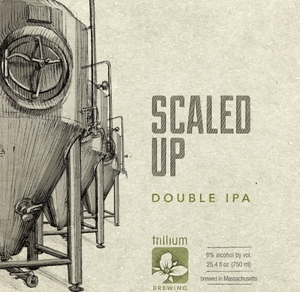
Brewing a Trillium Scaled Up clone

Back when I wasn't as picky a beer drinker, I thought that DIPAs were one of the easier styles to brew... you basically just had to throw a lot of hops in! Luckily (?), I'm not that naive anymore... it's just not that simple. I now know exactly the type of DIPA that I love, which means there's now a lot of DIPAs out there that I really don't enjoy. I want my Imperial IPA to be light in colour; an absolutely-huge hop aroma that's big on tropical fruit, citrus, and pine; ditto for the flavour, with a bit of supporting malt character, but no noticeable Crystal/caramel malt, and a moderate bitterness, finishing dry. In short: not dark amber, sweet, and bracingly bitter, which too many DIPAs are (in my opinion).

Now, if all that sounds good to you, and you're looking for a brewery that can provide you with such a beer, let me just say that Trillium Brewing is the place to go. I probably don't need to tell you that; if you're into hoppy beer I'm sure you've at least heard of Trillium. Based in Boston, they opened in 2013, with a second location outside the city, in Canton, opening a few months ago. Check them out on Rate Beer, or Untappd, or any rating-based website, and you'll see that virtually all of their beers are consistently rated extremely highly. I've had several different bottles, and I can attest that this is not simple hype talking... they really are that good, and they're brewing some of the best New England-style (Northeast?) IPAs around. A friend picked me up several beers on a trip last year, and they were all great.

After that, another friend was in Boston and brought back some Trillium to share; one of these was Scaled Up, one of their DIPAs. When people ask me, "What's the best beer you've ever had?", I can never really answer the question. I've had so many great beers, all at different times, different places, different circumstances, that I could never really select one best beer. But now I can say without a doubt that Scaled Up is definitely up there with the best beers I've had, probably in the top 3. I know some people hate using "juicy" as a descriptor for beer (I guess because it's too vague or something?), but Scaled Up is the epitome of juicy. It looked, smelled, and tasted very much like orange juice... but more. Super-hazy, super-fruity and tropical, super-smooth... super-everything. And I wasn't alone in my love for this beer; everyone else in the room agreed it was one of the best DIPAs they'd ever tried.


Naturally, I was curious as to what went into this beer, and I wanted to try cloning it. It's been awhile since I've brewed a clone beer, so just to confirm - I never really expect to brew an exact replica of a commercial beer when I set out to "clone" it, I'm just looking to see if I can brew something close... I guess that's the best way to put it. With this beer, Trillium's website did a pretty good job explaining what went into it, ingredient-wise:

The first Double IPA produced at our Canton brewery. Featuring four powerful aromatic hop varieties, Galaxy, Mosaic, Nelson Sauvin, and Columbus, Scaled Up emits dank, spicy aromas that lead into fruity, citrusy flavors of peach and orange on the palate. Lighter in body than most of our other DIPAs, Scaled Up finishes dry and smooth with a pleasant bitterness.

Of course, I reached out to the brewery via email - twice - to see if I could sneak a bit more info out of them, especially regarding the hops and what ratio they were used at. Unfortunately, I never received a reply, which is completely understandable. That didn't deter me, though, so I just got to work putting a recipe together on my own.

Thankfully, the Trillium site also listed the ingredients for the grist: Pilsner, White Wheat, Flaked Wheat, Dextrine, Dextrose, and C-15. I would assume that these were listed in decreasing order, in terms of % used, but of course I couldn't be sure. I ended up putting together something that looked good to me, with several substitutions:
  • 2-row replaced Pilsner (because I found out on brew day I was low on Pilsner... stupid)
  • Carapils replaced Dextrine (all I could get, plus it seems to me they're about the same thing)
  • Flaked Oats replaced Flaked Wheat (all I had on hand)
  • Table sugar replaced Dextrose (I've never felt it was worth it to pay more for Dextrose)
  • CaraRed replaced C-15 (the closest I had; CaraRed is ~20 L)
As you can tell, I certainly didn't put work into planning this too far ahead, for some reason. Plus, I've always had issues with inventory through BeerSmith; I think I'm the only one who has this problem, but it constantly fluctuates despite my keeping up with it. Even when I completely zero out a hop variety, for example, I'll see it pop up again a week later, saying I have 10 oz or something. Weird. Anyway, I still thought the grist looked good. I aimed for a mash temp of 149 F to try to keep the beer dry, and added Acid malt as usual to bring the mash pH into the 5.4 range.

I'm not sure what the IBUs are for Scaled Up; they're not listed on the website, but I really didn't care too much, anyway. I know where I wanted them based on my tastes; I was thinking around 60 would be sufficient. Low for a DIPA, yes, but this beer did not taste overly bitter to me, and in my hoppy-brewing experience lately, aiming in that range for a DIPA works well. I bittered at 60 min with a small amount of Polaris; this hop isn't listed by Trillium, but I don't feel that the bittering variety makes a difference. Columbus (CTZ) is listed, and maybe that's the hop they use for a bittering addition; then again, maybe they don't even add anything before the last part of the boil. In the end, I decided to use CTZ and Mosaic at 10 min, CTZ, Mosaic, and Nelson at flameout for a hop-stand, Galaxy, Nelson and Mosaic when I turned on my chiller, and two dry-hop additions (one in primary, one in my DH keg) of all three. I didn't go for huge amounts in the dry-hop, but a total of 6 oz seems like enough to me, now. In fact, I'm always a bit hesitant going above 3-4 oz in the dry-hop for my beers, after some previous not-great results and from reading about beer pH being increased with larger dry-hop additions. I was hoping 6 oz would be right for this beer.

I don't believe that Trillium makes it perfectly clear on their website which type of yeast strain they use, but based on their beers that I've tried, and the how they smell, taste and look, I immediately thought of using London Ale III (Wyeast 1318). I won't go on about how great this strain is; I've already done that on many of my recent hoppy-beer posts. But if you haven't brewed with it before, I suggest you seek it out. If you don't have access and want to use a neutral, American strain like US-05, I'm sure that you'd still have a very good beer. However, try to get LAIII; I don't think you'll regret it!

So, I seemed to be all set. The brew day went well, targets were mostly hit (OG was a couple of points low), and the wort smelled - as expected - pretty damned amazing after being chilled down to the low 60s F. I aerated with 90 seconds of pure oxygen and pitched the yeast slurry at 64 F; fermentation took off by the next morning and was soon going strong. When I saw signs of it slowing down after a day or two, I added the sugar (boiled and cooled in some water) and it picked up again, continuing actively for about a week. It was around 2 weeks or so that I added the first dry hop charge into primary (I took a final gravity, and it looked, smelled, and tasted just like OJ, which got me totally psyched) when the krausen had finally settled; five days later I racked to my dry hop keg with the second dry hop addition.

I've been drinking this beer for a little over a week now, and it's been on kind of an odd evolution. The first pour from the keg was, while a bit undercarbed, completely delicious. Similar to when I took the FG, it was very orangey, fruity, tropical. I made myself wait a few more days before trying it again, and I couldn't believe how different it now was. While it certainly wasn't as nasty as my experience trying to brew a Dinner clone (Maine Beer Co.'s white whale DIPA), it reminded me of it. The hops were more muted, a bit spicy and onion-y; also, quite dank. A few days later, it had improved slightly, and now it's back to being pretty good again.

Ultimately though, while I enjoy this beer, it's nowhere near as great as Scaled Up. And I'm ok with that; I don't expect miracles to happen. But I'm still a bit disappointed that, considering the hops that were used, the beer didn't come out very tropical or juicy; at least, not to the level I was hoping for. It definitely has a big berry character, and it's plenty dank... but I wasn't really going for dank. I also wonder if on my system, 6 oz total of dry hops is just too much? What would this beer have been like if I hadn't dry-hopped it at all?

So, what would I change? Aside from obviously using Pilsner malt instead of 2-row, I'd try dialling the dry-hop back a bit... say, 1.25 oz of each of the three used, as a single addition. Drop the CTZ from the hop steep, and replace it with Galaxy. I think London Ale III is a good yeast to go with, and the grist seems solid, at least until I can get the hops more where I'd like them to be, and then start adjusting other aspects of the recipe. If you're thinking of trying this recipe, I suggest you go with those changes, and expect a quite-good DIPA, but maybe not the BEST THING YOU'VE EVER TASTED.

In closing, however, I poured another glass of this beer last night for the picture below, and damn if it wasn't tasting even better! It's been on for several weeks now... maybe it really needed some time to settle into its own? If anyone ever has doubt that beer is like a living organism...

UPDATE: Someone on Reddit was kind enough to let me know (shortly after posting) that Trillium has said in the past that the yeast they use is the equivalent of White Labs 007 Dry English Ale; the Wyeast equivalent is 1098 British Ale. So, obviously I also recommend going with either of these two strains, as they would definitely differ from LAIII.

Recipe Targets: (5.5 gallons, 70% efficiency) OG 1.070, FG ~1.012, IBU ~60, SRM 5.5, ABV ~7.7%

Grains:
5.3 kg (79.5%) Canadian 2-row
325 g (4.9%) CaraPils
275 g (4.1%) Wheat malt
200 g (3%) CaraRed (20 L)
125 g (1.9%) Acid malt
90 g (1.4%) Flaked Oats
350 g (5.2%) Table sugar (added in primary when fermentation slowed)

Hops:
Polaris - 7 g (19.8% AA) @ 60 min

CTZ - 28 g (10.5% AA) @ 10 min
Mosaic - 28 g (11.9% AA) @ 10 min

CTZ - 28 g @ 0 min (with a 20 min hop steep)
Mosaic - 28 g @ 0 min (with a 20 min hop steep)
Nelson Sauvin - 28 g @ 0 min (with a 20 min hop steep)

Galaxy - 42 g @ 0 min (when begin chilling)
Mosaic - 42 g @ 0 min (when begin chilling)
Nelson Sauvin - 7 g @ 0 min (when begin chilling)

Galaxy - 28 g dry-hop for 5 days (in primary)
Mosaic - 28 g dry-hop for 5 days (in primary)
Nelson Sauvin - 28 g dry-hop for 5 days (in primary)

Galaxy - 28 g dry-hop for 5 more days (in keg)
Mosaic - 28 g dry-hop for 5 more days (in keg)
Nelson Sauvin - 35 g dry-hop for 5 more days (in keg)

Misc: 1/2 tab Irish Moss at 5 min

Yeast: Wyeast 1318 London Ale III (with a starter, ~250 billion cells)

Water: Fredericton city water, carbon-filtered; 7 g Gypsum and 7 g calcium chloride added to mash

- Brewed on April 12th, 2016, by myself. 60-minute mash with 18.5 L of strike water; mash temp on target at 149 F. Sparged with ~4.5 gallons of 168 F water for final volume of ~6.75 gallons.

- Pre-boil gravity at 1.051 (target 1.052, before sugar addition). 60-minute boil. Final volume ~5.75 gallons; OG a bit low at 1.062 (so, 1.068 with sugar addition). Chilled to 64 F, then poured into Better Bottle. Aerated with 90 seconds of pure O2, pitched yeast at 64 F.

- Great fermentation by the next morning, and was even showing signs of slowing down a mere 48 hours after pitching. I added the sugar at this point, and activity quickly picked up again and continued for several more days. After close to two weeks (FG 1.011), added the first round of dry hops into primary for 5 days, then racked to the dry-hop keg, added the second dry hops for 5 more days, then transferred via CO2 to the serving keg and began carbing.


Appearance: Pours with a moderate-sized, white fluffy head; good retention, sticky lacing left on the glass. Body is a very light amber colour, with better-than-expected clarity (although there's definitely still haze present).

Aroma: Lots of berries, basically. A bit dank, and just the slightest hint of alcohol.

Taste: Big hop blast - again, mainly berries and dankness - balanced slightly by the bready malt character; but, ultimately, yeah... hops. Should be more tropical, but it's still very tasty. Medium-high bitterness in the dry finish, more than expected from the ~60 IBUs for a 7.5% ABV beer.

Mouthfeel: Medium-light bodied, moderate carbonation.

Overall: Very good; I enjoy it as a DIPA, I like the berry hop character and dryness, but since I was hoping for - if not expecting - a closer version of Scaled Up, I have to admit I'm a touch disappointed.

Friday, 29 January 2016

Meek Celebration 2015: Imperial IPA with Amarillo, Comet and Hallertau Blanc

Well, it's that time of year again! Oh wait, no it isn't, it's over. Ok, so I didn't get this out in time to post before Christmas, but that doesn't mean I can't keep updating... albeit, slowly.

In November of 2014, I decided to brew a beer to give away to fellow homebrewers/craft beer drinkers as a Christmas gift. Ok, I planned on keeping some for myself, too, but only a few bottles! My whole family was spending Christmas in PEI that year as well, and I wanted to brew something specifically to celebrate that gathering (which hadn't happened in years and probably won't happen again). Of course the beer would center around hops; Red IPAs are one of my favorite styles to brew and drink, so I came up with a recipe for a really hoppy one, with Amarillo, Azacca, and Simcoe. I was really happy with how the beer came out (it was one of my favorites of mine of the year), so I pledged to brew a different "Meek Celebration" beer every year for Christmas.
Last year's beer, a Red IPA
When November rolled around again in 2015, I started planning a recipe. I wanted to focus on a hoppy style again (I'm sure most of these beers will be hoppy, but don't be surprised to see a dark, Belgian-style in the future); I've had not-the-best luck with DIPAs that I've brewed recently, so I decided to take another crack at the style. I love a good DIPA, but I've gotten really picky with them lately. I no longer enjoy the darker, maltier ones that are simply high in alcohol but don't have near as much hop aroma and flavour as I want. Give me a really hoppy Session IPA or APA any day - I love to enjoy hops without feeling drunk after one beer! So, my goal was a DIPA that was light in color, had a dry finish but still a creamy body, and a big hop aroma, with plenty of citrusy, fruity hop character to go with it. Minimal to no sweet caramel character, here.

I've brewed DIPAs before, of course, and have been happy with several grists that I've gone with. This time, though, I wanted to try something a little different. I had remembered reading a post from Derek of Bear-Flavored (and now, Kent Falls Brewing) when he was playing around with perfecting hoppy beers; the recipe was for a DIPA, and I liked how the grist looked: majority of 2-row, with ~7% each of Wheat malt and Carapils, some Flaked Oats, and about 5% table sugar to help dry the beer out. I've done similar ones in the past, but not exactly like this. So, I shamefully lifted it! Just kidding, there really is no copying in brewing. Well, mostly not.

Choosing a hop schedule was a little more difficult, as usual. Not because I can't think of hops I'd like to use... because there's too MANY hops that I would like to brew with! And I still have quite an inventory from 2014 on hand (and have picked up some 2015 varieties as well... gulp), so plenty to work with. As I mentioned, I wanted a beer with a big fruity, tropical profile; but I also wanted some dank, resinous character in there, too. I eventually decided on:
  • Amarillo - a no-brainer; it's been around for awhile now, and it consistently delivers. Such a fantastic hop that gives plenty of tropical fruit character to any beer I've used it in, it's still one of my favorites.
  • Comet - a hop that's been around for quite some time, I've actually brewed with it before. I split a pound on a whim with a friend, and sat on it. Then when I read a bit more about it, and saw it described as "intensely dank" and with an "intense wild American grapefruit" character (according to Bear-Flavored's Hop Guide); sounded great to me!
  • Hallertau Blanc - I've brewed with this hop, a fairly new tropical variety from Germany, once before in my first 100% Brett IPA, and I really liked it. It's not just fruity... it kind of has a lightly floral characteristic to it that works really well. I was looking to brew with it again, and thought it would great in a DIPA.
I went with a pretty-typical hopping schedule for me: 10 min, hop steep, chiller-on, and a big dry-hop, with the overall emphasis just slightly on the Amarillo and Hallertau Blanc. By the time the wort was poured into the Better Bottle, it was smelling pretty fantastic.

Normally for a beer of this style, I'd ferment with US-05. However, I've done a few beers with Wyeast 1318 London Ale III recently, and every time I make a starter I overbuild by 80-100 billion cells. I've really been enjoying the beers I've brewed with this yeast strain lately, and I've never done a DIPA with London Ale III, so I decided to give it a try, here. I build up what I had to ~260 billion cells, pitched at 64 F, aerated well with pure O2, and let 'er rip (temperature control is rarely needed this time of year in my house; if anything, when temps get REALLY cold, I have to make sure to keep the beer warm enough so the yeast don't poop out on me).

After 10 days or so in primary, I threw the dry hops into the BB for 7 days, and then bottled the beer. Of course I'd normally keg a beer like this, but since I'm basically giving more than half the batch away, for ASAP consumption, it's easier just to bottle it now. The only problem here is I wasn't thinking when I calculated how much priming sugar to add - I calculated for 2.5 vol CO2 for 5 gallons, but with all the hop sludge in this beer, I really only ended up with slightly over 4 gallons of beer. This would unfortunately give a carb level of ~2.9 vol. Oops.

I tried sampling the beer after it had been bottled for 5-6 days, and it was already carbonated more than I'd like for a DIPA. I was able to move all the bottles into my cellar, which is a perfect 48-50 F during the winter. Carbonation did increase after a little while, but luckily it's not TOO bad; high, yes, but it's not a Hefeweizen or anything. The other aspects of the beer, I was quite happy with. The aroma is huge, lots of mango and orange, some pine and dank in there, too. The flavour is a bit more restrained, but still a very enjoyable hop presence similar to the aroma; some bready malt character is there to help balance a little, but as I hoped for, no lingering sweetness. A touch of a carbonic bite in the finish (possibly due to the higher carbonation?). The bitterness is about perfect for a DIPA... for me. I'm not big on huge bitterness anymore, and ~60 IBUs works well in a hoppy beer.

Overall, this beer is extremely smooth. Smoother and easier-drinking that most DIPAs I've brewed, so I'm going to attribute that success to the London Ale III, and the changes in water chemistry to bring my mash pH down to 5.4. I've been doing this more and more with my hoppy beers lately, and most of the time it's worked out great (I'm sure the wheat malt and flaked oats helped as well). Aside from being smoother, the hop profiles seem to be... juicier. I'd love to do a Brulosophy-inspired experiment with the same hoppy beer fermented with London Ale III vs. US-05, and another with water chemistry changes vs. none at all. I'll put that on the list, see if it actually happens!

As much as I enjoy this beer, I think I have to tip the Celebration award to last year's Red IPA. I will say that after a month, this current beer is holding its own really well for a hoppy brew. I don't know why I still have a few bottles left; guess I didn't go out of my way to give as many away! Sharing? Bah, humbug! ;)

Recipe Targets: (5.5 gallons, 75% efficiency) OG 1.073, FG ~1.010, IBU ~62, SRM 4.5, ABV ~7.7%

Grains:
4.85 kg (75%) Canadian 2-row
475 g (7.3%) Wheat malt
475 g (7.3%) CaraPils
240 g (3.7%) Flaked Oats
100 g (1.5%) Acid malt
335 g (5.2%) Table sugar

Hops:
Hop extract - 5 mL @ 60 min (equivalent to 28 g of a 10% AA hop variety)
Amarillo - 28 g (7.4% AA) @ 10 min
Hallertau Blanc - 28 g (8.4% AA) @ 10 min

Amarillo - 56 g @ 0 min (with a 20 min hop steep)
Comet - 28 g @ 0 min (with a 20 min hop steep)

Comet - 28 g @ 0 min (when chilling started)
Hallertau Blanc - 56 g @ 0 min (when chilling started)

Amarillo - 39 g dry-hop for 5 days (in primary)
Comet - 42 g dry-hop for 5 days (in primary)
Hallertau Blanc - 42 g dry-hop for 5 days (in primary)

Misc: 1/2 tab Irish Moss at 5 min

Yeast: Wyeast 1318 London Ale III (with a starter, ~260 billion cells)

Water: Fredericton city water, carbon-filtered; 10 g Gypsum and 10 g calcium chloride added to mash

- Brewed on November 15th, 2015, by myself. 50-minute mash with 15 L of strike water; mash temp was reading all over the place at first, ranging from 150-158 F. Finally settled at 151 F; still holding at this temp at end of rest. Mashed-out for 10 minutes with 7.5 L of boiling water to 165 F. Sparged with ~3.5 gallons of 168 F water for final volume of ~6.75 gallons.

- Pre-boil gravity at 1.052 (target 1.054). 60-minute boil. Final volume ~5.5 gallons; OG low at 1.070 (after sugar calculation). Chilled to 62 F, then poured into Better Bottle. Aerated with 75 seconds of pure O2, pitched yeast slurry at 64 F.

- Fermentation took off quickly, going strong by the next morning. After a couple of days it started to slow, so I added the sugar in two separate additions over 12 hours, after boiling and cooling in some water.

- 4/12/15 - FG ~1.010. Threw dry hops in fermentor. Bottled 5 days later, aiming for 2.5 vol CO2 for 5 gallons, but wasn't thinking about loss to trub and hop matter, so only got ~4 gallons. Results in a too-high carbonation of ~2.9 vol.

Please excuse the crappiness of this photo

Appearance: Pours with a medium-large, off-white head that sticks around for quite some time before fading to 1/2-finger (probably at least partially due to the high carbonation). Body is quite hazy, with a light-golden colour. Slightly effervescent.

Aroma: Really big citrus and grapefruit bomb, and a tiny bit dank. All hops.

Taste: Plenty of grapefruit, lots of citrus and tropical fruit upfront, with a bit of dank following behind, as in the aroma. Supporting malt character is minimal, but keeps it in check. Finishes with a moderate bitterness, plenty dry.

Mouthfeel: Moderate-high carbonation, medium-light bodied. Slightly oily mouthfeel, I assume from the combination of the London Ale III and all the hop oils.

Overall: I quite like it. Too heavy on the carbonation, my fault for not thinking ahead. While it isn't as good as last year's Christmas beer, this is definitely the best DIPA I've brewed in a while.

Monday, 10 November 2014

Tasting : Galaxy DIPA

When I originally posted about this beer, a DIPA brewed entirely with Galaxy hops, I mentioned that Galaxy was "well known for making an almost-overwhelmingly fruity beer". By "well known", I was referring to tasting notes from other homebrewers who had experimented with the hop, not to mention the many descriptions noting just that from hop suppliers online. I hadn't brewed with Galaxy before, so I was really looking forward to an immensely-hoppy, fruity beer.

Unfortunately, I'm a little disappointed in how this beer came out. I don't find that I'm slapped in the face with fruity hoppy goodness. Maybe my hopes were too high, but like I said, I've read so much about how great the Galaxy hop is, and I know I've had some great commercial beers featuring Galaxy. I'm a bit confused how this happened. The hops I had were from the 2013 (the most recently-available at the time) harvest - no, not new, but not that old, and they had been vacuum-sealed and stored in the freezer the whole time. I used a 1/2-lb for a 4 gallon batch (that's the equivalent of ~3/4 lb for a 6-gallon batch of homebrew, the usual batch size, roughly), and all of those hops were added from flameout on (the single bittering addition at the beginning of the boil was hop extract).

So, what gives? Oxidation? I don't really think so - I used the same dry-hop method I've relied on for awhile, now (two additions: one in primary, and one in a weighted-down mesh bag in the keg), and the CO2 environment of the keg would cut down on oxygen issues, not to mention that the beer doesn't have that oxidized-hop aroma/flavor. I'm starting to think that it's just me - am I expecting too much with my beers lately? My wife and friends - fellow beer geeks, naturally - who have tried the beer seem to really like it. One friend in particular seemed to really enjoy it, and he's a BJCP-certified judge, so I trust his opinion and honest criticism.

Did I therefore just waste your time in a confused mini-rant about this beer? Sorry about that. If I could send out samples to everyone who wanted them, I would. It's really not a bad beer; I should have stressed from the beginning that the hops ARE there... I just wanted more from them. I'll admit that after typing this all up, I tried another pint of the beer, and liked it more... maybe I just needed to vent? In the meantime, I've ordered more Galaxy; I'm not scared to try it again. Maybe I'll even pair it with Nelson Sauvin in a beer (similar to the dry-hop of Stone Enjoy By), and/or try it in a Red IPA or something different.


Appearance: Poured with a moderate-sized, white, fluffy and sticky head that had very good retention, leaving thick lacing on the glass as the beer lowers. Body is a light golden color, with decent clarity and a bit of haziness.

Aroma: Fruity and citrusy, but not immensely so, as I was expecting. There’s a malt sweetness balancing it out; if anything, I would like to see more hops, and a bit less malt. Just a touch of alcohol in there as well.

Taste: As in the aroma - a good hop presence that’s mostly citrus, with a background of bready malt character. A firm (medium-high) bitterness in the finish, and a bit of warmth from the alcohol level.

Mouthfeel: Medium bodied, with moderate carbonation.

Overall: I'm just not crazy about this beer; I like it, but was expecting more from the Galaxy. It's still really decent, though, and mostly quite easy-drinking for a higher-ABV beer.

Tuesday, 11 September 2012

Brewing a Kern River Citra DIPA clone

When I was in San Diego a year ago, I was able to try a lot of fantastic new beers. Unfortunately, not every beer that I had hoped to find was available to me at the time. Some beers are just so sought after, that as soon as they are available in a beer store or beer bar, they can sell out pretty quickly. I'd say the #1 beer I really wanted to try that I couldn't find was Citra DIPA, made by Kern River Brewing Co. Currently rated #4 in the Imperial IPA category on Beer Advocate, it's supposed to be an excellent beer that has a high amount of Citra hops (of course) used during the brewing process, which would naturally provide a "strong pungent aroma" and a lot of the tropical fruits that one expects in the flavor. Anyone who has used Citra before can tell you that even a little bit goes a long way.

Every beer store that I checked in San Diego was out of Citra DIPA. When I started looking at beer lists online for the better beer bars in the area, I found that Hamiltons Tavern had just had a shipment in. We ended up there a couple of days later, but when I asked one of the bartenders if they still had it available, he informed me that they just sold out, and in fact, "I just had the last bottle myself. And it was awesome." Sonofa! Oh well, still a great beer bar, with lots of other awesome beers. So, I left San Diego resigned to the fact that I probably wouldn't get to try it anytime soon. And I haven't.

HOWEVER, luckily for me (and for lots of other homebrewers), the folks on the Can You Brew It podcast contacted Kyle Smith, the owner/brewmaster of Kern River Brewing, and he was kind enough to provide them with a homebrew recipe for Citra DIPA, which they were able to clone. I still had a pretty good supply of Citra hops on hand, so I decided that this would be the perfect opportunity to really put them to use. I also hadn't brewed a DIPA in over a year, when I attempted ANOTHER highly-rated and sought-after DIPA, Russian River's Pliny the Elder (which is a great recipe and turned out pretty awesome, by the way... I suggest you try it if you're a fan of the style).

The Citra DIPA recipe (which can be downloaded as the podcast, and is also written out here) is, as expected, pretty interesting. The grist is roughly 80% 2-row, 5% Munich malt, 2.5% each of Honey and Wheat malt, and 5% each of Carapils and Crystal 10. I didn't have access to Crystal 10, and since it's actually pretty comparable to Carapils, I just subbed in some more of that.  That seems, to me, like a pretty high amount of nonfermentables for a DIPA, but the mash temp is quite low at 148 F, so the beer is supposed to finish quite dry, with a lot of fermentable sugars provided for the yeast.

And this doesn't even include the dry hops
The hop schedule is where this beer really stands out, of course. While the bittering addition is Nugget, there are four more hop additions for the flavor/aroma, all Citra. Note that the amounts used are nothing crazy (about an oz each), but keep in mind that as I mentioned, Citra is a very pungent, powerful hop variety. Throw in four different dry-hop additions (combination of Citra and Amarillo, another citrusy hop), and you have a beer that is bound to pack a lot of hop punch... and be more expensive to brew than others! The calculated IBUs for this beer was 69.4, but with a 20-minute whirlpool, it'd probably be closer to 90-100, about on par for a DIPA.

Kyle notes in the podcast that the beer should be racked to secondary after only about 3 days, when fermentation is roughly 80% complete, and then the dry-hopping process can begin (they do it "warm" at Kern River Brewing, as opposed to cooler temps). I've always read that fermentation should be completely done before you start dry-hopping, but obviously these guys know what they're doing, and it worked for Tasty (who brewed the beer for CYBI). However, I'll be away for several days and won't be able to keep a strict watch on the every-3-day dry-hop schedule, so I'll be waiting a little longer than 3 days before racking to secondary. Fermentation will therefore likely be completely finished, but it's better than the alternative - racking too early.

As for fermentation, the easy-going/neutral WLP001/Wyeast 1056 is the strain of choice, with fermentation temps around 67 F to keep things focused on the hops. I didn't have time to make a starter, so I used Fermentis US-05 Safale dry yeast (rehydrated); I've had to go this route before, and have had results similar to Wyeast 1056 American Ale.

I'm not sure what to expect with this beer. Since I never got to try the actual Citra DIPA, I have nothing to compare to, as usual. And I've used Citra in healthy amounts before, and the resulting beer has been very hop-strong. I'm really looking forward to the results of this recipe... hopefully, at the very least, it'll make a decent DIPA that'll tide me over until my next trip to San Diego.

Recipe targets: (5.5 gallons, 73% efficiency): OG 1.070, FG 1.010, IBU 69.4, SRM 6, ABV 8%

Grains:
5.32 kg Canadian 2-row
682 g Carapils
341 g Munich malt
168 g Honey malt
168 g Wheat malt

Hops:
Nugget - 25 g (12.25% AA) @ 60 min
Citra - 28 g (12% AA) @ 15 min
Citra - 28 g @ 10 min
Citra - 28 g @ 5 min
Citra - 28 g @ flameout, begin 20-minute whirlpool

Dry-hop schedule:
33 g Citra & 14 g Amarillo for 3 days... then
20 g Citra for 3 more days... then
28 g Amarillo for 3 more days... then
28 g Citra for 3 more days.

Misc.:
1/2 tsp yeast nutrient @ 15 min
1/2 tab Irish moss @ 5 min

Yeast: US-05 Safale dry yeast, rehydrated

Water: Fredericton city water, carbon-filtered; mash water treated with 5 g of gypsum

- Brewed Sept 9th, 2012, with Jill. 50-minute saccharification rest with 17.35 L of water for a mash temp of 148 F. Mashed-out with 11.12 L of near-boiling water, resulting temp 167 F. Let rest for another 10 minutes, then vorlaufed 3-4 L and drained into kettle. Sparged with 8 L of 168 F water, stirred well, and left for 5 minutes before vorlaufing and draining into kettle again, for a total volume of close to 7 gallons (slightly over target).

- SG 1.054 (target 1.057). 60-minute boil. Began chilling 20 minutes after flameout and whirlpool; took about 40 minutes to get to 70 F. Poured into BB and set in ice water to drop temp a few more degrees. OG low at 1.065 (likely partially due to the bit of extra volume I had after boiling). When temp dropped to 66 F, pitched yeast, aerating by shaking well for several minutes before and after. Placed BB back in sink with a few ice packs to try to keep the temp in the high 60s.

10/9/12 - 12/9/12 - Over the first few days, fermentation took off in about 18 hours after pitching... activity got quite high by the second day, with some beer getting into the airlock. Bubbling 1-2 times per second, temp got as high as 70-72 F, but I managed to bring it quickly down to 68 F by adding ice packs to the water bath.

20/9/12 - Racked to secondary and added first dry-hop addition. Gravity 1.014 - 4 points above target FG, and I doubt it'll go down much more, if at all.

23/9/12 - Second dry-hop addition. Temps still around 70 F.

26/9/12 - Third dry-hop addition.

29/9/12 - Fourth and final dry-hop... smelling intensely Citra-y, as expected.

2/10/12 - Bottled with 120 g table sugar, aiming for 2.5 vol CO2 for 5 gallons with max temp of 72 F reached.

4/11/12 - Despite the numbers being off, this really made a delicious beer... tasting notes.